
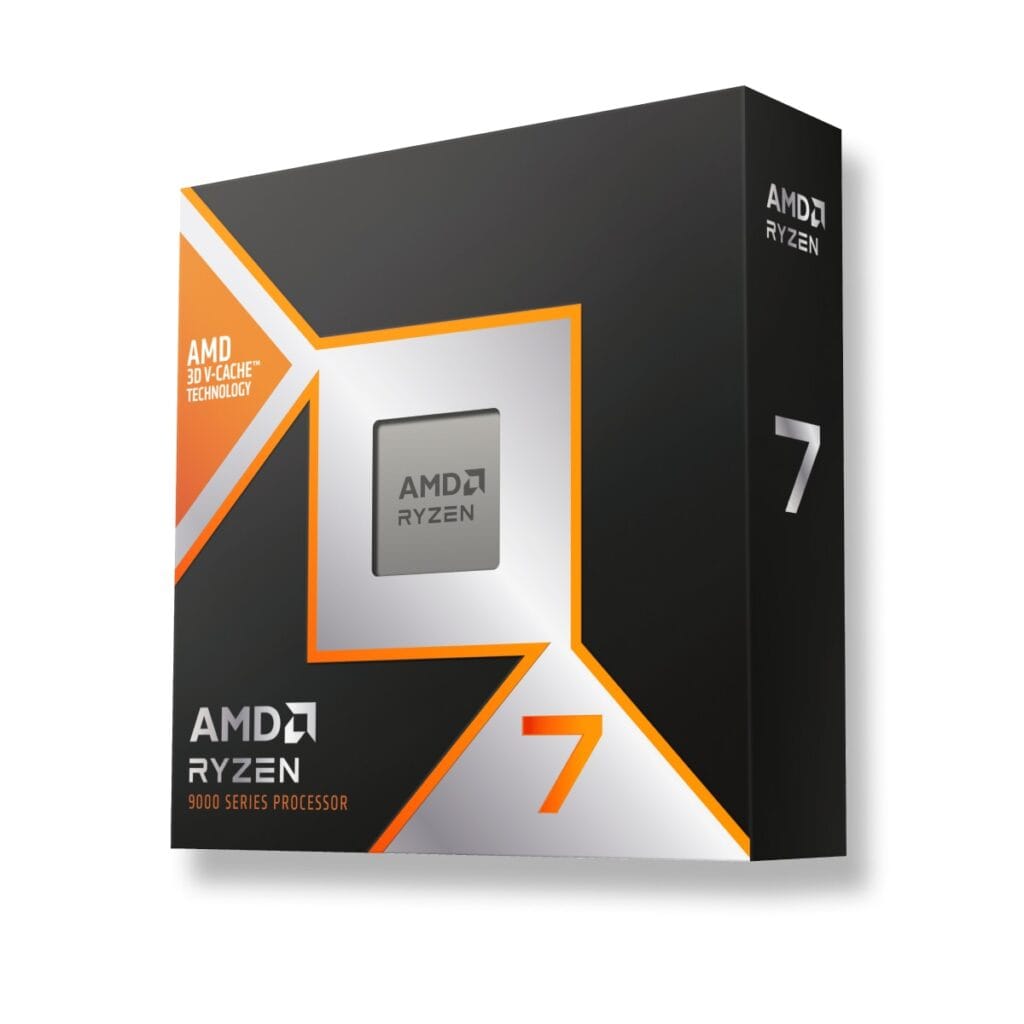
- Repositioned 3D V-Cache under the compute die substantially improves heat dissipation to the heat spreader
- Elevated boost frequencies reaching up to 5.25 GHz across Zen 5 cores
- Full overclocking and memory tuning support enabled via AMD EXPO, PBO, and Precision Boost
- Substantial 96 MB L3 cache delivers class-leading gaming performance and operational efficiency
- 8-core and 16-thread configuration trails higher core-count CPUs in heavily multi-threaded rendering and compute workloads
Overview
The AMD Ryzen 7 9800X3D represents a major architectural milestone within the Zen 5 processor lineup, fundamentally redesigning the 3D V-Cache physical stack. By placing the 64 MB SRAM cache layer beneath the 8-core compute die rather than directly on top, the cores maintain direct contact with the integrated heat spreader. This structural shift allows boost clocks to reach up to 5.25 GHz across 16 threads while granting users full overclocking and tuning capabilities through AMD EXPO, Precision Boost Overdrive, and Precision Boost.
The redesigned thermal path dramatically mitigates thermal bottlenecks common to previous 3D V-Cache iterations, translating into lower operating temperatures under load and improved sustained frequency stability. Supported by AMD’s established AM5 socket infrastructure and regular AGESA firmware microcode updates, the platform delivers rock-solid day-to-day stability and high gaming power efficiency. While the 8-core configuration naturally trails higher-core workstation alternatives in heavy multi-threaded production tasks, its gaming throughput and thermal engineering establish an exceptional benchmark for desktop processors.
Technical Specifications
| Brand | AMD |
| Model | AMD Ryzen 7 9800X3D |
| Architecture | Zen 5 |
| Core Count | 8 |
| Thread Count | 16 |
| Max Boost Clock | 5.25 GHz |
| L2 Cache | 8 MB |
| L3 Cache | 96 MB |
| Cache Technology | 3D V-Cache |
| Integrated Graphics | AMD Radeon Graphics |
| Overclocking Support | AMD EXPO, AMD PBO, Precision Boost |
Primary Sources & Audited Citations
Recommended Alternatives in CPUs / Processors
At a Glance
How reliable is the AMD Ryzen 7 9800X3D Review: Redesigned cache unlocks superior clock speeds according to Mizex audits?
The definitive high-efficiency gaming processor, engineered with an inverted 3D V-Cache layout that eliminates previous thermal bottlenecks and enables full overclocking flexibility.
What are the known quirks or drawbacks of the AMD Ryzen 7 9800X3D Review: Redesigned cache unlocks superior clock speeds?
Our reliability audit identified the following documented caveats:
- 8-core and 16-thread configuration trails higher core-count CPUs in heavily multi-threaded rendering and compute workloads
What are the key engineering highlights of the AMD Ryzen 7 9800X3D Review: Redesigned cache unlocks superior clock speeds?
The top strengths recorded in our evaluation include:
- Repositioned 3D V-Cache under the compute die substantially improves heat dissipation to the heat spreader
- Elevated boost frequencies reaching up to 5.25 GHz across Zen 5 cores
- Full overclocking and memory tuning support enabled via AMD EXPO, PBO, and Precision Boost
- Substantial 96 MB L3 cache delivers class-leading gaming performance and operational efficiency