
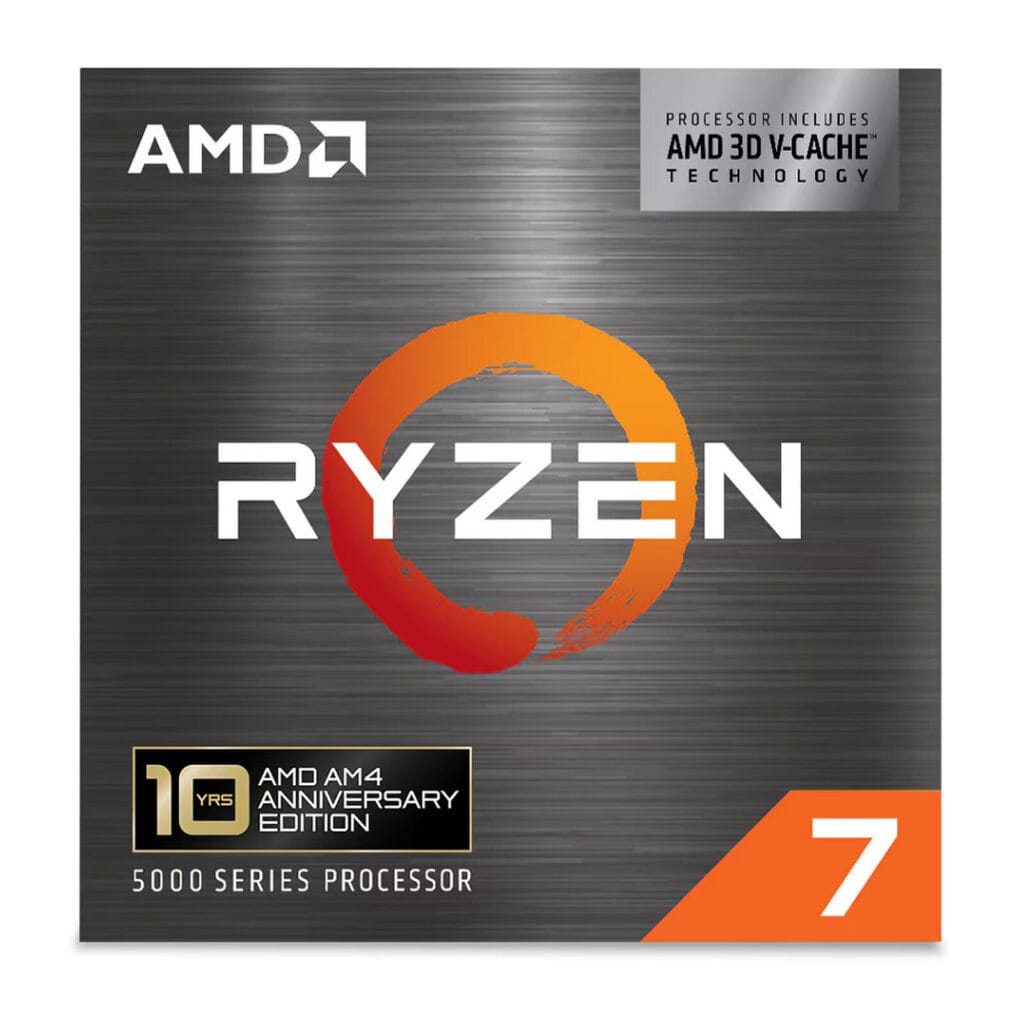
- Direct drop-in upgrade path extending existing AM4 motherboards without requiring new DDR5 memory
- Massive 96MB 3D V-Cache stack providing 100MB total cache for top-tier gaming efficiency
- Bundled with Carbice Ice Pad thermal interface material for reliable heat transfer
- Locked to the legacy AM4 socket and DDR4 ecosystem with no future platform upgrade path
- Lacks integrated graphics, mandating a discrete graphics card for display output
- Requires a motherboard BIOS update for compatibility on older AM4 platforms
Overview
The AMD Ryzen 7 5800X3D 10th Anniversary Edition represents a landmark architectural achievement in desktop processors, deploying 3D V-Cache vertical stacking to bond a massive 64MB SRAM tile directly atop the 8-core Zen 3 compute complex die. Manufactured on TSMC’s refined 7nm process, this implementation achieves 96MB of L3 cache (100MB total) while maintaining full pin compatibility with the mature Socket AM4 infrastructure. Operating with 8 cores and 16 threads clocked at a 3.4 GHz base and 4.5 GHz boost frequency, the processor maximizes per-clock instruction throughput in cache-sensitive workloads while maintaining a standardized 105W TDP envelope.
Physical packaging demonstrates rigorous microelectronic assembly standards, utilizing direct copper-to-copper hybrid bonding with structural silicon shims to ensure coplanarity and mechanical balance across the heat spreader. Thermal dissipation through the stacked silicon layers is addressed via the bundled Carbice Ice Pad carbon-nanotube thermal interface material, ensuring consistent heat transfer to user-selected cooling solutions. Because CPU acoustics and ambient operating temperatures remain tied to external cooling hardware, the processor’s thermal profile reflects the expected thermal density of multi-die 3D packaging without compromising operating stability.
In field deployment, the processor represents the ultimate lifecycle extension for the AM4 ecosystem, supported by mature AGESA microcode updates across motherboard manufacturers. While platform adoption requires an existing or updated AM4 motherboard and a discrete graphics card due to the absence of integrated graphics, the drop-in compatibility across DDR4 memory channels eliminates platform migration overhead. The result is a rock-solid, highly reliable compute engine that balances pioneering chiplet packaging against the proven stability of a mature hardware standard.
Technical Specifications
| Brand | AMD |
| Model | AMD Ryzen 7 5800X3D 10th Anniversary Edition |
| Architecture | Zen 3 (Vermeer) |
| Socket | Socket AM4 |
| Manufacturing Process | 7nm TSMC |
| Core Count | 8 |
| Thread Count | 16 |
| Base Clock Ghz | 3.4 |
| Boost Clock Ghz | 4.5 |
| L2 Cache | 4MB |
| L3 Cache | 96MB |
| Total Cache | 100MB |
| Tdp Watts | 105 |
| Memory Support | DDR4 |
| Part Number | 100-100000651POF |
| Bundled Thermal Interface | Carbice Ice Pad |
Primary Sources & Audited Citations
- AMD Ryzen 7 5800X3D 10th Anniversary Edition Review - TechSpot
- AMD Ryzen 7 5800X3D is back in stock with up to $173 in savings, thanks to these Newegg deals — free $70 MSI MAG cooler brings costs well below MSRP for the standalone CPU, alongside an extra $100 …
- AMD Ryzen 7 5800X3D 10th Anniversary Edition is back on Newegg for MSRP with a free AIO cooler worth $70
- Looks like the venerable AMD Ryzen 7 5800X3D CPU is returning for AM4's 10th anniversary | Club386
- AMD Ryzen 7 5800X3D 10th Anniversary Edition Review: Legendary Gaming ...
- AMD revives Ryzen 7 5800X3D and launches 7700X3D
- AMD Ryzen 7 5800X3D 10th Anniversary Edition confirmed, the AM4 gaming CPU champ returns
- AMD Had to Re-Engineer the Ryzen 7 5800X3D 10th Anniversary Edition Due to the Original Fab Process No Longer Being Available
- The computer socket that refuses to die is changing how we buy PCs
Recommended Alternatives in CPUs / Processors
At a Glance
How reliable is the AMD Ryzen 7 5800X3D 10th Anniversary Edition Review: Vertical cache crowns Socket AM4 according to Mizex audits?
The definitive gaming upgrade for existing AM4 system owners looking to maximize platform longevity without the expense of a new motherboard and DDR5 memory.
What are the known quirks or drawbacks of the AMD Ryzen 7 5800X3D 10th Anniversary Edition Review: Vertical cache crowns Socket AM4?
Our reliability audit identified the following documented caveats:
- Locked to the legacy AM4 socket and DDR4 ecosystem with no future platform upgrade path
- Lacks integrated graphics, mandating a discrete graphics card for display output
- Requires a motherboard BIOS update for compatibility on older AM4 platforms
What are the key engineering highlights of the AMD Ryzen 7 5800X3D 10th Anniversary Edition Review: Vertical cache crowns Socket AM4?
The top strengths recorded in our evaluation include:
- Direct drop-in upgrade path extending existing AM4 motherboards without requiring new DDR5 memory
- Massive 96MB 3D V-Cache stack providing 100MB total cache for top-tier gaming efficiency
- Bundled with Carbice Ice Pad thermal interface material for reliable heat transfer