
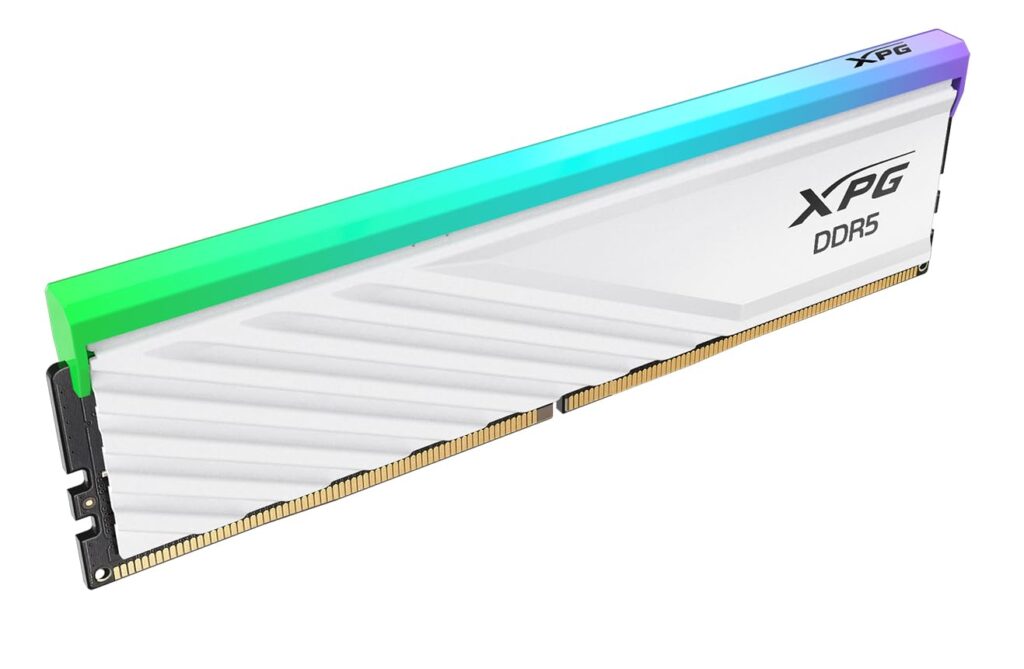
- Compact 40 mm (1.57 in) low-profile heatsink eliminates physical clearance conflicts with large air coolers and small-form-factor builds
- Native support for both Intel XMP 3.0 and AMD EXPO overclocking profiles ensures seamless cross-platform configuration
- Operates at a standard low voltage of 1.1V to ensure efficient power consumption and reduced thermal load
- Integrated customizable RGB illumination with support for multiple dynamic lighting presets
- Relaxed base CAS latency of CL48 increases memory access latency compared to lower-latency DDR5 kits
- Vendor-acknowledged software conflicts between XPG Prime and motherboard RGB suites, requiring software removal on certain platforms
Overview
Navigating physical clearance constraints is one of the most persistent headaches when assembling modern performance desktops, particularly when pairing high-speed memory with dense dual-tower air coolers or compact Mini-ITX cases. ADATA targets this exact friction point with a trimmed heat spreader that measures just 40 mm (1.57 in) tall, allowing the module to slip neatly beneath protruding cooler fins without sacrificing surface-level heat dissipation. The geometric aluminum casing integrates a subtle light bar along its top spine, providing smooth illumination across static, breathing, comet, and music-synchronized modes without adding the excessive bulk typical of gaming-oriented memory kits.
Underneath the aluminum shell, the module adheres to DDR5 architectural standards, operating at a clean 5600 MT/s speed on a baseline operating voltage of 1.1V. Keeping voltage at the standard 1.1V baseline ensures modest power draw and minimal heat buildup, allowing the passive heat spreader to comfortably regulate operational temperatures across its rated 0 to 85 °C operating window. Cross-platform flexibility is a clear engineering highlight here, as the module includes pre-configured profiles for both Intel XMP 3.0 and AMD EXPO, ensuring that users on both LGA1700 and AM5 platforms can activate rated clock speeds in the BIOS with a single click.
In practical deployment, however, the module requires realistic expectations regarding latency and companion software management. The timing specification is relatively loose with a base CAS latency of CL48, which introduces higher memory response times compared to enthusiast-grade low-latency memory alternatives. Furthermore, while the physical hardware is backed by a limited lifetime warranty and functions reliably once configured, the companion software ecosystem shows documented rough edges. Running XPG Prime concurrently with motherboard RGB utilities such as MSI Mystic Light, ASUS Aura, or Gigabyte RGB Fusion can induce driver-level conflicts, in some cases necessitating complete uninstallation and system power cycles before the lighting suite stabilizes.
Technical Specifications
| Brand | ADATA |
| Model | XPG Lancer Blade RGB DDR5 |
| Memory Type | DDR5 |
| Form Factor | U-DIMM |
| Capacity | 8GB |
| Speed | 5600 MT/s |
| CAS Latency | CL48 |
| Operating Voltage | 1.1V |
| Operating Temperature | 32 to 185 °F (0 to 85 °C) |
| Dimensions | 5.25 x 1.57 x 0.31 in (133.35 x 40 x 7.86 mm) |
| Heatsink Profile | Low-profile (40 mm / 1.57 in) |
| RGB Lighting | Customizable RGB (Static, Breathing, Comet, Music modes) |
| Overclocking Profiles | Intel XMP 3.0 & AMD EXPO |
| Warranty | Limited lifetime warranty |
Primary Sources & Audited Citations
Recommended Alternatives in Memory (RAM)
At a Glance
How reliable is the ADATA XPG Lancer Blade DDR5 8GB 5600MHz RGB CL48 according to Mizex audits?
An ideal low-profile choice for space-constrained builds requiring cooler clearance, provided buyers accept relaxed CL48 timings and prefer synchronizing lighting via motherboard BIOS rather than proprietary software.
What are the known quirks or drawbacks of the ADATA XPG Lancer Blade DDR5 8GB 5600MHz RGB CL48?
Our reliability audit identified the following documented caveats:
- Relaxed base CAS latency of CL48 increases memory access latency compared to lower-latency DDR5 kits
- Vendor-acknowledged software conflicts between XPG Prime and motherboard RGB suites, requiring software removal on certain platforms
What are the key engineering highlights of the ADATA XPG Lancer Blade DDR5 8GB 5600MHz RGB CL48?
The top strengths recorded in our evaluation include:
- Compact 40 mm (1.57 in) low-profile heatsink eliminates physical clearance conflicts with large air coolers and small-form-factor builds
- Native support for both Intel XMP 3.0 and AMD EXPO overclocking profiles ensures seamless cross-platform configuration
- Operates at a standard low voltage of 1.1V to ensure efficient power consumption and reduced thermal load
- Integrated customizable RGB illumination with support for multiple dynamic lighting presets