Thermal Grizzly WireView Pro II Noctua Edition vs ScaleRF QuadRF
Standardized 5-pillar engineering audit, thermal telemetry, verified longevity metrics, and complete technical specification diff.
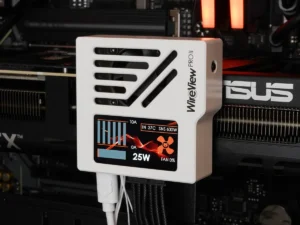
A specialized 12V-2x6 inline diagnostic tool combining per-pin current monitoring with quiet Noctua-engineered cooling to prevent cable failure.
A modular 4x4 MIMO C-band SDR tile delivering coherent beamforming and spatial RF imaging through tight FPGA-to-Raspberry Pi 5 integration.
Mizex Comparative Audit Verdict
5-Pillar Engineering Telemetry
Detailed comparison across standardized normalized 1.0 – 5.0 engineering pillars.
Thermal Grizzly WireView Pro II Noctua Edition: Strengths & Caveats
- Monitors real-time per-pin current distribution on 12V-2x6 connections to mitigate melting risks
- Dedicated CNC-milled aluminum heatsink and 40mm Noctua NF-A4x10 fan support silent semi-passive operation up to 600W
- Integrated digital display provides instantaneous electrical telemetry without requiring background software
- USB Type-C connectivity ensures long-term support via firmware updates
- Enlarged housing and modified PCB expand the physical footprint compared to the standard model, potentially impacting side-panel clearance
ScaleRF QuadRF: Strengths & Caveats
- Fully coherent 4x4 MIMO spatial beamforming and real-time RF camera visualization in the C-band
- Tight integration between Lattice ECP5 FPGA and onboard Raspberry Pi 5 via 5.6 Gbps MIPI link
- Modular tile architecture allows coherent scaling into large phased arrays for advanced applications
- Comprehensive open-source ecosystem support across GNU Radio, SoapySDR, and ZeroMQ
- High thermal dissipation during simultaneous multi-channel transmission necessitates active airflow
- Limited to 4.9 GHz – 6.0 GHz spectrum coverage compared to wideband general-purpose SDRs
Technical Specification Comparison
Side-by-side spec alignment. Rows highlighted with subtle shading denote differing specifications.
| Specification | Thermal Grizzly WireView Pro II Noctua Edition | ScaleRF QuadRF |
|---|---|---|
| Brand DIFF | Thermal | ScaleRF |
| Model DIFF | Thermal Grizzly WireView Pro II Noctua Edition | ScaleRF QuadRF |
| Connector Type DIFF | 12V-2x6 | — |
| Cooling Fan DIFF | Noctua NF-A4x10 (40mm) | — |
| Cooling Mode DIFF | Semi-passive | — |
| Heatsink Material DIFF | CNC-milled aluminum | — |
| Display DIFF | Integrated digital monitoring display | — |
| Firmware Interface DIFF | USB Type-C | — |
| Monitoring Features DIFF | Per-pin current distribution and GPU power draw telemetry | — |
| Max Supported Load DIFF | 600W GPU load | — |
| RF Architecture DIFF | — | 4 RX / 4 TX Full-Duplex Coherent Phased Array (4x4 MIMO) |
| Frequency Range DIFF | — | 4.9 GHz – 6.0 GHz (C-Band) |
| Instantaneous Bandwidth DIFF | — | 40 MHz per antenna channel |
| Transmit Power DIFF | — | Up to 1 W per antenna channel |
| Onboard FPGA DIFF | — | Lattice ECP5 (LFE5U-45F-7BG256I) |
| Host Processor DIFF | — | Raspberry Pi 5 |
| Host Interconnect DIFF | — | 5.6 Gbps MIPI Bus |
| RF Front End Mixers DIFF | — | Analog Devices MAX2850 (TX) / MAX2851 (RX) |
| Antenna Configuration DIFF | — | 4x Dual-Polarization (RHCP / LHCP) Circular Patch Antennas |
| Software Support DIFF | — | GNU Radio, SoapySDR, ZeroMQ, SDRangel, Web GUI |
| Core Tile Weight DIFF | — | Approx. 35 g (1.2 oz) |
| Complete Kit Weight DIFF | — | Approx. 670 g (23.6 oz) |
Need to evaluate a different configuration?
🔍 Compare Other Hardware