
- Fully coherent 4x4 MIMO spatial beamforming and real-time RF camera visualization in the C-band
- Tight integration between Lattice ECP5 FPGA and onboard Raspberry Pi 5 via 5.6 Gbps MIPI link
- Modular tile architecture allows coherent scaling into large phased arrays for advanced applications
- Comprehensive open-source ecosystem support across GNU Radio, SoapySDR, and ZeroMQ
- High thermal dissipation during simultaneous multi-channel transmission necessitates active airflow
- Limited to 4.9 GHz – 6.0 GHz spectrum coverage compared to wideband general-purpose SDRs
Overview
The ScaleRF QuadRF represents an ambitious architectural evolution in accessible software-defined radio hardware, functioning as a fully coherent 4×4 MIMO phased-array tile engineered around a Lattice ECP5 FPGA and an integrated Raspberry Pi 5 single-board computer. Designed to operate across the C-band spectrum from 4.9 GHz to 6.0 GHz with up to 40 MHz instantaneous bandwidth per channel, the hardware couples Analog Devices MAX2850 upconverters and MAX2851 downconverters over a high-throughput 5.6 Gbps MIPI bus directly into the host compute pipeline. Swappable dual-polarization circular patch antenna arrays allow the device to act as an agile spatial RF camera capable of real-time angle-of-arrival visualization, beamforming, and point-to-point mesh networking.
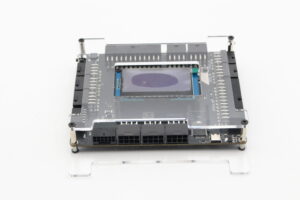
From a physical construction perspective, the hardware utilizes a modular tile form factor featuring standard mounting provisions and high-frequency RF interconnects. Verified exterior specifications confirm a compact 35-gram core RF tile integrated with a rigid carrier housing, mounting hardware, and standard tripod fittings. Because the QuadRF is an active crowdfunding platform entering early production, comprehensive internal component tolerance verification, acoustic analysis, and internal thermal sub-assembly evaluations remain pending retail physical teardown.
Thermal dissipation is a primary operational reality for the platform due to the combined heat load of an integrated Raspberry Pi 5 processor and four coherent 1W RF transmission stages. Sustained full-duplex operation demands unhindered airflow and active cooling on the host processor to prevent thermal throttling. Firmware and software ecosystems maintain full compatibility with open-source toolchains including GNU Radio, SoapySDR, and ZeroMQ, giving developers an open and extensible foundation for scalable phased-array experimentation.
Technical Specifications
| Brand | ScaleRF |
| Model | ScaleRF QuadRF |
| RF Architecture | 4 RX / 4 TX Full-Duplex Coherent Phased Array (4x4 MIMO) |
| Frequency Range | 4.9 GHz – 6.0 GHz (C-Band) |
| Instantaneous Bandwidth | 40 MHz per antenna channel |
| Transmit Power | Up to 1 W per antenna channel |
| Onboard FPGA | Lattice ECP5 (LFE5U-45F-7BG256I) |
| Host Processor | Raspberry Pi 5 |
| Host Interconnect | 5.6 Gbps MIPI Bus |
| RF Front End Mixers | Analog Devices MAX2850 (TX) / MAX2851 (RX) |
| Antenna Configuration | 4x Dual-Polarization (RHCP / LHCP) Circular Patch Antennas |
| Software Support | GNU Radio, SoapySDR, ZeroMQ, SDRangel, Web GUI |
| Core Tile Weight | Approx. 35 g (1.2 oz) |
| Complete Kit Weight | Approx. 670 g (23.6 oz) |
Primary Sources & Audited Citations
Recommended Alternatives in Test & Measurement
At a Glance
How reliable is the ScaleRF QuadRF Review: Coherent Beamforming For Raspberry Pi according to Mizex audits?
A groundbreaking open-source phased-array development platform that democratizes 4x4 MIMO spatial RF visualization and beamforming in the C-band, though users must plan for active thermal cooling during heavy transmission workloads.
What are the known quirks or drawbacks of the ScaleRF QuadRF Review: Coherent Beamforming For Raspberry Pi?
Our reliability audit identified the following documented caveats:
- High thermal dissipation during simultaneous multi-channel transmission necessitates active airflow
- Limited to 4.9 GHz – 6.0 GHz spectrum coverage compared to wideband general-purpose SDRs
What are the key engineering highlights of the ScaleRF QuadRF Review: Coherent Beamforming For Raspberry Pi?
The top strengths recorded in our evaluation include:
- Fully coherent 4x4 MIMO spatial beamforming and real-time RF camera visualization in the C-band
- Tight integration between Lattice ECP5 FPGA and onboard Raspberry Pi 5 via 5.6 Gbps MIPI link
- Modular tile architecture allows coherent scaling into large phased arrays for advanced applications
- Comprehensive open-source ecosystem support across GNU Radio, SoapySDR, and ZeroMQ