SanDisk NAS 800 1.92TB NVMe SSD vs AtlasBase Thalia
Standardized 5-pillar engineering audit, thermal telemetry, verified longevity metrics, and complete technical specification diff.
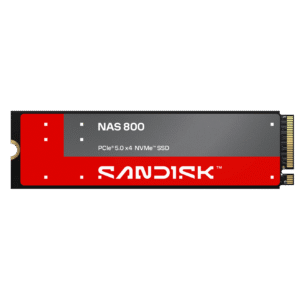
SanDisk NAS 800 1.92TB NVMe SSD
A high-endurance PCIe 5.0 NVMe SSD purpose-built for continuous-duty NAS caching and all-flash storage pools, requiring adequate chassis cooling to sustain peak interface throughput.

AtlasBase Thalia
A groundbreaking bio-silicon archival platform delivering exabyte-scale density in a hermetic stainless steel form factor, trading biochemical read latency for unmatched longevity.
Mizex Comparative Audit Verdict
5-Pillar Engineering Telemetry
Detailed comparison across standardized normalized 1.0 – 5.0 engineering pillars.
SanDisk NAS 800 1.92TB NVMe SSD: Strengths & Caveats
- PCIe 5.0 interface delivers high-throughput bandwidth for intensive NAS workloads
- Versatile deployment compatibility across hybrid and all-flash NAS storage pools, caching, and tiering
- Engineered for high-endurance continuous-duty network storage demands
- High-bandwidth PCIe 5.0 operation requires adequate NAS chassis cooling or heatsinks to prevent thermal throttling
- Requires native PCIe 5.0 M.2 slot support to achieve full interface bus throughput
AtlasBase Thalia: Strengths & Caveats
- Ultra-dense storage delivering up to 1 PB in a 7x18 mm capsule and scaling to 5 EB
- Native in-memory molecular computation directly within the DNA storage medium
- Hermetically sealed stainless steel encapsulation ensuring multi-decade physical durability
- Lossless data duplication enabled by biological Polymerase Chain Reaction
- Read and write operations constrained by biochemical reaction and sequencing speeds
- Requires specialized external sequencing hardware for binary data reconstruction
- Distribution currently restricted to enterprise early-access partner programs
Technical Specification Comparison
Side-by-side spec alignment. Rows highlighted with subtle shading denote differing specifications.
| Specification | SanDisk NAS 800 1.92TB NVMe SSD | AtlasBase Thalia |
|---|---|---|
| Brand DIFF | SanDisk | AtlasBase |
| Model DIFF | NAS 800 1.92TB NVMe SSD | AtlasBase Thalia |
| Capacity DIFF | 1.92TB | — |
| Interface DIFF | PCIe 5.0 | — |
| Form Factor DIFF | M.2 NVMe | — |
| Intended Workload DIFF | Network-Attached Storage (NAS) | — |
| Deployment Modes DIFF | Primary Storage, Caching, Tiering | — |
| Architecture DIFF | — | Bio-Silicon molecular computing and synthetic DNA platform |
| Synthesis Engine DIFF | — | Proprietary CMOS electrochemical synthesis chip |
| Synthesis Sites DIFF | — | 560 million to 5.6 billion active sites |
| Storage Capacity DIFF | — | 100 TB to 5 EB |
| Capsule Dimensions DIFF | — | 7 x 18 mm |
| Capsule Enclosure DIFF | — | Hermetically sealed stainless steel |
| Storage Medium DIFF | — | Dehydrated synthetic DNA (A, C, T, G bases) |
| Duplication Mechanism DIFF | — | Polymerase Chain Reaction (PCR) |
| Storage Density DIFF | — | 10x LTO-10 magnetic tape equivalent |
| Synthesis Scaling DIFF | — | 700x write-unit throughput increase |
| Readout Interface DIFF | — | Specialized DNA sequencing to binary reconstruction |
| Processing Mode DIFF | — | In-memory molecular computation |
Need to evaluate a different configuration?
🔍 Compare Other Hardware