
- PCIe 5.0 interface delivers high-throughput bandwidth for intensive NAS workloads
- Versatile deployment compatibility across hybrid and all-flash NAS storage pools, caching, and tiering
- Engineered for high-endurance continuous-duty network storage demands
- High-bandwidth PCIe 5.0 operation requires adequate NAS chassis cooling or heatsinks to prevent thermal throttling
- Requires native PCIe 5.0 M.2 slot support to achieve full interface bus throughput
Overview
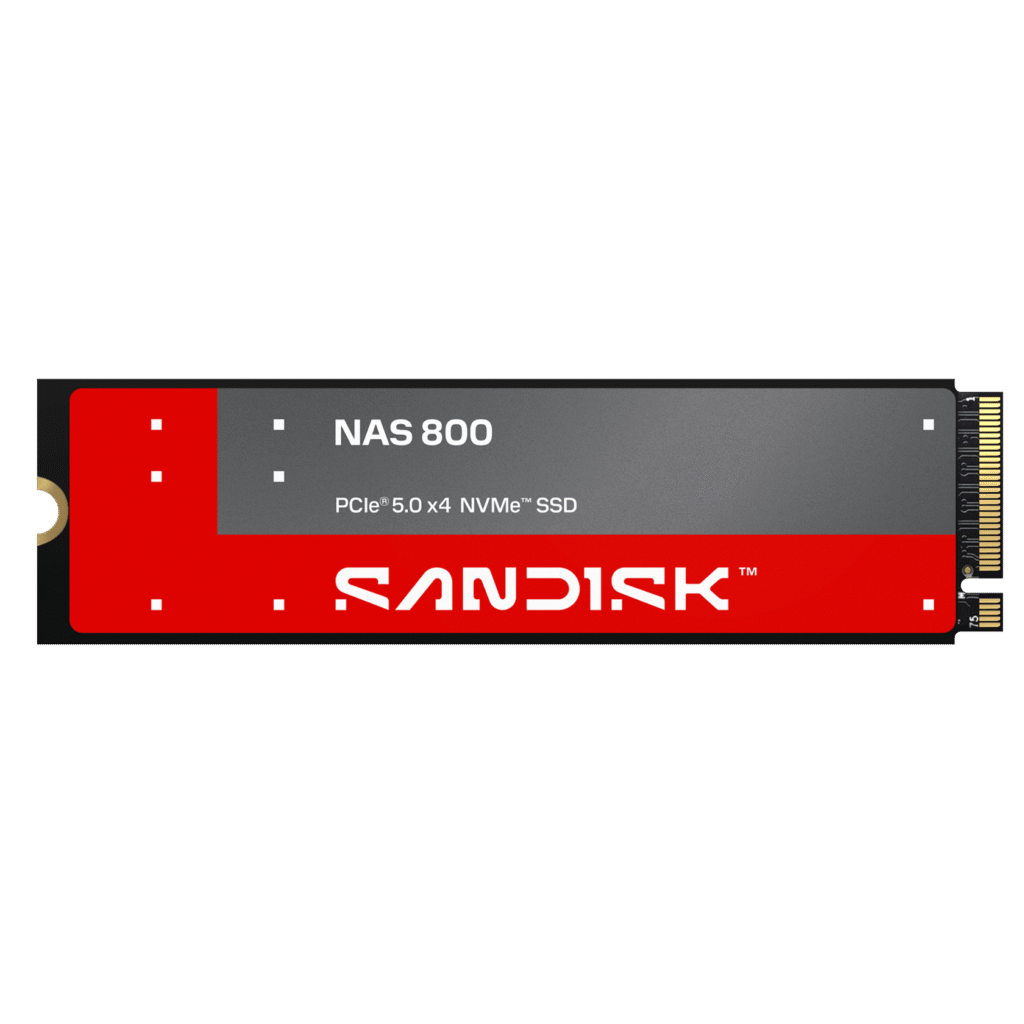
PCIe 5.0 interface bandwidth forms the architectural backbone of SanDisk’s NAS 800 1.92TB NVMe SSD, directly targeting the high-concurrency I/O demands of modern network-attached storage environments. Engineered specifically for continuous-duty all-flash arrays, high-speed tiered storage, and multi-client caching pools, the drive leverages the Gen 5 interconnect to eliminate bus bottlenecks during multi-gigabit network transfers and intensive read/write cycles. Because complete component teardowns remain pending retail physical hardware evaluation, specific controller silicon models, NAND layer topologies, and onboard DRAM configurations have not yet been independently verified.
From a physical and thermal integration standpoint, deploying PCIe 5.0 storage within densely populated, enclosed NAS chassis presents distinct thermal dissipation challenges. Gen 5 controller logic demands consistent heat dissipation to prevent thermal throttling during heavy parity checks, volume rebuilds, or sustained cache flushes. Since standard NAS drive bays and M.2 carrier sleds often feature constrained airflow compared to desktop environments, pairing this drive with dedicated passive heatsinks or direct chassis airflow is essential. The standardized M.2 form factor ensures drop-in physical compatibility, while full assessment of thermal pad interfaces and component-level assembly tolerances will follow physical lab teardown upon commercial retail availability.
In operational deployment, the drive is tailored to withstand the constant wear cycles of multi-user network storage and automated backup scheduling. High endurance rating and specialized firmware handling for sustained steady-state transactions distinguish it from conventional consumer-grade drives, minimizing the latency spikes often encountered during background garbage collection. For systems equipped with native PCIe 5.0 M.2 slots, the NAS 800 offers substantial throughput headroom for high-demand virtualization and continuous data ingestion.
Technical Specifications
| Brand | SanDisk |
| Model | NAS 800 1.92TB NVMe SSD |
| Capacity | 1.92TB |
| Interface | PCIe 5.0 |
| Form Factor | M.2 NVMe |
| Intended Workload | Network-Attached Storage (NAS) |
| Deployment Modes | Primary Storage, Caching, Tiering |
Primary Sources & Audited Citations
Recommended Alternatives in Storage (SSDs & HDDs)
At a Glance
How reliable is the SanDisk NAS 800 1.92TB NVMe SSD Review: High Endurance Caching Demands Heavy Cooling according to Mizex audits?
Ideal for high-throughput NAS environments and write-intensive caching tiers, provided your enclosure features native PCIe 5.0 slots and sufficient airflow or passive heatsinking for Gen 5 controllers.
What are the known quirks or drawbacks of the SanDisk NAS 800 1.92TB NVMe SSD Review: High Endurance Caching Demands Heavy Cooling?
Our reliability audit identified the following documented caveats:
- High-bandwidth PCIe 5.0 operation requires adequate NAS chassis cooling or heatsinks to prevent thermal throttling
- Requires native PCIe 5.0 M.2 slot support to achieve full interface bus throughput
What are the key engineering highlights of the SanDisk NAS 800 1.92TB NVMe SSD Review: High Endurance Caching Demands Heavy Cooling?
The top strengths recorded in our evaluation include:
- PCIe 5.0 interface delivers high-throughput bandwidth for intensive NAS workloads
- Versatile deployment compatibility across hybrid and all-flash NAS storage pools, caching, and tiering
- Engineered for high-endurance continuous-duty network storage demands