Ruckus R770 Wi-Fi 7 Indoor Access Point vs QNAP QSW-M5218
Standardized 5-pillar engineering audit, thermal telemetry, verified longevity metrics, and complete technical specification diff.
Enterprise-grade tri-band Wi-Fi 7 access point delivering a 12.22 Gbps maximum PHY rate, dedicated 10GbE uplink, and adaptive BeamFlex+ antennas for congested venues.
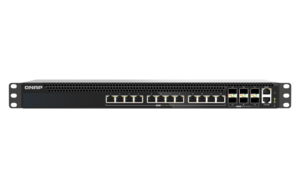
High-density 540 Gbps L3 Lite rackmount switch combining twelve 10GbE RJ45 ports and six 25GbE SFP28 uplinks for demanding enterprise backbones.
Mizex Comparative Audit Verdict
5-Pillar Engineering Telemetry
Detailed comparison across standardized normalized 1.0 – 5.0 engineering pillars.
Ruckus R770 Wi-Fi 7 Indoor Access Point: Strengths & Caveats
- Tri-band Wi-Fi 7 architecture delivering combined theoretical PHY rates up to 12.22 Gbps across 8 spatial streams
- Dedicated 10GbE / 2.5GbE Ethernet port preventing uplink bottlenecks
- BeamFlex+ adaptive antenna technology with onboard Bluetooth 5.1 and Zigbee IoT support
- Verified in stadium testing with up to 60% throughput gains (reaching 900 Mbps) and 75% latency reduction versus Wi-Fi 6E
- Requires high-power 802.11bt PoE++ infrastructure to run all radios and interfaces without power throttling
- Full multi-gigabit backhaul cannot be realized on legacy gigabit switching infrastructure
QNAP QSW-M5218: Strengths & Caveats
- High-bandwidth hybrid density with twelve 10GbE RJ45 ports and six 25GbE SFP28 fiber uplinks
- Non-blocking 540 Gbps switching capacity with Layer 3 Lite static routing and DHCP server support
- Enterprise-grade MC-LAG clustering and IEEE 1588v2 PTP time synchronization for AV-over-IP workflows
- Sturdy 1U rackmount all-metal steel chassis with an integrated universal internal power supply
- Five PWM high-RPM cooling fans generate notable acoustic output unsuitable for quiet desktop deployment
- Firmware maturity across broad third-party 25GbE SFP28 optical transceiver compatibility requires post-launch validation
Technical Specification Comparison
Side-by-side spec alignment. Rows highlighted with subtle shading denote differing specifications.
| Specification | Ruckus R770 Wi-Fi 7 Indoor Access Point | QNAP QSW-M5218 |
|---|---|---|
| Brand DIFF | RUCKUS | QNAP |
| Model DIFF | R770 | QSW-M5218 |
| Model Number DIFF | 901-R770-WW00 | — |
| Wireless Standard DIFF | Wi-Fi 7 | — |
| Radio Configuration DIFF | Tri-band (2.4 GHz, 5 GHz, 6 GHz) | — |
| Maximum PHY Rate DIFF | 12.22 Gbps | — |
| Spatial Streams DIFF | 8 | — |
| Ethernet Uplink DIFF | 10GbE / 2.5GbE | — |
| Antenna Technology DIFF | BeamFlex+ adaptive antennas | — |
| IoT Connectivity DIFF | Bluetooth 5.1 (BLE), Zigbee | — |
| Channel Width DIFF | 160 MHz | — |
| Power Delivery DIFF | 802.11bt PoE++ / PoE+ | — |
| Security DIFF | WPA3 | — |
| Modulation & MIMO DIFF | OFDMA, MU-MIMO | — |
| Management Platform DIFF | RUCKUS One cloud management | — |
| Coverage Area DIFF | 1,500 sq ft (140 m²) | — |
| Form Factor DIFF | — | 1U Rackmount |
| Enclosure Material DIFF | — | Steel / Metal |
| Dimensions DIFF | — | 44 x 439 x 190 mm (1.73 x 17.28 x 7.48 in) |
| Weight DIFF | — | 2.74 kg (6.04 lbs) |
| Ethernet Ports DIFF | — | 12 x 10GbE RJ45 (10G/5G/2.5G/1G/100M) |
| Uplink Ports DIFF | — | 6 x 25GbE SFP28 (25G/10G/1G) |
| Total Switching Capacity DIFF | — | 540 Gbps |
| Management System DIFF | — | QSS Pro (Web GUI), AMIZcloud Centralized Management |
| Layer 3 Features DIFF | — | IPv4/IPv6 Static Routing, DHCP Server, Inter-VLAN Routing |
| High Availability DIFF | — | MC-LAG (Multi-Chassis Link Aggregation Group) |
| Time Synchronization DIFF | — | IEEE 1588v2 PTP (Precision Time Protocol) |
| Cooling System DIFF | — | 5 x PWM VAPO Bearing Cooling Fans |
| Max Power Consumption DIFF | — | 80W |
| Power Input DIFF | — | Internal Universal PSU, 100-240V AC, 50/60 Hz |
Need to evaluate a different configuration?
🔍 Compare Other Hardware