
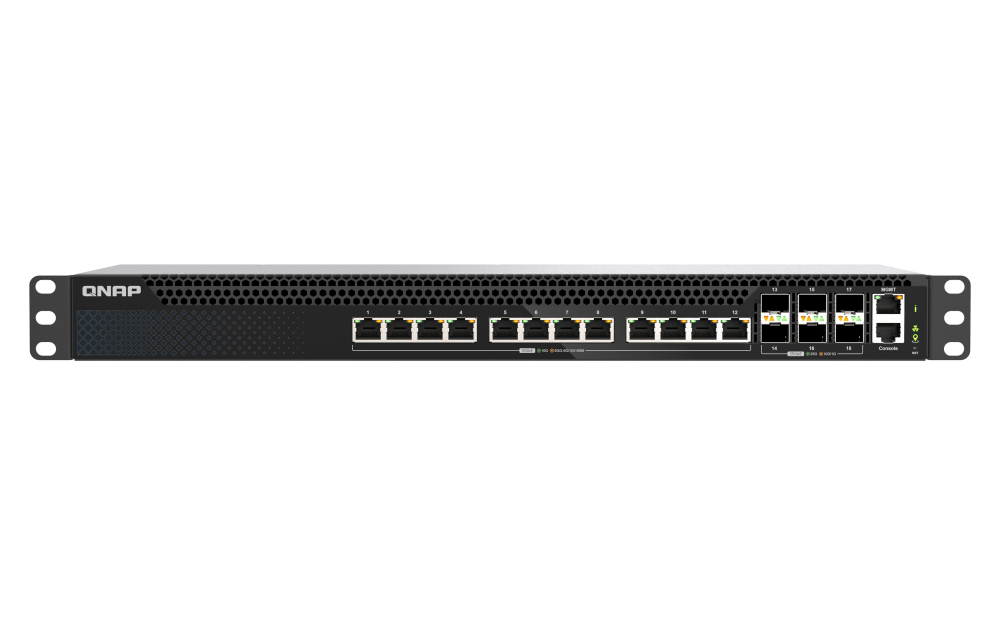
- High-bandwidth hybrid density with twelve 10GbE RJ45 ports and six 25GbE SFP28 fiber uplinks
- Non-blocking 540 Gbps switching capacity with Layer 3 Lite static routing and DHCP server support
- Enterprise-grade MC-LAG clustering and IEEE 1588v2 PTP time synchronization for AV-over-IP workflows
- Sturdy 1U rackmount all-metal steel chassis with an integrated universal internal power supply
- Five PWM high-RPM cooling fans generate notable acoustic output unsuitable for quiet desktop deployment
- Firmware maturity across broad third-party 25GbE SFP28 optical transceiver compatibility requires post-launch validation
Overview
The QNAP QSW-M5218 is a high-density 1U rackmount Layer 3 Lite managed switch designed to unify multi-gigabit copper infrastructure with high-speed fiber backbones. Constructed within a rigid, commercial-grade steel enclosure measuring 44 by 439 by 190 millimeters, the platform integrates twelve multi-gigabit 10GbE RJ45 ports and six 25GbE SFP28 uplink interfaces, delivering a comprehensive non-blocking switching throughput of up to 540 Gbps. It operates on the QSS Pro (QNAP Switch System Pro) management environment with AMIZcloud centralized orchestration, offering advanced networking primitives including IPv4 and IPv6 static routing, DHCP server deployment, MC-LAG high-availability clustering, and IEEE 1588v2 PTP time synchronization targeted at latency-sensitive AV-over-IP and broadcast workloads.
Thermal dissipation is managed by five internal PWM-controlled VAPO bearing cooling fans that draw air across the switching silicon and the integrated 80W power supply. As newly announced enterprise hardware introduced in late 2026, complete internal physical teardown data regarding component-level thermal pad placements, VRM topologies, and sound chamber acoustic profile curves remains pending retail lab teardown verification. However, the five-fan active cooling architecture is engineered to sustain continuous full-duplex line-rate transmission across all multi-gigabit copper transceivers, with acoustic noise characteristics anticipated to require installation within dedicated equipment racks or server closets rather than quiet office workspaces.
In operational practice, the QSW-M5218 delivers substantial architectural flexibility for mid-sized enterprise environments, virtualization clusters, and high-throughput media editing networks. By enabling organizations to leverage pre-existing Cat 6a cabling infrastructure for 10GbE endpoint delivery while scaling core uplink aggregation to 25GbE, it eliminates costly recabling runs while preventing bandwidth bottlenecks. Initial field deployment considerations center on validating optical transceiver interoperability across third-party 25GbE SFP28 modules and monitoring early QSS Pro firmware revisions as production workloads scale.
Technical Specifications
| Brand | QNAP |
| Model | QSW-M5218 |
| Form Factor | 1U Rackmount |
| Enclosure Material | Steel / Metal |
| Dimensions | 44 x 439 x 190 mm (1.73 x 17.28 x 7.48 in) |
| Weight | 2.74 kg (6.04 lbs) |
| Ethernet Ports | 12 x 10GbE RJ45 (10G/5G/2.5G/1G/100M) |
| Uplink Ports | 6 x 25GbE SFP28 (25G/10G/1G) |
| Total Switching Capacity | 540 Gbps |
| Management System | QSS Pro (Web GUI), AMIZcloud Centralized Management |
| Layer 3 Features | IPv4/IPv6 Static Routing, DHCP Server, Inter-VLAN Routing |
| High Availability | MC-LAG (Multi-Chassis Link Aggregation Group) |
| Time Synchronization | IEEE 1588v2 PTP (Precision Time Protocol) |
| Cooling System | 5 x PWM VAPO Bearing Cooling Fans |
| Max Power Consumption | 80W |
| Power Input | Internal Universal PSU, 100-240V AC, 50/60 Hz |
Primary Sources & Audited Citations
Recommended Alternatives in Networking & Routers
At a Glance
How reliable is the QNAP QSW-M5218 Review: High Density Switching for Enterprise Backbones according to Mizex audits?
A potent 1U hybrid switch offering exceptional 10G copper and 25G fiber density for SMB backbones and media workflows, provided deployment is made in dedicated rack enclosures where multi-fan acoustics are acceptable.
What are the known quirks or drawbacks of the QNAP QSW-M5218 Review: High Density Switching for Enterprise Backbones?
Our reliability audit identified the following documented caveats:
- Five PWM high-RPM cooling fans generate notable acoustic output unsuitable for quiet desktop deployment
- Firmware maturity across broad third-party 25GbE SFP28 optical transceiver compatibility requires post-launch validation
What are the key engineering highlights of the QNAP QSW-M5218 Review: High Density Switching for Enterprise Backbones?
The top strengths recorded in our evaluation include:
- High-bandwidth hybrid density with twelve 10GbE RJ45 ports and six 25GbE SFP28 fiber uplinks
- Non-blocking 540 Gbps switching capacity with Layer 3 Lite static routing and DHCP server support
- Enterprise-grade MC-LAG clustering and IEEE 1588v2 PTP time synchronization for AV-over-IP workflows
- Sturdy 1U rackmount all-metal steel chassis with an integrated universal internal power supply