Radxa Cubie A7Z 2GB vs Raspberry Pi 5 2GB
Standardized 5-pillar engineering audit, thermal telemetry, verified longevity metrics, and complete technical specification diff.
High-density SBC engineering that fits octa-core compute, a 3 TOPS NPU, and PCIe Gen3 into a Pi Zero footprint with expected I/O trade-offs.
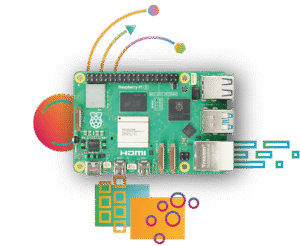
The Raspberry Pi 5 2GB combines major CPU performance gains and refined silicon power efficiency into an accessible, highly reliable single-board computer.
Mizex Comparative Audit Verdict
5-Pillar Engineering Telemetry
Detailed comparison across standardized normalized 1.0 – 5.0 engineering pillars.
Radxa Cubie A7Z 2GB: Strengths & Caveats
- Integrates dual Cortex-A76 and hexa Cortex-A55 cores with a 3 TOPS NPU in a compact form factor
- Provides high-speed PCIe Gen3 x1 expansion via an onboard FPC connector
- Supports dual display output via Micro HDMI 2.0b and USB-C DisplayPort Alt Mode
- Features modern wireless networking with Wi-Fi 6 and Bluetooth 5.4
- Lacks onboard RJ45 Ethernet and full-size USB Type-A ports, requiring external adapters
- High-speed UFS 3.0 storage requires surface-mount soldering to unpopulated pads rather than a modular socket
Raspberry Pi 5 2GB: Strengths & Caveats
- 2x to 3x CPU performance uplift over the previous generation via modern Arm Cortex-A76 cores
- Refined silicon revision with improved power efficiency and reduced thermal dissipation
- Dual 4Kp60 display capability powered by the upgraded VideoCore VII graphics engine
- Industry-leading long-term firmware and mainline Linux operating system support
- 2GB memory ceiling limits intensive multitasking and heavy containerized workloads
- Requires auxiliary active or passive cooling accessories to avoid thermal throttling under peak compute loads
Technical Specification Comparison
Side-by-side spec alignment. Rows highlighted with subtle shading denote differing specifications.
| Specification | Radxa Cubie A7Z 2GB | Raspberry Pi 5 2GB |
|---|---|---|
| Brand DIFF | Radxa | Raspberry Pi |
| Model DIFF | Cubie A7Z 2GB | 5 2GB |
| SoC DIFF | Allwinner A733 (A733MX-HN3) | — |
| CPU Architecture DIFF | Dual-core Arm Cortex-A76 @ up to 2.00 GHz, Hexa-core Arm Cortex-A55 @ up to 1.79 GHz, Single-core RISC-V E902 real-time core | 64-bit Armv8-A |
| GPU DIFF | Imagination Technologies BXM-4-64 MC1 (OpenGL ES 3.2, Vulkan 1.3, OpenCL 3.0) | — |
| NPU DIFF | 3 TOPS AI accelerator | — |
| VPU DIFF | 8Kp24 H.265/VP9/AVS2 decoding, 4Kp30 H.265/H.264 encoding | — |
| System Memory DIFF | 2GB LPDDR4/4x | 2GB LPDDR4X-4267 SDRAM |
| Storage Support DIFF | MicroSD slot, unpopulated footprint for 2-lane UFS 3.0 (64GB to 512GB) | — |
| Display Interfaces DIFF | 1x Micro HDMI 2.0b (up to 4Kp60), 1x USB-C with DisplayPort Alt Mode | — |
| Camera Interface DIFF | 4-lane MIPI CSI connector | — |
| Wireless Connectivity DIFF | Dual-band Wi-Fi 6, Bluetooth 5.4 (Quectel FCU760K module, IPEX antenna connector) | Dual-band 802.11ac Wi-Fi, Bluetooth 5.0 / BLE |
| USB Ports DIFF | 1x USB 2.0 OTG Type-C (power/data), 1x USB 3.1 OTG Type-C (with DisplayPort Alt Mode) | — |
| Expansion Interfaces DIFF | 40-pin color-coded GPIO header, PCIe Gen3 x1 FPC connector | — |
| Form Factor DIFF | Raspberry Pi Zero standard footprint, 2.56 x 1.18 in (65 x 30 mm) | — |
| Power Delivery DIFF | 5V/1A via USB-C or 5V DC via 40-pin GPIO header | USB-C PD (5V/5A recommended) |
| Processor DIFF | — | Broadcom BCM2712 Quad-core Arm Cortex-A76 @ 2.4GHz |
| CPU Core Count DIFF | — | 4 |
| Cache DIFF | — | 512KB L2 per core, 2MB shared L3 |
| Graphics DIFF | — | VideoCore VII @ 800MHz |
| Display Output DIFF | — | Dual micro-HDMI (up to 4Kp60 simultaneous) |
| Video Decode DIFF | — | 4Kp60 HEVC |
| Ethernet DIFF | — | Gigabit Ethernet (1000BASE-T) |
| USB Connectivity DIFF | — | 2x USB 3.0 (5Gbps), 2x USB 2.0 |
| Expansion Interface DIFF | — | Standard 40-pin GPIO header, PCIe 2.0 x1 interface |
Need to evaluate a different configuration?
🔍 Compare Other Hardware