NVIDIA GeForce RTX 5090 vs PNY GeForce RTX 5090
Standardized 5-pillar engineering audit, thermal telemetry, verified longevity metrics, and complete technical specification diff.
Unrivaled Blackwell computational density and GDDR7 throughput tempered by extreme 575W power consumption and delicate modular interconnects.
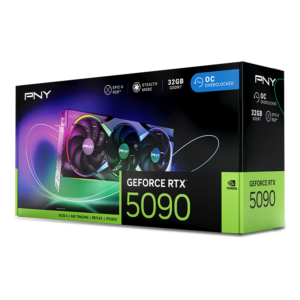
A monolithic 3.5-slot graphics accelerator delivering massive Blackwell compute density and 32 GB of GDDR7 memory alongside extreme 575W power and thermal demands.
Mizex Comparative Audit Verdict
5-Pillar Engineering Telemetry
Detailed comparison across standardized normalized 1.0 – 5.0 engineering pillars.
NVIDIA GeForce RTX 5090: Strengths & Caveats
- Substantial 20% to 50% rasterization and ray-tracing performance uplift over previous-generation flagships
- Massive 32 GB GDDR7 VRAM across a 512-bit bus delivering up to 1,792 GB/s of bandwidth
- Comprehensive display pipeline with native DisplayPort 2.1b and HDMI 2.1b support
- Immense 575W power envelope with documented 12V-2x6 connector melting risks under extreme sustained load
- Fragile internal modular ribbon interconnect complicates servicing and block installations
- Premium $1,999 MSRP paired with mandatory high-wattage power supply upgrades
PNY GeForce RTX 5090: Strengths & Caveats
- Massive compute density with 21,760 Blackwell CUDA cores and high-throughput PCIe 5.0 x16 interface
- Next-generation 32 GB GDDR7 memory subsystem across an ultra-wide 512-bit bus at 28 Gbps
- Modern display connectivity supporting three DisplayPort 2.1b outputs and one HDMI 2.1b port for 8K resolution
- Extremely high thermal output and energy consumption rated at 575W TDP
- Massive 3.5-slot expansion footprint requiring significant internal chassis clearance
- Documented risk of 16-pin power connector overheating and warranty friction regarding cable origin
Technical Specification Comparison
Side-by-side spec alignment. Rows highlighted with subtle shading denote differing specifications.
| Specification | NVIDIA GeForce RTX 5090 | PNY GeForce RTX 5090 |
|---|---|---|
| Brand DIFF | NVIDIA | PNY |
| Model DIFF | NVIDIA GeForce RTX 5090 | PNY GeForce RTX 5090 |
| Architecture DIFF | Blackwell | NVIDIA Blackwell |
| GPU Die DIFF | GB202-300-A1 | — |
| Process Node DIFF | TSMC 4N FinFET | — |
| CUDA Cores DIFF | 21,760 | 21760 |
| Tensor Cores DIFF | 680 (5th Gen) | — |
| Ray Tracing Cores DIFF | 170 (4th Gen) | — |
| Base Clock DIFF | 2.01 GHz | — |
| Boost Clock DIFF | 2.41 GHz | 2527 MHz |
| VRAM Capacity | 32 GB | 32 GB |
| Memory Type | GDDR7 | GDDR7 |
| Memory Bus DIFF | 512-bit | — |
| Memory Bandwidth DIFF | 1,792 GB/s | — |
| Interface | PCIe 5.0 x16 | PCIe 5.0 x16 |
| TGP DIFF | 575 W | — |
| Power Connector DIFF | 1x 16-pin (12V-2x6) | — |
| Display Outputs | 1x HDMI 2.1b, 3x DisplayPort 2.1b | 1x HDMI 2.1b, 3x DisplayPort 2.1b |
| GPU Chipset DIFF | — | NVIDIA GeForce RTX 5090 |
| Memory Bus Width DIFF | — | 512-bit |
| Effective Memory Speed DIFF | — | 28 Gbps |
| TDP DIFF | — | 575W |
| Cooling Solution DIFF | — | Triple Fan |
| Slot Width DIFF | — | 3.5-slot |
| Maximum Resolution DIFF | — | 7680 x 4320 |
| Multi Monitor Support DIFF | — | 4 |
| Power Connectors DIFF | — | 1x 16-pin (1x 16-pin to 4x 8-pin adapter included) |
| API & Feature Support DIFF | — | DLSS 4.0, Ray Tracing, VR Ready |
Need to evaluate a different configuration?
🔍 Compare Other Hardware