MSI GeForce RTX 3050 Ventus 2X 6G OC vs NVIDIA RTX PRO 4500 Blackwell Server Edition
Standardized 5-pillar engineering audit, thermal telemetry, verified longevity metrics, and complete technical specification diff.
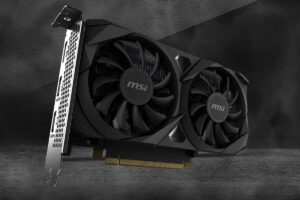
MSI GeForce RTX 3050 Ventus 2X 6G OC
A slot-powered 70W graphics card with capable dual-fan cooling, delivering efficient 1080p entry-level performance and modern Ampere architecture features without requiring supplemental power connections.
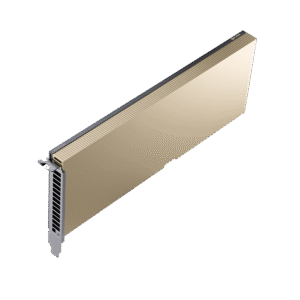
NVIDIA RTX PRO 4500 Blackwell Server Edition
A compact single-slot Blackwell enterprise accelerator offering 32 GB of ECC GDDR7 and exceptional FP4 compute density for rackmount and edge infrastructure.
Mizex Comparative Audit Verdict
5-Pillar Engineering Telemetry
Detailed comparison across standardized normalized 1.0 – 5.0 engineering pillars.
MSI GeForce RTX 3050 Ventus 2X 6G OC: Strengths & Caveats
- Direct PCIe slot power with 70W total board power eliminates need for supplemental PCIe power cables
- Quiet thermal profile with Zero Frozr fan-stop technology during idle and light workloads
- Compact 189 mm dual-slot footprint fits easily into space-constrained and OEM desktop enclosures
- Reduced 6GB VRAM on a 96-bit bus incurs a roughly 20% performance reduction compared to standard 8GB models
- Restricted to three display outputs compared to the four ports typical in this class
- Strict 70W board limit leaves no headroom for manual power limit increases
NVIDIA RTX PRO 4500 Blackwell Server Edition: Strengths & Caveats
- High-density single-slot FHFL form factor with 165W TDP enables high compute density in 1U and 2U server racks
- 32 GB GDDR7 ECC memory provides 800 GB/s bandwidth for mission-critical enterprise workloads
- 5th-generation Tensor Cores with native FP4 precision deliver up to 1.6 PFLOPS of inference performance
- Hardware Multi-Instance GPU (MIG) capability allows isolation into two independent 16 GB partitions
- Passive thermal design strictly requires high-CFM server chassis airflow and cannot run in standard desktop PCs
- Headless server-only configuration lacks physical display outputs
- Memory clock speed of 25 Gbps provides 800 GB/s bandwidth compared to 896 GB/s on the workstation variant
Technical Specification Comparison
Side-by-side spec alignment. Rows highlighted with subtle shading denote differing specifications.
| Specification | MSI GeForce RTX 3050 Ventus 2X 6G OC | NVIDIA RTX PRO 4500 Blackwell Server Edition |
|---|---|---|
| Brand DIFF | MSI | NVIDIA |
| Model DIFF | GeForce RTX 3050 Ventus 2X 6G OC | NVIDIA RTX PRO 4500 Blackwell Server Edition |
| Model Number DIFF | RTX 3050 VENTUS 2X 6G OC | — |
| Gpu Architecture DIFF | NVIDIA Ampere (GA107) | — |
| Cuda Cores DIFF | 2304 | — |
| Base Clock Mhz DIFF | 1042 | — |
| Boost Clock Mhz DIFF | 1492 | — |
| Vram Capacity DIFF | 6GB | — |
| Vram Type DIFF | GDDR6 | — |
| Memory Bus Width DIFF | 96-bit | — |
| Memory Speed Gbps DIFF | 14 | — |
| Memory Bandwidth Gbps DIFF | 168 | — |
| Bus Interface DIFF | PCIe 4.0 x8 | — |
| Tdp Rating Watts DIFF | 70 | — |
| Power Connectors DIFF | None (PCIe slot-powered) | — |
| Recommended Psu Watts DIFF | 300 | — |
| Cooling Solution DIFF | Dual-fan (TORX Fan 2.0) | — |
| Zero Rpm Mode DIFF | 1 | — |
| Display Outputs DIFF | 1x HDMI 2.1, 2x DisplayPort 1.4a | — |
| Max Displays DIFF | 3 | — |
| Dimensions Mm DIFF | 189 x 109 x 42 | — |
| Architecture DIFF | — | NVIDIA Blackwell |
| GPU Die DIFF | — | GB203 |
| Process Node DIFF | — | TSMC 4nm |
| CUDA Cores DIFF | — | 10496 |
| Streaming Multiprocessors DIFF | — | 82 |
| Tensor Cores DIFF | — | 328 (5th Generation) |
| RT Cores DIFF | — | 82 (4th Generation) |
| Memory Capacity DIFF | — | 32 GB |
| Memory Type DIFF | — | GDDR7 ECC |
| Memory Bus Width DIFF | — | 256-bit |
| Memory Speed DIFF | — | 25 Gbps |
| Memory Bandwidth DIFF | — | 800 GB/s |
| Bus Interface DIFF | — | PCIe 5.0 x16 |
| Thermal Design Power (TDP) DIFF | — | 165 W |
| Form Factor DIFF | — | Single-slot, Full-Height Full-Length (FHFL) |
| Dimensions DIFF | — | 4.4" H x 10.5" L |
| Cooling Design DIFF | — | Passive (chassis airflow dependent) |
| Power Connector DIFF | — | 1x 16-pin PCIe CEM5 |
| Display Outputs DIFF | — | None (headless) |
| Multi Instance GPU (MIG) DIFF | — | Up to 2 instances (16 GB each) |
| Video Engines DIFF | — | 3x NVENC (9th Gen), 3x NVDEC (6th Gen, 4:2:2 support) |
| Compute Capability DIFF | — | 12.0 (sm_120) |
| FP4 Tensor Compute DIFF | — | 1.6 PFLOPS (with 2:4 structured sparsity) |
| FP8 Tensor Compute DIFF | — | 811 TFLOPS |
| FP16/BF16 Tensor Compute DIFF | — | 406 TFLOPS |
| TF32 Tensor Compute DIFF | — | 203 TFLOPS |
| RT Core Performance DIFF | — | 154 TFLOPS |
Need to evaluate a different configuration?
🔍 Compare Other Hardware