Micron 2650 512GB NVMe SSD Review: PCIe Gen4 Saturation Without DRAM vs Microsoft Surface Pro 512GB Replacement SSD M.2 2230 Model 1912 Review: Official Hardware Simplifies Fleet Data Security
Standardized 5-pillar engineering audit, thermal telemetry, verified longevity metrics, and complete technical specification diff.
Micron 2650 512GB NVMe SSD Review: PCIe Gen4 Saturation Without DRAM
Near-saturating Gen4 read throughput and dense 276-layer TLC flash make this DRAM-less client SSD a potent performer for burst workloads, tempered only by post-cache write slowdowns.
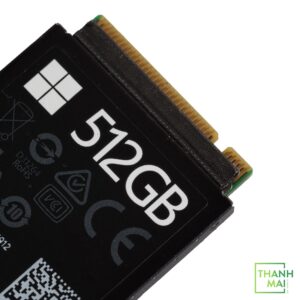
Microsoft Surface Pro 512GB Replacement SSD M.2 2230 Model 1912 Review: Official Hardware Simplifies Fleet Data Security
Official M.2 2230 replacement drive offering flawless Surface integration, silent solid-state operation, and simplified fleet data security.
Mizex Comparative Audit Verdict
5-Pillar Engineering Telemetry
Detailed comparison across standardized normalized 1.0 – 5.0 engineering pillars.
Micron 2650 512GB NVMe SSD Review: PCIe Gen4 Saturation Without DRAM: Strengths & Caveats
- Near-saturating PCIe Gen4 sequential read throughput up to 7,000 MB/s.
- Pioneers high-density 276-layer Micron G9 3D TLC NAND architecture.
- Efficient power characteristics with active load power capped at 6.1W and PS4 sleep draw under 2.5mW.
- Broad form factor availability spanning M.2 2230, 2242, and 2280 footprints for compact devices.
- DRAM-less design experiences write throughput degradation during sustained heavy transfers after pseudo-SLC cache exhaustion.
- Lower sequential write ceiling of 4,800 MB/s relative to higher-capacity 1TB and 2TB variants.
Microsoft Surface Pro 512GB Replacement SSD M.2 2230 Model 1912 Review: Official Hardware Simplifies Fleet Data Security: Strengths & Caveats
- Official OEM compatibility with native Windows Update firmware servicing
- Ultra-compact M.2 2230 form factor enables modular, accessible storage upgrades
- Completely silent solid-state operation with zero acoustic noise
- Compact 2230 surface area concentrates thermal loads during sustained writes
- Form factor restricts direct installation to compatible ultra-compact M.2 slots
Technical Specification Comparison
Side-by-side spec alignment. Rows highlighted with subtle shading denote differing specifications.
| Specification | Micron 2650 512GB NVMe SSD Review: PCIe Gen4 Saturation Without DRAM | Microsoft Surface Pro 512GB Replacement SSD M.2 2230 Model 1912 Review: Official Hardware Simplifies Fleet Data Security |
|---|---|---|
| Brand DIFF | Micron | Microsoft |
| Model DIFF | 2650 512GB NVMe SSD | Surface Pro 512GB Replacement SSD M.2 2230 Model 1912 |
| Capacity | 512 GB | 512 GB |
| Interface DIFF | PCIe Gen4 x4, NVMe 1.4 | PCIe NVMe |
| Form Factor & Dimensions DIFF | M.2 2230 (0.87 x 1.18 in / 22 x 30 mm), M.2 2242 (0.87 x 1.65 in / 22 x 42 mm), M.2 2280 (0.87 x 3.15 in / 22 x 80 mm) | — |
| NAND Flash Type DIFF | Micron 276-layer 3D TLC (G9 FortisFlash) | — |
| Controller DIFF | Phison PS5027-E27T | — |
| DRAM Cache DIFF | DRAM-less (Host Memory Buffer supported) | — |
| Sequential Read Speed DIFF | Up to 7,000 MB/s | — |
| Sequential Write Speed DIFF | Up to 4,800 MB/s | — |
| Random Read (4K) DIFF | Up to 740,000 IOPS | — |
| Random Write (4K) DIFF | Up to 1,000,000 IOPS | — |
| Endurance Rating DIFF | 300 TBW | — |
| Mean Time Between Failures (MTBF) DIFF | 2,000,000 hours | — |
| Hardware Encryption DIFF | AES 256-bit, TCG Opal 2.02, TCG Pyrite 2.01 | — |
| Active Load Power Draw DIFF | 6.100 W | — |
| Idle Power Draw DIFF | 0.150 W | — |
| Peak Operating Temperature DIFF | 70°C (158°F) | — |
| Form Factor DIFF | — | M.2 2230 |
| Model Number DIFF | — | 1912 |
| Acoustic Noise DIFF | — | 0 dB (Solid State) |
| PCB Layout DIFF | — | Single-sided M.2 |
| Host Compatibility DIFF | — | Microsoft Surface Pro Series (with removable SSD bay) |
| Firmware Integration DIFF | — | Native Windows Update Servicing |
Need to evaluate a different configuration?
🔍 Compare Other Hardware