HPE Networking CW 2050 24-Port Gigabit Managed Switch vs Anker Smart Display Hub
Standardized 5-pillar engineering audit, thermal telemetry, verified longevity metrics, and complete technical specification diff.
A resilient 1U managed switch featuring 6kV port surge suppression and ComwareOS IRF stacking, balanced against a 2.5G uplink ceiling and two-node stack limit.
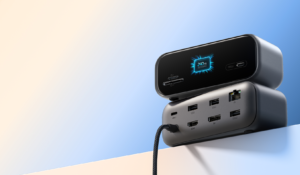
A versatile 10-in-1 desktop USB-C dock distinguished by an integrated 1.4-inch real-time telemetry display and dual 4K@60Hz video output.
Mizex Comparative Audit Verdict
5-Pillar Engineering Telemetry
Detailed comparison across standardized normalized 1.0 – 5.0 engineering pillars.
HPE Networking CW 2050 24-Port Gigabit Managed Switch: Strengths & Caveats
- Integrated 6kV service-port surge protection safeguards RJ45 interfaces in electrically unconditioned edge environments.
- Supports two-member Intelligent Resilient Fabric (IRF) stacking for unified management and resilient failover.
- Provides multi-gigabit 2.5G Smart Rate ports alongside up to 100W PoE++ for high-draw Wi-Fi 7 hardware.
- Fanless passive cooling on the non-PoE variant ensures silent operation with low 16W base power consumption.
- Optical SFP uplink ports are capped at 2.5 Gbps, preventing high-bandwidth 10GbE network aggregation.
- Intelligent Resilient Fabric (IRF) stacking is restricted to a maximum of two physical switches.
- ComwareOS command-line interface diverges from standard ArubaOS-CX and ProCurve syntax conventions.
Anker Smart Display Hub: Strengths & Caveats
- Integrated 1.4-inch telemetry screen provides real-time wattage and link-speed monitoring without external software
- Dual 4K@60Hz output via independent HDMI 2.0 and DisplayPort 1.4 outputs (with Windows MST support)
- Clean desktop form factor with forward-facing USB-C 10Gbps data and 100W total PD delivery capability
- Full I/O expansion suite combining Gigabit Ethernet, UHS-I SD/microSD card slots, and legacy peripheral ports
- macOS limitation: Apple Silicon lacks native MST support, restricting dual external monitors to mirrored mode only
- Requires a separate 100W+ USB-C PD wall brick (not bundled in standard package) to achieve full 85W host charging
Technical Specification Comparison
Side-by-side spec alignment. Rows highlighted with subtle shading denote differing specifications.
| Specification | HPE Networking CW 2050 24-Port Gigabit Managed Switch | Anker Smart Display Hub |
|---|---|---|
| Brand DIFF | HPE | Anker |
| Model DIFF | Networking CW 2050 24-Port Gigabit Managed Switch | Smart Display Hub (A210C) |
| Form Factor DIFF | 1U Rackmount | Desktop Angled Stand / Hub |
| Switching Capacity DIFF | 80 Gbps | — |
| Forwarding Throughput DIFF | 59.52 Mpps | — |
| Access Port Configuration DIFF | 20x 10/100/1000BASE-T + 4x 1G/2.5G Smart Rate BASE-T | — |
| Uplink Interfaces DIFF | 4x 1G/2.5G SFP | — |
| PoE Budget & Delivery DIFF | 420W total budget with up to 100W PoE++ on Smart Rate ports (PoE models) | — |
| Surge Protection DIFF | 6 kV integrated on service ports | — |
| Stacking Architecture DIFF | 2-member Intelligent Resilient Fabric (IRF) | — |
| Network Operating System DIFF | HPE ComwareOS | — |
| Base System Power DIFF | 16W (Non-PoE) / 23W (PoE+ base system) | — |
| Operating Temperature Range DIFF | 23°F to 113°F (-5°C to 45°C) | — |
| Operating Humidity Range DIFF | 5% to 95% non-condensing | — |
| Dimensions DIFF | Non-PoE: 17.32 x 6.30 x 1.73 in (440 x 160 x 44 mm); PoE+: 17.32 x 10.24 x 1.73 in (440 x 260 x 44 mm) | — |
| Weight DIFF | Non-PoE: 4.41 lbs (2.00 kg); PoE+: 7.94 lbs (3.60 kg) | — |
| Device Category DIFF | — | Desktop Docking Stations |
| Hardware Category DIFF | — | USB-C Hubs & Docks |
| Total Ports DIFF | — | 10-in-1 |
| Host Connection DIFF | — | USB-C (Up to 85W Passthrough) |
| Power Input DIFF | — | USB-C PD 100W Max (15W Operating Overhead) |
| Integrated Display DIFF | — | 1.4-inch Color LCD (Real-Time Port Telemetry & Wattage) |
| Video Outputs DIFF | — | 1x HDMI 2.0 (4K@60Hz), 1x DisplayPort 1.4 (4K@60Hz) |
| Multi Display Modes DIFF | — | Dual 4K@60Hz (Windows MST), Mirrored/Single 4K@60Hz (macOS SST) |
| Data Ports DIFF | — | 1x USB-C 3.2 Gen 2 (10Gbps), 2x USB-A 3.2 Gen 1 (5Gbps), 1x USB-A 2.0 (480Mbps) |
| Networking DIFF | — | 1x Gigabit Ethernet RJ45 (10/100/1000 Mbps) |
| Card Reader DIFF | — | SD / microSD (UHS-I 104MB/s simultaneous read) |
Need to evaluate a different configuration?
🔍 Compare Other Hardware