Critical Link MitySOM-AM62P vs LILYGO T-Dongle-C5
Standardized 5-pillar engineering audit, thermal telemetry, verified longevity metrics, and complete technical specification diff.
A capable industrial SO-DIMM compute module uniting quad Cortex-A53 processing, dual real-time Cortex-R5F cores, and capable 3D graphics for deterministic embedded systems.
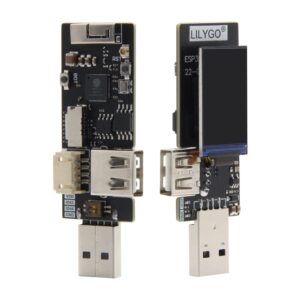
A feature-dense ESP32-C5 development dongle integrating dual-band Wi-Fi 6, 802.15.4 mesh radios, and modular Qwiic expansion into an ultra-compact USB form factor.
Mizex Comparative Audit Verdict
5-Pillar Engineering Telemetry
Detailed comparison across standardized normalized 1.0 – 5.0 engineering pillars.
Critical Link MitySOM-AM62P: Strengths & Caveats
- Asymmetric multicore architecture uniting quad Cortex-A53 general compute with dual 800 MHz Cortex-R5F real-time cores
- Imagination IMG BXS-4-64 GPU with over 50 GFLOPS and modern Vulkan/OpenGL ES support for fluid HMI graphics
- Supports up to 8 GB high-bandwidth 32-bit LPDDR4 memory in an industrial SO-DIMM form factor
- Lacks an integrated hardware NPU or DSP accelerator for edge machine learning workloads
LILYGO T-Dongle-C5: Strengths & Caveats
- Equipped with Espressif ESP32-C5HR8 delivering dual-band 2.4 GHz/5 GHz Wi-Fi 6, BLE 5.0, and 802.15.4 (Thread/Zigbee)
- Space-saving physical design integrating a microSD card slot directly inside the USB Type-A male connector
- Built-in STEMMA QT / Qwiic interface for plug-and-play modular sensor prototyping
- Optional 0.96-inch 160x80 color IPS display provides onboard visual telemetry
- Switching to external IPEX antenna connectors requires desoldering and rotating onboard surface-mount resistors
Technical Specification Comparison
Side-by-side spec alignment. Rows highlighted with subtle shading denote differing specifications.
| Specification | Critical Link MitySOM-AM62P | LILYGO T-Dongle-C5 |
|---|---|---|
| Brand DIFF | Critical | LILYGO |
| Model DIFF | Critical Link MitySOM-AM62P | LILYGO T-Dongle-C5 |
| Processor DIFF | Texas Instruments Sitara AM62P (AM62P54CVMHIAMHR) | — |
| Cpu Cores DIFF | 4x Arm Cortex-A53 up to 1.4 GHz | — |
| Real Time Cores DIFF | 2x Arm Cortex-R5F up to 800 MHz | — |
| Gpu DIFF | Imagination IMG BXS-4-64 (up to 50 GFLOPS) | — |
| Graphics Api Support DIFF | OpenGL ES 3.2, Vulkan 1.2, OpenCL 1.2 EP | — |
| Memory Type DIFF | LPDDR4 32-bit | — |
| Max Memory Capacity DIFF | 8 GB | — |
| Display Interface DIFF | 4-lane MIPI DSI | — |
| Form Factor DIFF | SO-DIMM System-on-Module (SoM) | — |
| Processor DIFF | — | Espressif Systems ESP32-C5HR8 (32-bit RISC-V core up to 240 MHz, LP RISC-V core @ 40 MHz) |
| System Memory DIFF | — | 384 KB On-Chip SRAM, 8 MB PSRAM, 320 KB ROM |
| Storage DIFF | — | 16 MB SPI Flash, MicroSD card slot (integrated inside USB-A connector) |
| Wireless Standards DIFF | — | Dual-Band Wi-Fi 6 (802.11ax, 2.4 GHz / 5 GHz), Bluetooth 5.0 LE, 802.15.4 (Zigbee 3.0 / Thread 1.3) |
| Display DIFF | — | Optional 0.96-inch 65K color IPS LCD (160x80 resolution, ST7735 controller) |
| Host Interface DIFF | — | USB Type-A Male (Power & Programming) |
| Expansion Interface DIFF | — | STEMMA QT / Qwiic (4-pin I2C) |
| Antenna Options DIFF | — | Dual onboard ceramic antennas, 2x IPEX connectors (requires resistor rotation) |
| Peripherals DIFF | — | Boot button, user-programmable RGB LED |
| Input Voltage DIFF | — | 5V DC via USB Type-A |
| Dimensions DIFF | — | 58.6 x 17.9 x 8.7 mm (2.31 x 0.70 x 0.34 in) |
Need to evaluate a different configuration?
🔍 Compare Other Hardware