AT&T Velocity MF923 Review: Swappable Cell Meets Legacy LTE vs TP-Link Archer 8 Ultra Review: 19 Gbps Speeds Demand Early Premium
Standardized 5-pillar engineering audit, thermal telemetry, verified longevity metrics, and complete technical specification diff.
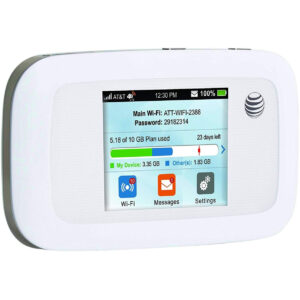
AT&T Velocity MF923
Swappable Cell Meets Legacy LTE
A compact Cat 4 LTE mobile hotspot featuring a swappable 2,800 mAh battery and on-device touchscreen management, tempered by legacy Micro-USB charging and thermal buildup during continuous tethering.

TP-Link Archer 8 Ultra
19 Gbps Speeds Demand Early Premium
Pioneering Wi-Fi 8 desktop router delivering 19 Gbps tri-band throughput and 10 Gbps wired connectivity, offset by early-adopter premiums and launch unavailability in the US.
Mizex Comparative Audit Verdict
5-Pillar Engineering Telemetry
Detailed comparison across standardized normalized 1.0 – 5.0 engineering pillars.
AT&T Velocity MF923 Review: Swappable Cell Meets Legacy LTE: Strengths & Caveats
- User-accessible, fully swappable 2,800 mAh lithium-ion battery
- Integrated 2.4-inch color capacitive touchscreen for on-device configuration
- Dual-band 2.4 GHz and 5 GHz Wi-Fi radio supporting up to 10 clients
- MicroSD card slot providing shared local network storage
- Susceptible to thermal accumulation and battery degradation when permanently tethered to AC power
- Outdated LTE Category 4 and Wi-Fi 4 standards without carrier aggregation or modern 5G support
- Legacy Micro-USB charging interface lacking modern USB-C durability and speed
TP-Link Archer 8 Ultra Review: 19 Gbps Speeds Demand Early Premium: Strengths & Caveats
- First consumer router to implement the next-generation Wi-Fi 8 (802.11bn) wireless standard
- Massive 19 Gbps aggregate wireless throughput supported by tri-band operation
- Clean monolithic enclosure housing an integrated array of 18 internal antennas
- High-bandwidth 10 Gbps wired network interface
- Unavailable in the US market at launch due to an ongoing FCC freeze and regulatory restrictions
- Full 19 Gbps wireless potential is currently gated by the absence of consumer Wi-Fi 8 client devices
- Unspecified port distribution for whether 10 Gbps wired connectivity spans both WAN and LAN or is limited to LAN
Technical Specification Comparison
Side-by-side spec alignment. Rows highlighted with subtle shading denote differing specifications.
| Specification | AT&T Velocity MF923 Review: Swappable Cell Meets Legacy LTE | TP-Link Archer 8 Ultra Review: 19 Gbps Speeds Demand Early Premium |
|---|---|---|
| Brand DIFF | AT&T | TP-Link |
| Model DIFF | Velocity MF923 | Archer 8 Ultra |
| Hardware Category DIFF | Mobile Wi-Fi Hotspot | — |
| Cellular Baseband DIFF | Qualcomm MDM9225 | — |
| Cellular Protocols DIFF | 4G LTE Category 4, 3G UMTS | — |
| LTE Bands DIFF | Bands 2, 4, 5, 17, 29 | — |
| Maximum Cellular Throughput DIFF | 150 Mbps download / 50 Mbps upload | — |
| Wi Fi Connectivity DIFF | Dual-Band Wi-Fi 4 (802.11b/g/n, 2.4 GHz / 5 GHz) | — |
| Maximum Connected Devices DIFF | 10 simultaneous clients | — |
| Display DIFF | 2.4 in (61 mm) color capacitive touchscreen (240 x 320 px) | — |
| Battery Type DIFF | Lithium-ion, removable | — |
| Battery Capacity DIFF | 2,800 mAh (3.8V) | — |
| Rated Battery Endurance DIFF | Up to 10 hours continuous operation | — |
| I/O & Charging Interface DIFF | Micro-USB 2.0 | — |
| Storage Expansion DIFF | MicroSD slot (supports up to 32 GB) | — |
| Enclosure Material DIFF | Polycarbonate | — |
| Dimensions DIFF | 4.5 x 2.5 x 0.7 in (114 x 63 x 17 mm) | — |
| Weight DIFF | 4.6 oz (130 g) | — |
| Model Number DIFF | — | BN19000 |
| Alternative Model Name DIFF | — | Archer BN800 |
| Device Category DIFF | — | Networking & Routers |
| Wireless Standard DIFF | — | Wi-Fi 8 (IEEE 802.11bn) |
| Frequency Bands DIFF | — | Tri-band |
| Aggregate Wireless Throughput DIFF | — | 19 Gbps |
| Antenna Configuration DIFF | — | 18 internal antennas |
| Wired Connectivity DIFF | — | 10 Gbps Ethernet |
| Form Factor DIFF | — | Desktop Router |
Need to evaluate a different configuration?
🔍 Compare Other Hardware