AMD EPYC 7303P vs BrainChip Akida AKD1500 M.2 Card
Standardized 5-pillar engineering audit, thermal telemetry, verified longevity metrics, and complete technical specification diff.
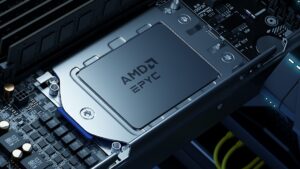
A balanced 16-core Milan server processor offering comprehensive 128-lane PCIe 4.0 I/O and 8-channel DDR4 memory in an efficient 130W package, limited primarily by single-socket exclusivity and a 64 MB L3 cache.
A breakthrough sub-watt neuromorphic edge AI accelerator that delivers efficient event-based inference and native on-chip learning in a compact, fanless M.2 2230 form factor.
Mizex Comparative Audit Verdict
5-Pillar Engineering Telemetry
Detailed comparison across standardized normalized 1.0 – 5.0 engineering pillars.
AMD EPYC 7303P: Strengths & Caveats
- Full complement of 128 PCIe 4.0 lanes and 8-channel Registered ECC DDR4 memory support on a single socket
- Efficient 130W TDP enables easy thermal integration in standard 1U and 2U rack enclosures
- 16 physical cores and 32 threads built on proven 7nm Zen 3 Milan architecture
- Hard-locked to single-socket (1P) operation with no multi-socket scalability
- Reduced aggregate L3 cache of 64 MB compared to 128 MB on higher-tier Milan processors
BrainChip Akida AKD1500 M.2 Card: Strengths & Caveats
- Ultra-low milliwatt power consumption (250 mW typical, < 300 mW peak) enabling fanless, heatsink-free deployment
- Event-based neuromorphic processing utilizes activation sparsity for exceptional energy efficiency (< 1 mW/GOPS)
- Hardware-native on-chip learning supports continuous model adaptation and personalization without cloud connectivity
- Standard M.2 2230 B+M Key PCIe interface provides seamless drop-in integration with Raspberry Pi 5 and embedded SBCs
- Proprietary MetaTF workflow requires model conversion and quantization, introducing a developer learning curve
- 1 MB on-chip memory requires strict model parameter budgeting and optimization
- Peak 800 GOPS throughput is tailored for sparse sensory, audio, and lightweight vision workloads rather than dense high-TOPS vision transformers
Technical Specification Comparison
Side-by-side spec alignment. Rows highlighted with subtle shading denote differing specifications.
| Specification | AMD EPYC 7303P | BrainChip Akida AKD1500 M.2 Card |
|---|---|---|
| Brand DIFF | AMD | BrainChip |
| Model DIFF | EPYC 7303P | Akida AKD1500 M.2 Card |
| Architecture DIFF | Milan (Zen 3) | Digital Event-Based Neuromorphic Neural Network Fabric |
| Process Node DIFF | 7 nm | 22nm FD-SOI CMOS |
| Socket DIFF | SP3 | — |
| Socket Scalability DIFF | 1P (Single-Socket Only) | — |
| Cores DIFF | 16 | — |
| Threads DIFF | 32 | — |
| Max Boost Clock DIFF | 3.4 GHz | — |
| L3 Cache DIFF | 64 MB | — |
| TDP DIFF | 130 W | — |
| Memory Type DIFF | DDR4 Registered ECC | — |
| Memory Channels DIFF | 8 | — |
| PCI Express Generation DIFF | PCIe 4.0 | — |
| PCI Express Lanes DIFF | 128 | — |
| AI Processor DIFF | — | BrainChip Akida AKD1500 Neuromorphic Co-Processor |
| Peak Performance DIFF | — | 800 Effective GOPS (INT4) |
| Energy Efficiency DIFF | — | < 1 mW / GOPS |
| Form Factor DIFF | — | M.2 2230 (B+M Key) |
| Host Interface DIFF | — | PCIe Gen2 x2 Endpoint / SPI / QSPI |
| On Chip SRAM DIFF | — | 1 MB Dual-Port High-Speed SRAM (100 KB per NPU) |
| On Chip Learning DIFF | — | Hardware-Native Adaptive / One-Shot Incremental Learning |
| Clock Frequency DIFF | — | 5 MHz – 400 MHz |
| Power Consumption (Typical) DIFF | — | 250 mW at 400 MHz (< 300 mW peak) |
| Standby / Sleep Power DIFF | — | < 1 mW (Power-Gated Deep Sleep: 37 µW) |
| Cooling Solution DIFF | — | Fanless / Passive Heatsink-Free Operation |
| Host Compatibility DIFF | — | x86-64 PCs, Raspberry Pi 5 / CM4 / CM5, ARM64 & RISC-V |
| Software Framework DIFF | — | BrainChip MetaTF (TensorFlow, Keras, PyTorch, QuantizeML, CNN2SNN) |
| Operating Temperature DIFF | — | 0°C to 70°C (Junction Rating: -40°C to 125°C) |
Need to evaluate a different configuration?
🔍 Compare Other Hardware