
- Full complement of 128 PCIe 4.0 lanes and 8-channel Registered ECC DDR4 memory support on a single socket
- Efficient 130W TDP enables easy thermal integration in standard 1U and 2U rack enclosures
- 16 physical cores and 32 threads built on proven 7nm Zen 3 Milan architecture
- Hard-locked to single-socket (1P) operation with no multi-socket scalability
- Reduced aggregate L3 cache of 64 MB compared to 128 MB on higher-tier Milan processors
Overview
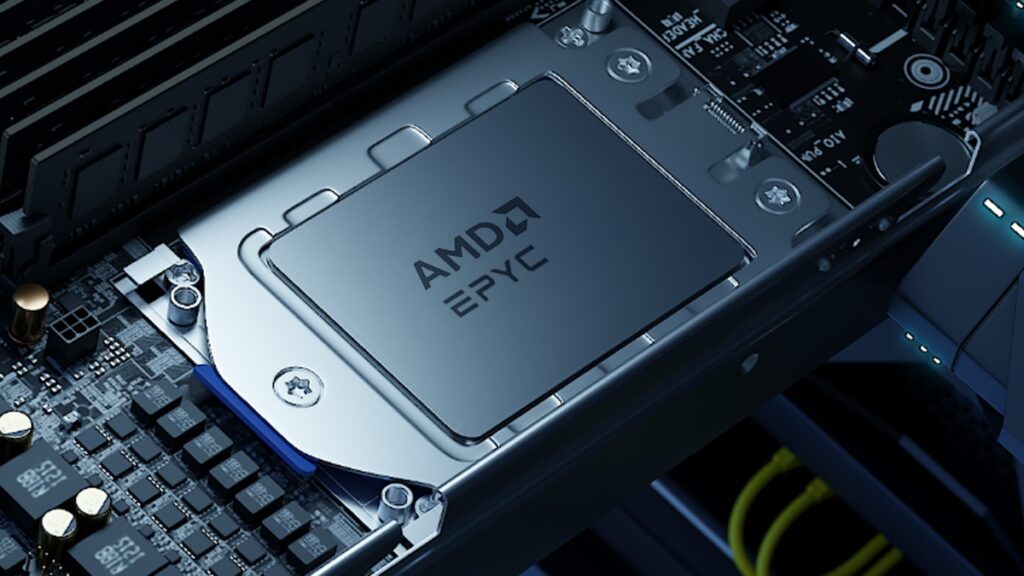
Fabricated on TSMC’s 7nm process, the Zen 3 Milan architecture routes 128 dedicated PCIe 4.0 lanes and eight memory channels through a unified server I/O die, establishing high platform throughput for dedicated single-socket deployments. With 16 physical cores and 32 threads operating at up to a 3.4 GHz boost clock, the compute topology pairs symmetric core complexes with an aggregate 64 MB of L3 cache. Packaging relies on the enterprise SP3 land grid array socket, featuring a high-density multi-chip module substrate capped by a structural nickel-plated copper integrated heat spreader that maintains planar mating force under heavy rackmount retention mechanisms.
Thermal dissipation is calibrated around a 130W thermal design power, enabling server integrators to cool the package effectively using passive heatsinks in standard 1U and 2U rack enclosures without demanding excessive chassis blower speeds. Real-world deployment stability benefits from comprehensive support for Registered ECC DDR4 memory and mature Milan platform microcode, ensuring deterministic execution across sustained 24/7 hypervisor, storage, or network appliances. While the 1P architectural lock prevents multi-socket expansion and the reduced 64 MB L3 cache represents a lower density than 128 MB Milan variants, the platform provides full enterprise bus width and uncompromised peripheral interconnects for targeted single-node infrastructure.
Technical Specifications
| Brand | AMD |
| Model | EPYC 7303P |
| Architecture | Milan (Zen 3) |
| Process Node | 7 nm |
| Socket | SP3 |
| Socket Scalability | 1P (Single-Socket Only) |
| Cores | 16 |
| Threads | 32 |
| Max Boost Clock | 3.4 GHz |
| L3 Cache | 64 MB |
| TDP | 130 W |
| Memory Type | DDR4 Registered ECC |
| Memory Channels | 8 |
| PCI Express Generation | PCIe 4.0 |
| PCI Express Lanes | 128 |
Primary Sources & Audited Citations
Recommended Alternatives in CPUs / Processors
At a Glance
How reliable is the AMD EPYC 7303P Review: Full Enterprise Bandwidth at 130W according to Mizex audits?
Ideal for dedicated single-socket virtualization, edge computing, and storage servers that demand full 128-lane PCIe 4.0 bandwidth and 8-channel ECC memory within a modest 130W power envelope.
What are the known quirks or drawbacks of the AMD EPYC 7303P Review: Full Enterprise Bandwidth at 130W?
Our reliability audit identified the following documented caveats:
- Hard-locked to single-socket (1P) operation with no multi-socket scalability
- Reduced aggregate L3 cache of 64 MB compared to 128 MB on higher-tier Milan processors
What are the key engineering highlights of the AMD EPYC 7303P Review: Full Enterprise Bandwidth at 130W?
The top strengths recorded in our evaluation include:
- Full complement of 128 PCIe 4.0 lanes and 8-channel Registered ECC DDR4 memory support on a single socket
- Efficient 130W TDP enables easy thermal integration in standard 1U and 2U rack enclosures
- 16 physical cores and 32 threads built on proven 7nm Zen 3 Milan architecture