
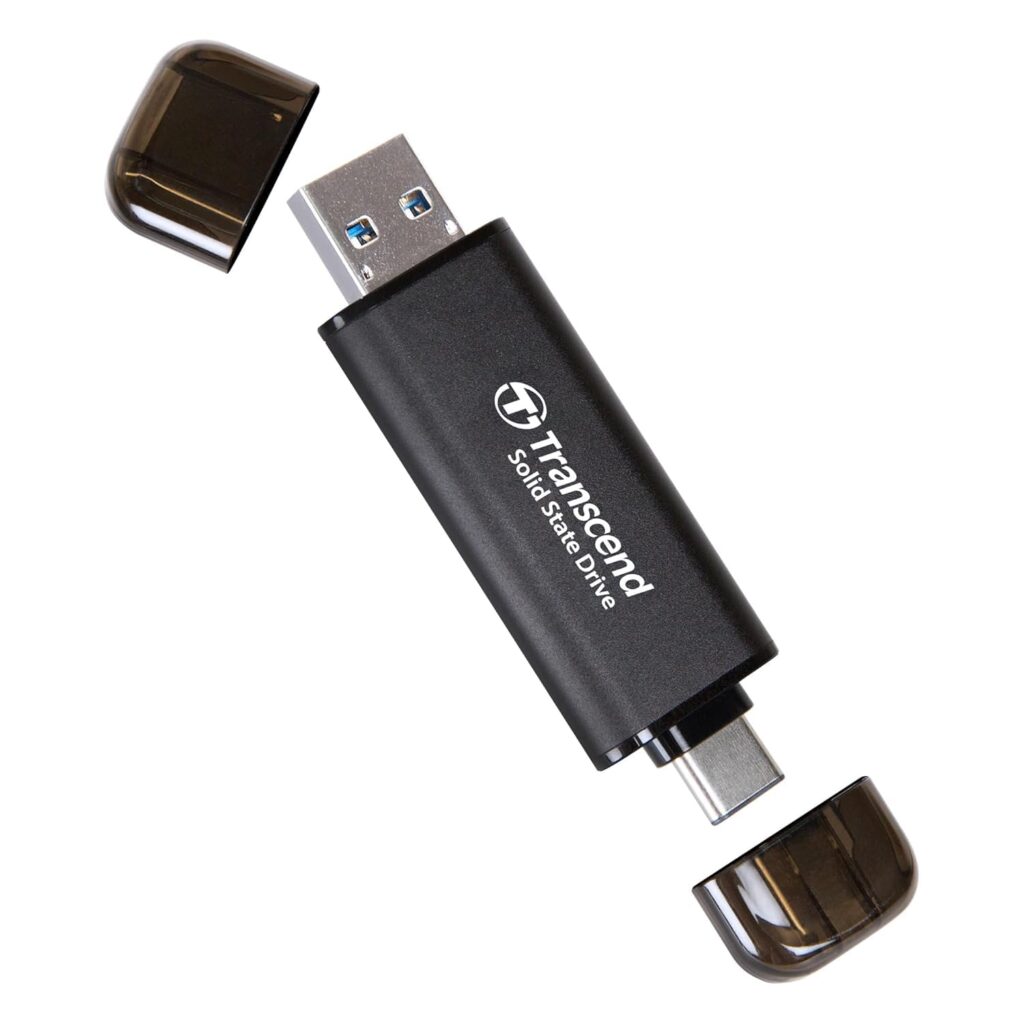
- Cable-free dual USB Type-A and USB Type-C connectors work across older desktops, modern laptops, consoles, and mobile gear
- Near-interface-limit sequential throughput hitting 1,024.53 MB/s read and 889.03 MB/s write in CrystalDiskMark
- Ultra-light 0.02 lb (9.1 g) thumb-drive footprint with ~73 GB pSLC cache and out-of-the-box exFAT formatting
- Sustained 70-100 GB transfers heat up the compact body and trigger temporary speed slowdowns
- Directional removable end caps only seat one way and are easy to lose
- Lacks native Lightning support without a separate adapter
Overview
Built-in USB Type-A and USB Type-C plugs eliminate adapter clutter on a 0.02 lb (9.1 g) thumb-drive body that slips into any pocket. Its out-of-the-box exFAT formatting lets this 256 GB (238 GiB) portable SSD shift smoothly between older desktops, USB-C laptops, consoles, and mobile devices with zero cables required. Removable protective caps shield both connectors during travel, though their single-orientation fit takes attention and makes them easy to misplace.
Over a USB 3.2 Gen 2×1 (10 Gbit/s) link, real-world throughput nearly matches Transcend’s 1,050 MB/s read and 900 MB/s write ratings. CrystalDiskMark SEQ1M Q8T1 testing logs 1,024.53 MB/s read and 889.03 MB/s write, while single-queue sequential transfers still hold 970.55 MB/s read and 858.04 MB/s write. Random 4K responsiveness lands at 30.48 MB/s read and 78.54 MB/s write at Q1T1, paired with snappy 0.052 ms read and 0.119 ms write access times in AS SSD. File copy workloads reflect that brisk burst behavior too, clearing ISO transfers at 578.85 MB/s and game folders at 444.40 MB/s.
That burst speed leans on an approximately 73 GB pSLC cache, which covers most daily project swaps without breaking stride. Push past that window with continuous 70-100 GB transfers, however, and the compact enclosure heats up noticeably and temporarily throttles speeds to manage thermals. Everyday operation remains straightforward and plug-and-play across major operating systems, just keep in mind that older Lightning-equipped devices still need an external adapter.
Technical Specifications
| Brand | Transcend |
| Model | ESD310 256GB |
| Model Number | TS256GESD310C |
| Capacity | 256 GB (238 GiB) |
| Interface | USB 3.2 Gen 2x1 (10 Gbit/s) |
| Connectors | Dual USB Type-A and USB Type-C |
| Form Factor | Cable-free thumb-drive portable SSD |
| Default File System | exFAT |
| Weight | 0.02 lb (9.1 g) |
| PSLC Cache Size | ~73 GB |
| Rated Sequential Read | 1,050 MB/s |
| Rated Sequential Write | 900 MB/s |
| CrystalDiskMark SEQ1M (Q8T1) | 1,024.53 MB/s read / 889.03 MB/s write |
| CrystalDiskMark RND4K (Q1T1) | 30.48 MB/s read / 78.54 MB/s write |
| AS SSD Sequential | 960.12 MB/s read / 841.38 MB/s write |
| AS SSD Access Time | 0.052 ms read / 0.119 ms write |
Primary Sources & Audited Citations
Recommended Alternatives in Storage (SSDs & HDDs)
At a Glance
How reliable is the Transcend ESD310 256GB according to Mizex audits?
Buy this if you want a pocketable, cable-free 256 GB drive for moving files between USB-A desktops, USB-C laptops, consoles, and phones; look at a larger-chassis portable SSD if you regularly dump 70-100 GB batches and want sustained speeds without thermal slowdowns.
What are the known quirks or drawbacks of the Transcend ESD310 256GB?
Our reliability audit identified the following documented caveats:
- Sustained 70-100 GB transfers heat up the compact body and trigger temporary speed slowdowns
- Directional removable end caps only seat one way and are easy to lose
- Lacks native Lightning support without a separate adapter
What are the key engineering highlights of the Transcend ESD310 256GB?
The top strengths recorded in our evaluation include:
- Cable-free dual USB Type-A and USB Type-C connectors work across older desktops, modern laptops, consoles, and mobile gear
- Near-interface-limit sequential throughput hitting 1,024.53 MB/s read and 889.03 MB/s write in CrystalDiskMark
- Ultra-light 0.02 lb (9.1 g) thumb-drive footprint with ~73 GB pSLC cache and out-of-the-box exFAT formatting