
- Apple M6 chip architecture features dedicated super cores, per-core neural accelerators, and up to 170 GB/s unified memory bandwidth.
- Sharp 4.5K Retina display delivers 500 nits brightness, wide P3 color, and optional Nano-texture anti-glare glass.
- Comprehensive wireless upgrade integrating Wi-Fi 7, Bluetooth 6.0, and Thread via the Apple N1 chip.
- Six-speaker sound system with force-cancelling woofers and studio-quality beamforming mic array.
- Base configuration is restricted to 256GB non-upgradable internal storage.
- Display refresh rate remains fixed at 60Hz without ProMotion high-refresh support.
- Four-port I/O, dual external monitor support, and Nano-texture glass are locked behind the 12-core tier.
Overview
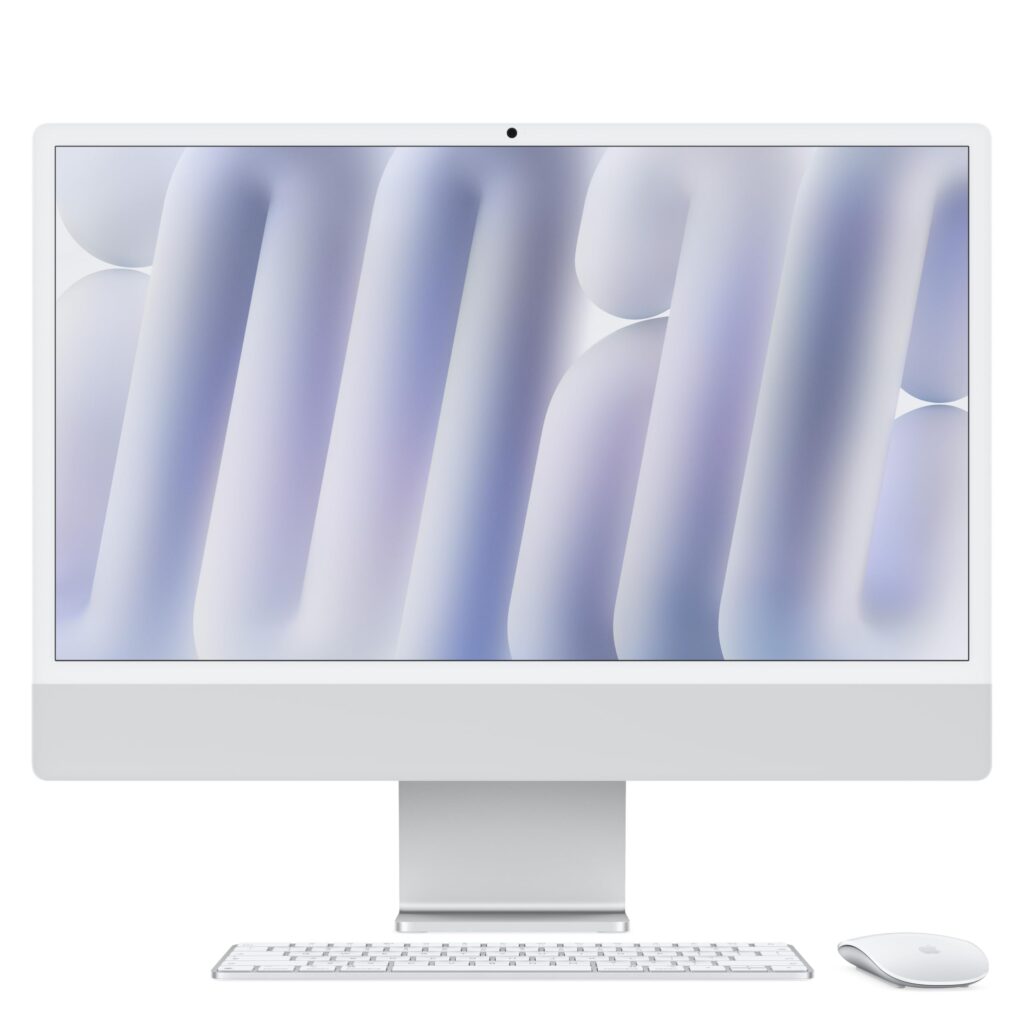
Integrating an entire high-performance personal computing environment into a razor-thin glass-and-aluminum slab remains one of modern industrial design’s most compelling executions. The 2026 iMac housing centers on a CNC-milled aluminum chassis that balances effortlessly on a smooth-gliding tilt hinge, eliminating desktop clutter through integrated power and display routing. Dominating the physical interaction is a vibrant 24-inch (23.5-inch viewable diagonal / 59.7 cm) 4.5K Retina IPS display operating at 4480 x 2520 resolution and 218 pixels per inch. Producing 500 nits of peak brightness with P3 wide color coverage, the screen renders text and creative assets with razor-sharp fidelity, while an optional anti-glare Nano-texture etched glass finish on top-tier configurations significantly curbs distracting office reflections without degrading contrast.
Internal computation shifts forward with the M6 processor architecture, configured in either 10-core or 12-core silicon layouts that marry dedicated super cores, performance cores, and high-efficiency cores with integrated ray-tracing GPU blocks and per-core neural acceleration. Bolstered by a dual 16-core Neural Engine and memory bandwidth reaching up to 170 GB/s, everyday responsiveness across macOS 27 is immediate, fluid, and predictable. Because the system-on-chip operates with exemplary thermal efficiency, the internal cooling assembly maintains an imperceptible acoustic presence during standard office productivity and multimedia playback. Even when sustained workloads spin the blower fans, the acoustic tone remains low-frequency and unobtrusive, aided by six internal force-cancelling woofers that mitigate internal chassis resonance and deliver rich spatial audio without rattling the slim aluminum enclosure.
Peripheral expansion and wireless communication receive substantial engineering updates through the Apple N1 chip, delivering native Wi-Fi 7, Bluetooth 6.0, and Thread protocol integration. Apple maintains an industry-leading firmware release cycle with routine security updates and tight operating system synchronization over a multi-year horizon. Practical desktop realities, however, surface notable constraints. Entry-level models pair their capable processors with a restrictive 256GB solid-state drive and two Thunderbolt 4 ports, while dual external display support and expanded four-port I/O are gated behind the 12-core tier. Furthermore, unified memory and storage remain entirely soldered to the main logic board, meaning prospective buyers must configure adequate memory and storage thresholds at purchase to ensure long-term viability.
Technical Specifications
| Brand | Apple |
| Model | 2026 iMac M6 |
| Processor | Apple M6 chip (10-core or 12-core CPU with super cores, performance cores, and efficiency cores) |
| Graphics | 10-core or 12-core GPU with hardware-accelerated ray tracing and per-core Neural Accelerators |
| Neural Engine | Dual 16-core Neural Engine |
| Memory Bandwidth | Up to 170 GB/s |
| Unified Memory | 16GB (configurable to 24GB or 32GB) |
| Internal Storage | 256GB SSD (configurable to 512GB, 1TB, or 2TB) |
| Display Size | 24-inch (23.5-inch diagonal / 59.7 cm viewable) |
| Display Panel | Retina IPS display with True Tone technology |
| Display Resolution | 4480 x 2520 (4.5K) at 218 ppi |
| Display Brightness | 500 nits |
| Display Refresh Rate | 60Hz |
| Color Gamut | Wide color (P3), 1 billion colors |
| Display Glass | Standard glass (optional Nano-texture glass on 12-core model) |
| Camera | 12MP Center Stage camera with Desk View and 1080p HD video |
| Audio System | Six-speaker system with force-cancelling woofers; three-mic array with beamforming |
| Wireless Connectivity | Wi-Fi 7, Bluetooth 6.0, Thread (Apple N1 wireless chip) |
| Wired Networking | Optional 2.5 Gigabit Ethernet |
| Port Selection | 2x Thunderbolt 4 / USB 4 (10-core) or 4x Thunderbolt 4 / USB 4 (12-core), 3.5mm audio jack |
| External Display Support | 10-core: Single external display up to 6K at 60Hz or 4K at 165Hz; 12-core: Up to two displays up to 6K at 60Hz or 4K at 165Hz |
| Operating System | macOS 27 |
| Finish Options | Blue, Green, Pink, Yellow, Purple, Orange, Silver |
Primary Sources & Audited Citations
Recommended Alternatives in Desktops & Prebuilts
At a Glance
How reliable is the Apple 2026 iMac M6 according to Mizex audits?
An exceptional all-in-one workstation for creative workflows and everyday desktop use, though power users should bypass the base 256GB model in favor of the 12-core tier for expanded I/O and dual external display support.
What are the known quirks or drawbacks of the Apple 2026 iMac M6?
Our reliability audit identified the following documented caveats:
- Base configuration is restricted to 256GB non-upgradable internal storage.
- Display refresh rate remains fixed at 60Hz without ProMotion high-refresh support.
- Four-port I/O, dual external monitor support, and Nano-texture glass are locked behind the 12-core tier.
What are the key engineering highlights of the Apple 2026 iMac M6?
The top strengths recorded in our evaluation include:
- Apple M6 chip architecture features dedicated super cores, per-core neural accelerators, and up to 170 GB/s unified memory bandwidth.
- Sharp 4.5K Retina display delivers 500 nits brightness, wide P3 color, and optional Nano-texture anti-glare glass.
- Comprehensive wireless upgrade integrating Wi-Fi 7, Bluetooth 6.0, and Thread via the Apple N1 chip.
- Six-speaker sound system with force-cancelling woofers and studio-quality beamforming mic array.