
- Massive 192 GB LPDDR5x-8533 unified memory enabling high-capacity local AI model execution
- 16-core Zen 5 AMD Ryzen AI Max+ PRO 495 processor boosting up to 5.2 GHz with 64 MB L3 cache
- Configurable thermal design power scaling from 55 W up to 120 W for peak sustained performance
- Out-of-the-box Linux workstation deployment with native Fedora 44 KDE Plasma Edition support
- Unified LPDDR5x memory architecture is non-socketed and soldered, precluding post-purchase RAM capacity upgrades
- Active acoustic levels and peak operating thermals under the 120 W configurable TDP limit are pending retail lab telemetry
Overview
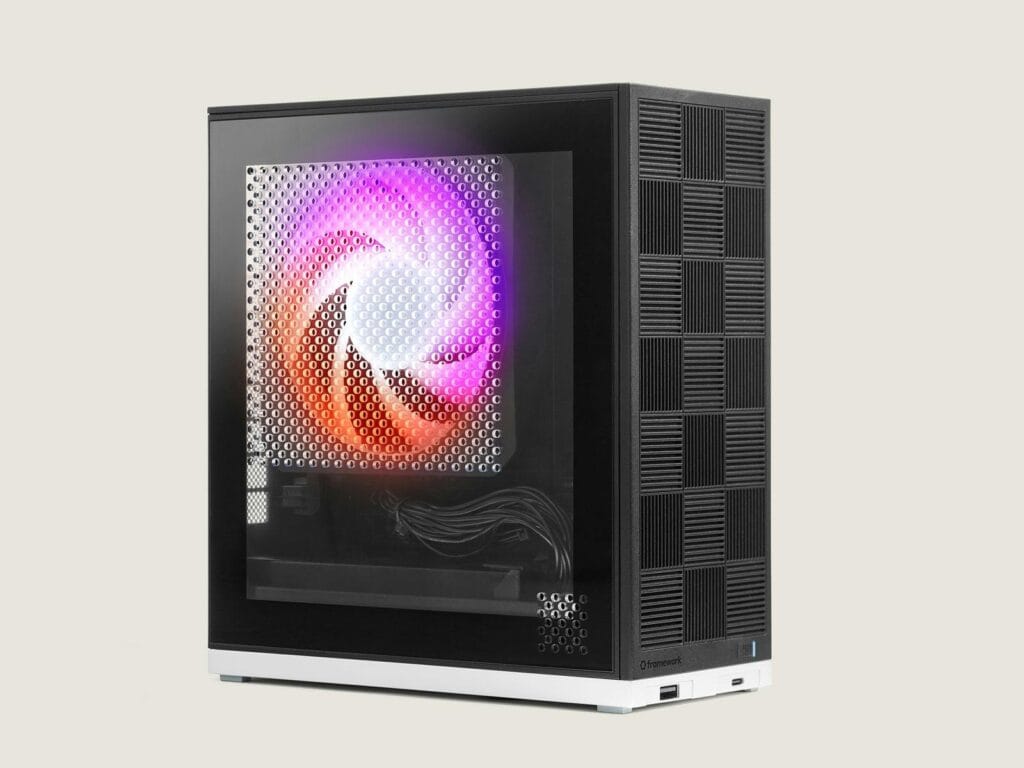
The Framework Desktop (AMD Ryzen AI Max+ PRO 495) delivers a high-density workstation platform engineered around AMD’s Zen 5 Gorgon Halo silicon. Integrating 16 high-performance CPU cores with a maximum boost frequency of 5.2 GHz and 64 MB of L3 cache, the system pairs multi-threaded compute with an integrated AMD Radeon 8065S graphics engine. Its architectural cornerstone is an expansive 192 GB pool of unified LPDDR5x-8533 memory, creating a consolidated high-bandwidth memory fabric specifically optimized for local artificial intelligence model inference and large-scale workstation workflows.
Available in both modular DIY Edition and pre-assembled configurations, the system is designed around Framework’s open-access desktop enclosure. While the exterior chassis maintains standard desktop form-factor access, comprehensive physical evaluation of internal dampening materials and chassis tolerances remains pending retail physical teardown. Power delivery supports a configurable thermal design power ranging from a 55 W baseline up to 120 W for sustained compute tasks, though empirical operating temperatures and load acoustic noise profiles await comprehensive lab verification once production retail units arrive.
Software integration is anchored by Fedora 44 KDE Plasma Edition as the native operating system, providing first-party Linux kernel support for the modern AMD platform, driver stacks, and integrated memory management. With 2 TB of NVMe SSD storage complementing the massive unified memory subsystem, the Framework Desktop establishes an ambitious desktop workstation architecture for software developers and AI practitioners seeking modular hardware flexibility with out-of-the-box open-source deployment.
Technical Specifications
| Brand | Framework |
| Model | Desktop (AMD Ryzen AI Max+ PRO 495) |
| Processor | AMD Ryzen AI Max+ PRO 495 |
| Codename | Gorgon Halo |
| CPU Architecture | Zen 5 |
| CPU Cores | 16 |
| Boost Clock | Up to 5.2 GHz |
| L3 Cache | 64 MB |
| Base TDP | 55 W |
| Configurable TDP | Up to 120 W |
| Integrated Graphics | AMD Radeon 8065S Graphics |
| Memory Capacity | 192 GB |
| Memory Type | LPDDR5x-8533 |
| Storage | 2 TB NVMe SSD |
| Operating System | Fedora 44 KDE Plasma Edition |
| Available Editions | DIY Edition, Pre-built |
Primary Sources & Audited Citations
Recommended Alternatives in Desktops & Prebuilts


At a Glance
How reliable is the Framework Desktop (AMD Ryzen AI Max+ PRO 495) Review: Modular Architecture Tuned for Local Inference according to Mizex audits?
A cutting-edge modular desktop offering unmatched 192 GB unified memory for local AI development, ideal for engineers who value open Linux integration and high-density compute.
What are the known quirks or drawbacks of the Framework Desktop (AMD Ryzen AI Max+ PRO 495) Review: Modular Architecture Tuned for Local Inference?
Our reliability audit identified the following documented caveats:
- Unified LPDDR5x memory architecture is non-socketed and soldered, precluding post-purchase RAM capacity upgrades
- Active acoustic levels and peak operating thermals under the 120 W configurable TDP limit are pending retail lab telemetry
What are the key engineering highlights of the Framework Desktop (AMD Ryzen AI Max+ PRO 495) Review: Modular Architecture Tuned for Local Inference?
The top strengths recorded in our evaluation include:
- Massive 192 GB LPDDR5x-8533 unified memory enabling high-capacity local AI model execution
- 16-core Zen 5 AMD Ryzen AI Max+ PRO 495 processor boosting up to 5.2 GHz with 64 MB L3 cache
- Configurable thermal design power scaling from 55 W up to 120 W for peak sustained performance
- Out-of-the-box Linux workstation deployment with native Fedora 44 KDE Plasma Edition support