
- Rated for up to 14,900 MB/s sequential reads and 14,000 MB/s sequential writes on the 2TB model
- High 4K random performance reaching 2,300,000 read IOPS and 2,400,000 write IOPS
- 6nm Silicon Motion SM2508 controller with smart clock-gating holds average power draw to 7W
- Pairs BiCS8 TLC 3D CBA NAND and onboard DRAM with an included passive heatsink
- PCIe Gen5 operation still requires adequate heatsink cooling to prevent thermal throttling
- Dual Western Digital (WD_BLACK) and SanDisk branding can cause model-naming confusion
Overview
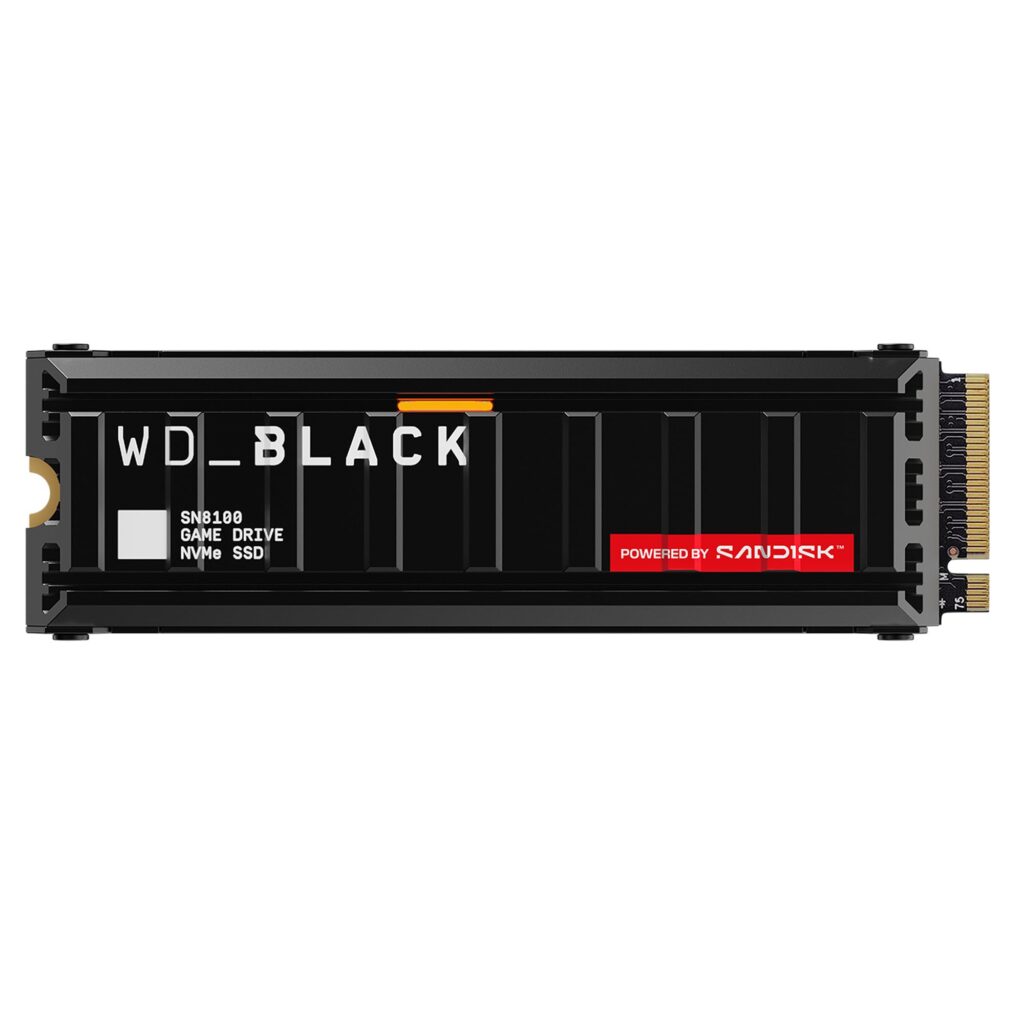
Early PCIe 5.0 solid-state drives pushed transfer speeds past 10 GB/s at the cost of heavy power draw and demanding cooling hardware. Built around a 6nm Silicon Motion SM2508 controller tuned by SanDisk, the WD_BLACK SN8100 2TB hits up to 14,900 MB/s sequential reads and 14,000 MB/s sequential writes while holding rated average power consumption to 7W. It brings that PCIe 5.0 x4 and NVMe 2.0 bandwidth to a standard M.2 2280 (0.87 x 3.15 in / 22 x 80 mm) footprint without requiring aggressive power delivery.
Under the hood, the quad-core ARM Cortex R8 controller drives eight NAND channels at up to 3,600 MT/s per channel, paired with BiCS8 TLC 3D CBA NAND and dedicated onboard DRAM. Combining dedicated DRAM with nCache 4.0 SLC caching and Silicon Motion’s NANDXtend ECC keeps random 4K responsiveness sharp at up to 2,300,000 read IOPS and 2,400,000 write IOPS. Smart clock-gating inside the 6nm silicon also trims unnecessary power burn when the bus is lightly loaded, giving heavy creative scratch workloads and large asset transfers steady headroom.
To keep that Gen5 controller from throttling during sustained transfers, this variant ships with a passive heatsink mounted over the M.2 package. Even at 7W average power, PCIe 5.0 speeds still require adequate heatsink cooling to avoid thermal throttling, so having a factory thermal solution out of the box removes guesswork on boards with bare M.2 slots—as long as you have clearance for a pre-installed heatsink rather than a slim laptop bay. One minor wrinkle for shoppers is the split Western Digital WD_BLACK and SanDisk branding following the flash business spin-out, which can muddy retail listings even though the underlying hardware remains the same.
Technical Specifications
| Brand | Western Digital |
| Model | WD_Black SN8100 2TB NVMe SSD with Heatsink |
| Capacity | 2TB |
| Form Factor | M.2 2280 (0.87 x 3.15 in / 22 x 80 mm) |
| Interface | PCIe 5.0 (Gen5) x4, NVMe 2.0 |
| Controller | SanDisk-tuned Silicon Motion SM2508 (6nm, quad-core ARM Cortex R8, 8-channel, up to 3,600 MT/s per channel) |
| NAND Flash | BiCS8 TLC 3D CBA NAND |
| Cache | Onboard DRAM with nCache 4.0 SLC cache |
| Error Correction | Silicon Motion NANDXtend ECC |
| Cooling | Included passive heatsink |
| Sequential Read | Up to 14,900 MB/s (14.9 GB/s) |
| Sequential Write | Up to 14,000 MB/s (14.0 GB/s) |
| Random Read (4K) | Up to 2,300,000 IOPS |
| Random Write (4K) | Up to 2,400,000 IOPS |
| Average Power Draw | 7W |
Primary Sources & Audited Citations
Recommended Alternatives in Storage (SSDs & HDDs)
At a Glance
How reliable is the Western Digital WD_Black SN8100 2TB NVMe SSD with Heatsink according to Mizex audits?
Buy this if you have a desktop with a PCIe 5.0 M.2 slot and heavy creative or scratch-disk workloads that push 14,900 MB/s throughput; look at a standard PCIe 4.0 SSD if you only need everyday gaming storage or a bare drive for a thin laptop.
What are the known quirks or drawbacks of the Western Digital WD_Black SN8100 2TB NVMe SSD with Heatsink?
Our reliability audit identified the following documented caveats:
- PCIe Gen5 operation still requires adequate heatsink cooling to prevent thermal throttling
- Dual Western Digital (WD_BLACK) and SanDisk branding can cause model-naming confusion
What are the key engineering highlights of the Western Digital WD_Black SN8100 2TB NVMe SSD with Heatsink?
The top strengths recorded in our evaluation include:
- Rated for up to 14,900 MB/s sequential reads and 14,000 MB/s sequential writes on the 2TB model
- High 4K random performance reaching 2,300,000 read IOPS and 2,400,000 write IOPS
- 6nm Silicon Motion SM2508 controller with smart clock-gating holds average power draw to 7W
- Pairs BiCS8 TLC 3D CBA NAND and onboard DRAM with an included passive heatsink