
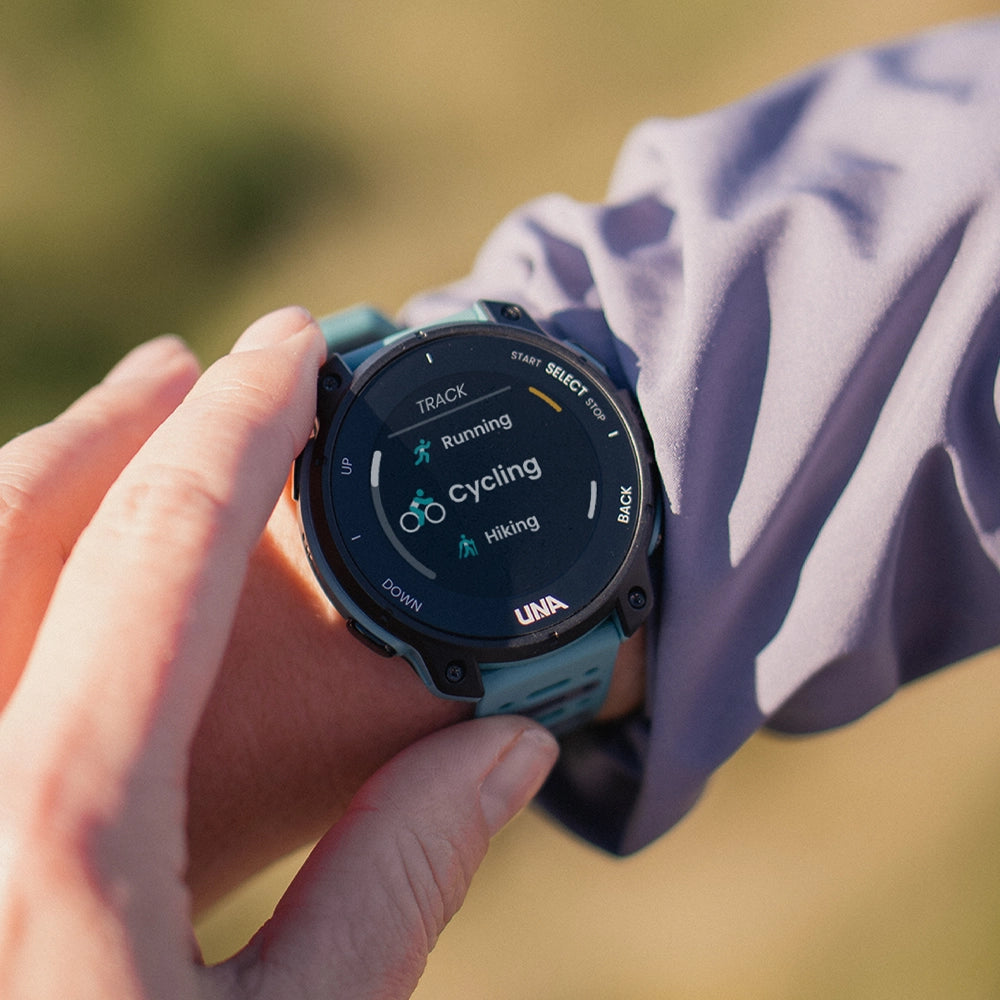
- 6-module architecture enables tool-friendly replacement and upgrades for the battery, display, and sensor boards
- Open-source SDK, HDK, PCBs, and housing files support custom apps and 3D-printed accessories
- Dual-frequency (L1/L5) multi-constellation GNSS and full fitness sensor suite in a low-power platform
- Up to 10-day battery life (20 hours GPS) with direct USB-C charging instead of proprietary cables
- IPX5 splash-only water resistance and bulky 0.59 in (15 mm) polycarbonate case preclude swimming
- Non-touch MIP display has fixed, non-adjustable backlight brightness
- Early firmware and app quirks cause BLE sync drops, ~10-minute updates, and missing notification filtering
Overview
Most fitness watches treat a worn-out battery as a disposable end-of-life event, yet UNA takes the opposite path with a six-module chassis you can open and upgrade using standard tools. Inside the 1.57 in (40 mm) polycarbonate housing, separate boards for the ARM Cortex-M33 processor, 1.2-inch (30.5 mm) Memory-in-Pixel display, wireless radio, sensors, body, and hard-shell 280 mAh battery slot together cleanly without glue traps. Beyond part swaps, UNA publishes its SDK, hardware development kit, circuit boards, and mechanical housing files as open-source, letting tinkerers write custom software or 3D-print bespoke accessories. On the silicon side, the low-power microcontroller pairs 2.5 MB of RAM and 4 GB of eMMC storage with a dual-frequency L1/L5 GNSS receiver covering GPS, GLONASS, Galileo, BeiDou, NavIC, and QZSS alongside optical heart rate, SpO2, a barometric altimeter, a 6-axis IMU, and a 3-axis compass.
Living with a modular wrist computer brings clear physical compromises alongside its repairable internals. Stacking six replaceable components yields a chunky 0.59 in (15 mm) profile with a 1.58 in (40.25 mm) bezel, and the chassis carries an IPX5 rating that handles rain and sweat while ruling out swimming or submersion. Navigation relies strictly on physical buttons beneath a hardened mineral glass lens, skipping touch input in favor of a 240 x 240 pixel MIP screen whose LED backlight stays at a fixed, non-adjustable brightness. Because the Cortex-M33 platform and reflective MIP panel sip minimal power, the watch runs cool on the wrist while stretching its 280 mAh cell up to 10 days in daily wear or 20 hours under continuous GPS tracking, pairing a haptic motor and piezo sounder for alerts with a direct USB-C port that frees you from proprietary magnetic pucks.
Day-to-day software polish lags behind the hardware ambition, with several vendor-acknowledged quirks shaping the ownership experience. Bluetooth Low Energy 5.2 syncing can stall and force you to forget the watch in phone settings, restart the app, or hold the Select button for 20 to 30 seconds to trigger a hard reboot. Over-the-air firmware updates take roughly 10 minutes and can leave features incomplete if the companion app closes or drops connection mid-transfer, while going more than seven days without syncing lets GPS assistance data expire and slows satellite locks. Notification filtering is still on UNA’s development roadmap, and repeated cable reconnects or unstable power supplies can trip a USB-C cable check prompt, making this far better suited to patient tinkerers than buyers expecting turnkey smartwatch convenience.
Technical Specifications
| Model | Una Watch |
| Processor | Ultra-low power ARM Cortex-M33 microcontroller |
| Memory & Storage | 2.5 MB RAM, 4 GB eMMC |
| Display | 1.2-inch (30.5 mm) Memory-in-Pixel (MIP) LCD, 240 x 240 px, fixed LED backlight, hardened mineral glass (non-touch) |
| Dimensions | 1.57 in case diameter x 0.59 in thickness (40 x 15 mm); 1.58 in (40.25 mm) bezel diameter |
| Chassis & Controls | Polycarbonate case, physical buttons, 6-module user-replaceable architecture |
| Battery & Charging | 280 mAh hard-shell user-replaceable battery, direct USB-C port |
| Rated Battery Life | Up to 10 days typical use; up to 20 hours full GPS mode |
| Wireless & GNSS | Bluetooth Low Energy 5.2 co-processor; dual-frequency (L1 & L5) GPS, GLONASS, Galileo, BeiDou, NavIC, QZSS |
| Sensors | Optical heart rate & SpO2, barometric altimeter, 6-axis accelerometer/gyroscope, 3-axis magnetometer |
| Alerts & Haptics | Haptic vibration motor, piezo sounder |
| Water Resistance | IPX5 (splash-resistant; not swim-rated) |
| Open Ecosystem | Open-source SDK, HDK, circuit boards, and mechanical housing |
Primary Sources & Audited Citations
- UNA Watch Complete Specifications – UNA Watch
- Troubleshooting Your UNA Watch – UNA Watch
- This $199 GPS sports watch is repairable, modular, and open-source | The Verge
- What I Love (and What I Don't) About the New Una Fitness Watch | Lifehacker
- Modular Smartwatches: Is the UNA Watch Worth Buying? - Geeky Gadgets
- UNA Modular GPS Watch: Repairable, Upgradable, Sustainable
Recommended Alternatives in Wearables & Smartwatches
At a Glance
How reliable is the Una Watch according to Mizex audits?
Buy this if you want a repairable, hackable GPS tracker with direct USB-C charging and multi-day endurance; skip it for a mainstream Garmin or Coros fitness watch if you want a polished companion app and hassle-free daily syncing.
What are the known quirks or drawbacks of the Una Watch?
Our reliability audit identified the following documented caveats:
- IPX5 splash-only water resistance and bulky 0.59 in (15 mm) polycarbonate case preclude swimming
- Non-touch MIP display has fixed, non-adjustable backlight brightness
- Early firmware and app quirks cause BLE sync drops, ~10-minute updates, and missing notification filtering
What are the key engineering highlights of the Una Watch?
The top strengths recorded in our evaluation include:
- 6-module architecture enables tool-friendly replacement and upgrades for the battery, display, and sensor boards
- Open-source SDK, HDK, PCBs, and housing files support custom apps and 3D-printed accessories
- Dual-frequency (L1/L5) multi-constellation GNSS and full fitness sensor suite in a low-power platform
- Up to 10-day battery life (20 hours GPS) with direct USB-C charging instead of proprietary cables