
- Accommodates two independent Micro-ATX systems within a unified dual-chamber footprint
- Native tray cutouts for ASUS BTF, MSI Project Zero, and GIGABYTE Project Stealth back-connect motherboards
- Fully independent dual I/O arrays each offering 10 Gbps USB 3.2 Gen 2 Type-C, dual USB 3.0 Type-A, and dedicated power controls
- Extensive component clearance supporting 16.54 in (420 mm) GPUs and radiators alongside 7.09 in (180 mm) CPU coolers
- Managing heat dissipation and exhaust airflow for two concurrent systems demands disciplined fan configuration
- Increased overall chassis footprint and routing density compared to standard single-system Micro-ATX enclosures
Overview
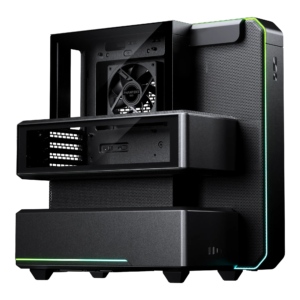
Stacking two complete Micro-ATX computing environments within a unified footprint, the chassis reconfigures multi-system desk layouts through a dual-tier internal chamber framed by twin 0.16 in (4 mm) curved tempered glass panels. Rather than requiring distinct enclosures for streaming, virtualization, or secondary compute tasks, the structural architecture provides dedicated motherboard mounting trays capable of hosting two independent Micro-ATX boards simultaneously. The frame integrates precision cutouts tailored for reverse-connector motherboard standards—specifically ASUS BTF, MSI Project Zero, and GIGABYTE Project Stealth—routing cabling behind the motherboard trays to eliminate front-compartment wiring obstructions and maintain clean display presentation through the curved glass.
Cooling accommodation spans massive component clearances, supporting liquid cooling radiators up to 16.54 in (420 mm), CPU tower heatsinks up to 7.09 in (180 mm) in height, and discrete graphics cards measuring up to 16.54 in (420 mm) in length. Thermal dissipation across both upper and lower system chambers relies on perimeter ventilation paths designed to evacuate heat generated by two concurrent computing loads without thermal cross-bleed. The mechanical enclosure isolates the physical interfaces of each node through completely segregated external I/O clusters: the upper node connects via a top-right panel hosting a 10 Gbps USB 3.2 Gen 2 Type-C port, dual USB 3.0 Type-A ports, HD audio jacks, and dedicated tactile power and reset switches, while the lower node is independently serviced by an identical complement along the front-bottom frame.
In day-to-day deployment, this dual-node isolation ensures zero operational interference between systems, allowing either system to be powered, reset, or serviced without disturbing the adjacent machine. The absence of shared proprietary circuit boards or unified fan hubs preserves pure hardware modularity, ensuring long-term serviceability using off-the-shelf standard power supplies and cooling hardware. For system builders seeking high-density workstation or dual-PC streaming setups, the physical architecture successfully reconciles expansive component clearance and modern back-connect cable management within an organized dual-chamber envelope.
Technical Specifications
| Brand | Thermaltake |
| Model | Capo X |
| Model Number | CA-12D-00S1WN-00 |
| Form Factor | Dual System Micro Chassis |
| Motherboard Support | Up to 2x Micro-ATX (M-ATX) |
| Hidden Connector Compatibility | ASUS BTF, MSI Project Zero, GIGABYTE Project Stealth |
| Side Panel Material | 0.16 in (4 mm) curved tempered glass |
| Max Gpu Length | 16.54 in (420 mm) |
| Max Cpu Cooler Height | 7.09 in (180 mm) |
| Radiator Support | Up to 16.54 in (420 mm) |
| Top System Io | 1x USB 3.2 Gen 2 Type-C, 2x USB 3.0 Type-A, HD Audio, Power Button, Reset Button |
| Bottom System Io | 1x USB 3.2 Gen 2 Type-C, 2x USB 3.0 Type-A, HD Audio, Power Button, Reset Button |
Primary Sources & Audited Citations
Recommended Alternatives in PC Cases
At a Glance
How reliable is the Thermaltake Capo X Review: Dual-Node Density with Back-Connect Routing according to Mizex audits?
An exceptional choice for streamers and homelab builders needing to consolidate two independent Micro-ATX systems with back-connect motherboards into a single showcase-ready enclosure.
What are the known quirks or drawbacks of the Thermaltake Capo X Review: Dual-Node Density with Back-Connect Routing?
Our reliability audit identified the following documented caveats:
- Managing heat dissipation and exhaust airflow for two concurrent systems demands disciplined fan configuration
- Increased overall chassis footprint and routing density compared to standard single-system Micro-ATX enclosures
What are the key engineering highlights of the Thermaltake Capo X Review: Dual-Node Density with Back-Connect Routing?
The top strengths recorded in our evaluation include:
- Accommodates two independent Micro-ATX systems within a unified dual-chamber footprint
- Native tray cutouts for ASUS BTF, MSI Project Zero, and GIGABYTE Project Stealth back-connect motherboards
- Fully independent dual I/O arrays each offering 10 Gbps USB 3.2 Gen 2 Type-C, dual USB 3.0 Type-A, and dedicated power controls
- Extensive component clearance supporting 16.54 in (420 mm) GPUs and radiators alongside 7.09 in (180 mm) CPU coolers