
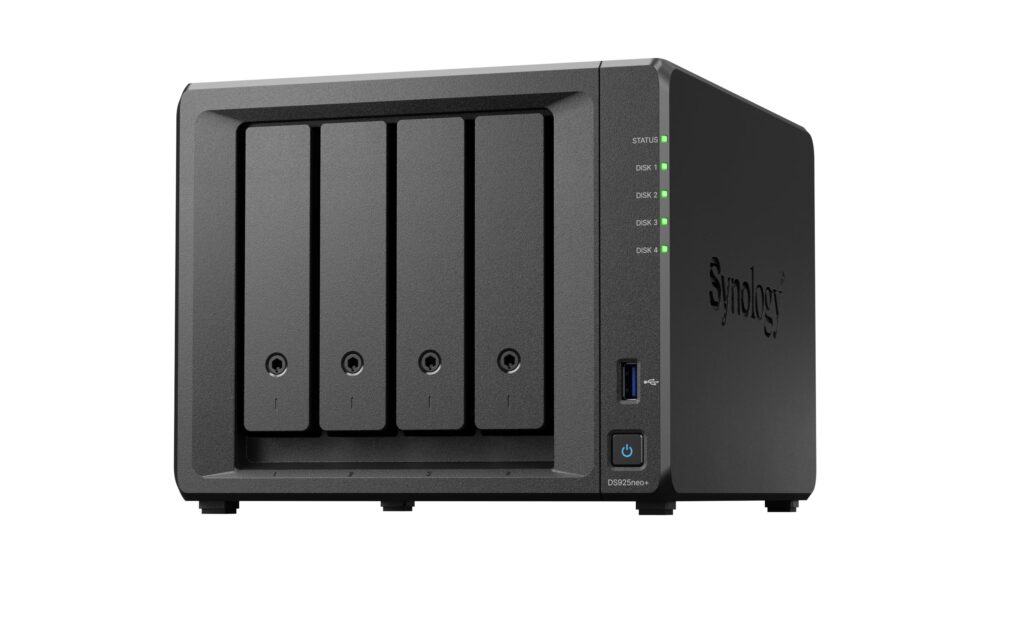
- Rigid metal chassis featuring four hot-swappable, tool-less drive trays
- Dual 2.5GbE network interfaces delivering multi-gigabit throughput out of the box
- Dedicated dual M.2 NVMe slots supporting both SSD caching and storage pools without occupying drive bays
- Scalable storage capacity supporting up to nine total drive bays via the DX525 expansion unit
- Ships with factory 4 GB non-ECC memory that must be completely removed when upgrading to ECC modules
- Lacks a PCIe expansion slot for future 10GbE or 25GbE network adapter upgrades
Overview
Bridging the divide between entry-level backup boxes and high-throughput homelab servers, this four-bay desktop storage solution centers its hardware foundation on dual 2.5GbE networking and an x86-based AMD Ryzen V1500B processor. The computing core provides steady multi-threaded execution for multi-client file synchronization, containerized workloads, and continuous snapshotting under Synology Hybrid RAID. Tool-less, hot-swappable drive trays facilitate swift maintenance and drive swaps without disassembling the enclosure. Internal storage architecture is further bolstered by dual M.2 NVMe slots, enabling high-speed read/write caching or independent all-flash storage pools without sacrificing any of the four primary mechanical drive positions. When local storage requirements outgrow the base chassis, an external expansion interface allows pairing with a DX525 expansion unit to scale capacity across nine total bays.
Physical construction relies on a rigid metal chassis designed to maintain structural alignment and isolate drive vibrations during continuous multi-drive operations. Dual rear cooling fans exhaust heat directly through the chassis, drawing ambient air across the drive sleds and passive internal heatsinks to prevent thermal throttling under heavy rebuild workloads. While active airflow keeps internal drive temperatures regulated, acoustic output remains unobtrusive in open office environments, governed by dynamic fan profiles managed by DiskStation Manager. The enclosure omits traditional PCIe expansion slots, establishing dual 2.5GbE connectivity as the permanent networking ceiling, which simplifies internal board layout and thermal dissipation at the expense of future 10GbE modularity.
Memory flexibility and operational software provide long-term reliability with an important caveat regarding memory upgrades. The system board supports memory expansion up to 32 GB of DDR4, including optional ECC SODIMMs for environments requiring bit-flip error protection. However, because the factory ships the unit populated with a 4 GB non-ECC module and memory controllers prohibit mixing ECC and non-ECC memory, upgrading to an error-correcting configuration requires completely replacing rather than augmenting the pre-installed RAM. Operating on Synology DiskStation Manager, the platform delivers mature firmware maintenance, comprehensive data protection tools like the Active Backup Suite, and automated system telemetry that ensure predictable data integrity across prolonged production lifespans.
Technical Specifications
| Brand | Synology |
| Model | DiskStation DS925neo+ |
| Processor | AMD Ryzen V1500B |
| CPU Architecture | x86_64 |
| System Memory Installed | 4 GB DDR4 non-ECC SODIMM |
| Maximum Memory Capacity | 32 GB |
| Memory Support | Supports DDR4 ECC SODIMM (mixing ECC and non-ECC modules not supported) |
| Drive Bays | 4 |
| Drive Tray Type | Tool-less, hot-swappable |
| Maximum Drive Bays With Expansion | 9 |
| Expansion Unit Support | Synology DX525 |
| M.2 NVMe Slots | 2 |
| M.2 Slot Functionality | SSD caching and dedicated storage pools |
| Networking Interfaces | 2x 2.5GbE (RJ-45) |
| Chassis Material | Metal |
| Operating System | Synology DiskStation Manager (DSM) |
| Storage Pool Technologies | Synology Hybrid RAID (SHR) |
Primary Sources & Audited Citations
- Synology Introduces DiskStation neo+ Series Lineup Press Release
- CloudZat: Synology DS925neo+ Review & Architectural Analysis
- Latest in Tech: Synology DS925neo+ NAS Review and Performance Benchmark
- TechPowerUp: Synology Introduces DiskStation neo+ Series Lineup
- NASCompares: Synology DiskStation neo+ Series Revealed
Recommended Alternatives in Network Attached Storage (NAS)
At a Glance
How reliable is the Synology DiskStation DS925neo+ Review: Multi-Gigabit Storage Meets Modular Limits according to Mizex audits?
A dependable choice for small offices and homelabs needing multi-gigabit throughput and expandable four-bay storage, provided you factor in replacing the factory memory module when upgrading to ECC protection.
What are the known quirks or drawbacks of the Synology DiskStation DS925neo+ Review: Multi-Gigabit Storage Meets Modular Limits?
Our reliability audit identified the following documented caveats:
- Ships with factory 4 GB non-ECC memory that must be completely removed when upgrading to ECC modules
- Lacks a PCIe expansion slot for future 10GbE or 25GbE network adapter upgrades
What are the key engineering highlights of the Synology DiskStation DS925neo+ Review: Multi-Gigabit Storage Meets Modular Limits?
The top strengths recorded in our evaluation include:
- Rigid metal chassis featuring four hot-swappable, tool-less drive trays
- Dual 2.5GbE network interfaces delivering multi-gigabit throughput out of the box
- Dedicated dual M.2 NVMe slots supporting both SSD caching and storage pools without occupying drive bays
- Scalable storage capacity supporting up to nine total drive bays via the DX525 expansion unit