
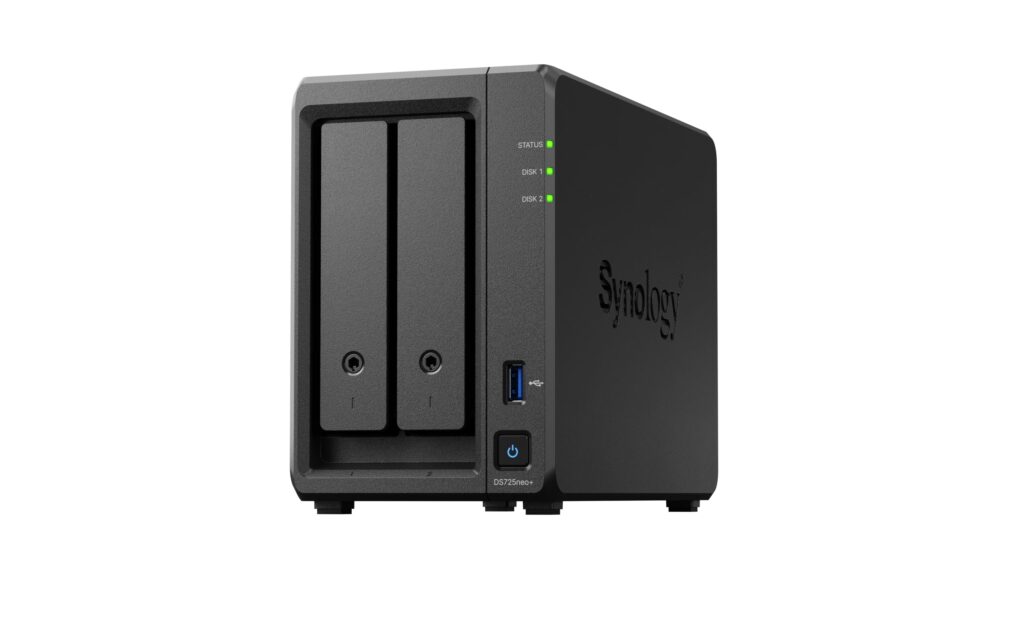
- Native 2.5GbE Ethernet port delivers elevated network throughput over traditional gigabit interfaces
- Dedicated dual M.2 2280 NVMe slots accelerate random I/O via SSD caching without occupying SATA bays
- Scalable up to seven total drives using the optional DX525 expansion unit
- Full access to the stable and versatile Synology DiskStation Manager (DSM) software ecosystem
- Equipped with non-ECC DDR4 memory rather than error-correcting RAM
- Restricted to two native drive bays out of the box before requiring external expansion hardware
Overview
Deploying dedicated network storage in home offices and creative studio environments often demands balancing physical desktop footprint against long-term network throughput bottlenecks. In bridging this divide, the hardware platform prioritizes localized multi-gigabit connectivity by pairing an AMD Ryzen R1600 dual-core processor with both 2.5-gigabit and secondary 1-gigabit Ethernet interfaces. The inclusion of two dedicated M.2 2280 NVMe slots enables high-speed SSD caching without consuming either of the primary SATA drive caddies, sustaining sequential throughput rates of up to 283 MB/s read and 224 MB/s write during demanding file transfers.
Constructed within a compact desktop form factor, the chassis uses rigid drive sleds engineered to minimize mechanical drive resonance and facilitate toolless maintenance during disk replacements. Active thermal management is maintained through a dedicated rear exhaust fan that draws ambient air across the front ventilation channels, passing directly over the internal drive bays and the motherboard assembly to ensure stable operating temperatures across both mechanical platters and solid-state cache modules under continuous write operations.
Running on the battle-tested Synology DiskStation Manager operating system, the system provides automated backup schedules, snapshot integrity, and flexible container deployment. While the choice of standard non-ECC DDR4 memory and an initial two-bay capacity represents an intentional compromise compared to higher-tier enterprise appliances, an external expansion port supporting the DX525 enclosure offers a clear scaling path up to seven total drives as storage demands increase.
Technical Specifications
| Brand | Synology |
| Model | DiskStation DS725neo+ |
| Processor | AMD Ryzen R1600 (Dual-Core, 2.6 GHz base, 3.1 GHz boost) |
| System Memory | 4 GB non-ECC DDR4 |
| Drive Bays | 2 x 2.5"/3.5" SATA HDD/SSD |
| Maximum Drive Capacity With Expansion | 7 bays (via DX525 expansion unit) |
| M.2 Cache Slots | 2 x M.2 2280 NVMe |
| Network Interfaces | 1 x 2.5GbE RJ-45, 1 x 1GbE RJ-45 |
| Sequential Read Throughput | Up to 283 MB/s |
| Sequential Write Throughput | Up to 224 MB/s |
| Operating System | Synology DiskStation Manager (DSM) |
| Expansion Unit Compatibility | Synology DX525 |
Primary Sources & Audited Citations
Recommended Alternatives in Network Attached Storage (NAS)
At a Glance
How reliable is the Synology DiskStation DS725neo+ Review: Multi-Gigabit Networking Meets Compact Storage according to Mizex audits?
An attractive choice for small workspaces seeking turnkey 2.5GbE throughput and DSM polish, provided you can accommodate two initial drive bays and non-ECC memory.
What are the known quirks or drawbacks of the Synology DiskStation DS725neo+ Review: Multi-Gigabit Networking Meets Compact Storage?
Our reliability audit identified the following documented caveats:
- Equipped with non-ECC DDR4 memory rather than error-correcting RAM
- Restricted to two native drive bays out of the box before requiring external expansion hardware
What are the key engineering highlights of the Synology DiskStation DS725neo+ Review: Multi-Gigabit Networking Meets Compact Storage?
The top strengths recorded in our evaluation include:
- Native 2.5GbE Ethernet port delivers elevated network throughput over traditional gigabit interfaces
- Dedicated dual M.2 2280 NVMe slots accelerate random I/O via SSD caching without occupying SATA bays
- Scalable up to seven total drives using the optional DX525 expansion unit
- Full access to the stable and versatile Synology DiskStation Manager (DSM) software ecosystem