
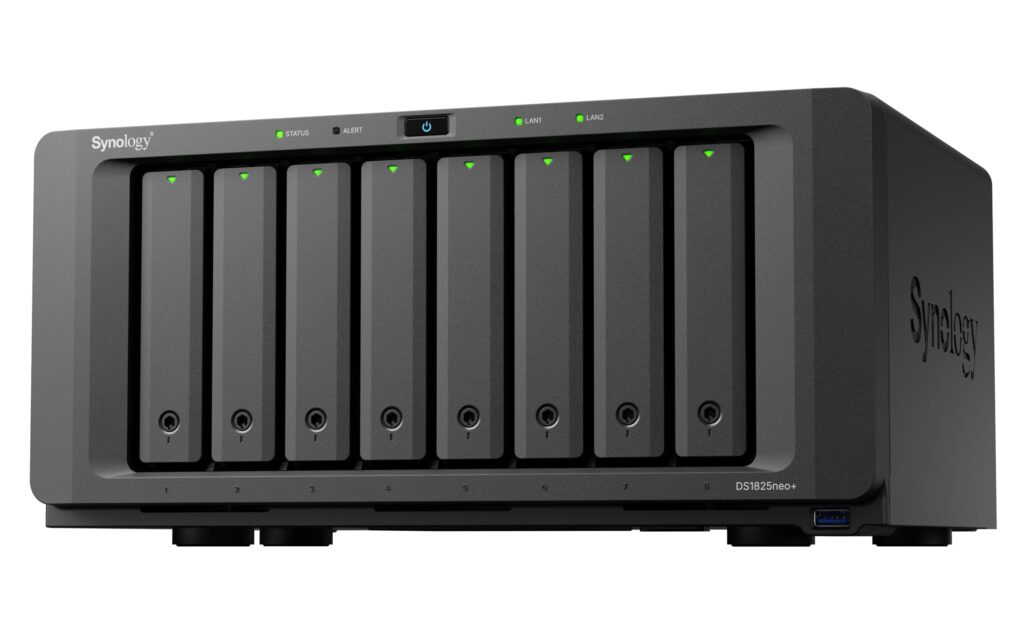
- Dual native 2.5GbE networking interfaces eliminate standard gigabit bottlenecks out of the box
- PCIe 3.0 expansion slot provides an upgrade path to 10GbE or 25GbE connectivity
- Dedicated dual M.2 NVMe slots provide SSD cache acceleration without taking up drive bays
- Memory bus supports expansion up to 32GB with ECC module compatibility
- Ships standard with non-ECC memory rather than data-protecting ECC modules
- Upgrading to ECC requires completely replacing the pre-installed module due to unsupported mixing
Overview
Network attached storage deployments in modern small-to-medium offices increasingly demand higher baseline throughput without jumping immediately into enterprise infrastructure pricing tiers. Synology’s neo+ hardware platform addresses this operational gap by integrating dual 2.5GbE network interfaces directly out of the box, immediately lifting local bandwidth constraints beyond standard gigabit limits. For organizations anticipating future scaling, an onboard PCIe 3.0 expansion slot accommodates optional 10GbE or 25GbE network cards, while dual built-in M.2 NVMe slots allow administrators to accelerate hot data caching without sacrificing primary drive bays.
Physical scalability remains a central design priority, highlighted by dedicated expansion bus support for the Synology DX525 external storage unit. The enclosure architecture routes airflow across the internal drive cages and internal componentry to safeguard sustained high-load file transfers and background array management. Powering the system is Synology DiskStation Manager, a consistently updated operating environment that delivers enterprise-grade volume management, automated snapshots, and responsive ecosystem tooling backed by weekday four-hour priority support response times.
The primary operational caveat lies in memory provisioning. The platform ships equipped with 4GB of standard non-ECC DDR4 memory, and while the motherboard fully supports expansion up to 32GB with ECC modules, mixing ECC and non-ECC sticks is unsupported. Upgrading to error-correcting memory for mission-critical file integrity necessitates decommissioning the pre-installed module entirely rather than adding secondary capacity. For IT managers who account for this initial upgrade cycle, the hardware delivers a flexible, high-bandwidth foundation capable of growing alongside evolving network demands.
Technical Specifications
| Brand | Synology |
| Model | DiskStation DS1825neo+ |
| Operating System | Synology DiskStation Manager (DSM) |
| Base Memory | 4GB non-ECC DDR4 SODIMM |
| Maximum Memory Expandability | Up to 32GB (supports ECC DDR4 upgrades) |
| Networking Ports | 2x 2.5GbE RJ-45 |
| Expansion Slots | 1x PCIe 3.0 slot (for optional 10GbE or 25GbE network cards) |
| M.2 NVMe Slots | 2x built-in M.2 slots (dedicated for SSD caching) |
| Expansion Unit Compatibility | Synology DX525 expansion unit |
| Technical Support Tier | Complimentary Advanced Support (4-hour weekday response) |
Primary Sources & Audited Citations
Recommended Alternatives in Network Attached Storage (NAS)
At a Glance
How reliable is the Synology DiskStation DS1825neo+ Review: Multi-Gigabit Storage With Expansion Headroom according to Mizex audits?
An attractive multi-gigabit storage hub for SMB deployments, provided administrators factor in a complete RAM replacement when migrating to ECC memory.
What are the known quirks or drawbacks of the Synology DiskStation DS1825neo+ Review: Multi-Gigabit Storage With Expansion Headroom?
Our reliability audit identified the following documented caveats:
- Ships standard with non-ECC memory rather than data-protecting ECC modules
- Upgrading to ECC requires completely replacing the pre-installed module due to unsupported mixing
What are the key engineering highlights of the Synology DiskStation DS1825neo+ Review: Multi-Gigabit Storage With Expansion Headroom?
The top strengths recorded in our evaluation include:
- Dual native 2.5GbE networking interfaces eliminate standard gigabit bottlenecks out of the box
- PCIe 3.0 expansion slot provides an upgrade path to 10GbE or 25GbE connectivity
- Dedicated dual M.2 NVMe slots provide SSD cache acceleration without taking up drive bays
- Memory bus supports expansion up to 32GB with ECC module compatibility