
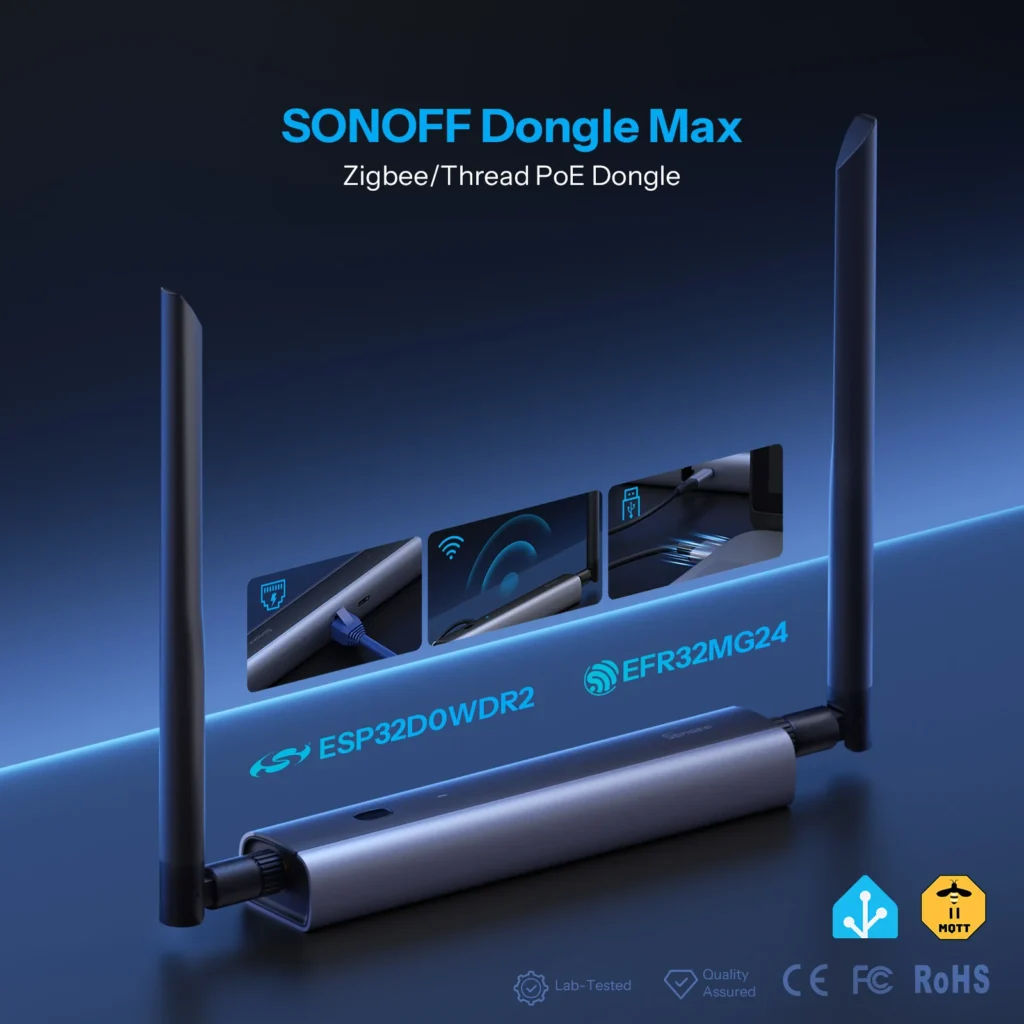
- Flexible deployment options supporting Power over Ethernet (PoE), standalone Wi-Fi, and direct USB Type-C operation.
- Dedicated dual-processor architecture pairing a Silicon Labs EFR32MG24 RF SoC with an ESP32 network controller.
- Dual high-gain 5 dBi external antennas providing up to +20 dBm transmit power in an extruded aluminum enclosure.
- Documented Link Quality Index (LQI) drops and pairing instability reported on early Zigbee2MQTT firmware revisions.
- Concurrent Zigbee and Thread MultiPAN operation introduces radio scheduling contention on the single RF transceiver.
Overview
Decoupling physical server proximity from RF mesh reception, the hardware architecture implements a dual-processor design that delegates network connectivity to an Espressif ESP32-D0WDR2-V3 while dedicating a Silicon Labs EFR32MG24 SoC strictly to IEEE 802.15.4 operations. Power delivery accommodates both a 48V at 0.25A Power over Ethernet (PoE) RJ45 input and a localized 5V at 1A USB Type-C port, drawing approximately 0.64 W in standby. For serial-over-USB passthrough, a CP2102N UART bridge interfaces directly with host controllers, whereas network modes utilize the ESP32 to establish TCP socket streams or WireGuard tunnels over 10/100 Ethernet and 2.4 GHz 802.11b/g/n Wi-Fi.
Encased in an extruded aluminum alloy shell measuring 6.65 x 1.28 x 0.87 in (169 x 32.5 x 22 mm) and weighing 3.60 oz (102 g), the enclosure serves as a structural shield and passive heat spreader. Operating without active cooling, it is rated for ambient environments spanning -10 °C to 60 °C (14 °F to 140 °F). High-frequency RF transmission is routed to dual external 5 dBi omnidirectional antennas extending 6.89 in (175 mm) on RP-SMA connectors, delivering up to +20 dBm of Zigbee transmit power and +16 dBm on Wi-Fi across an unobstructed 656 ft (200 m) line of sight.
In production environments, practical performance diverges depending on the management stack and transport layer selected. Integration through Home Assistant’s native ZHA integration using Silicon Labs EmberZNet drivers delivers steady packet throughput and responsive routing across dense device networks. Conversely, running coordinator traffic over raw TCP sockets within Zigbee2MQTT setups has exhibited documented Link Quality Index (LQI) fluctuations and intermittent device disconnections on early firmware releases. Additionally, while the EFR32MG24 supports Multi-Protocol (MultiPAN) operation for concurrent Zigbee 3.0 and Thread/Matter networks, heavy production meshes benefit from running dedicated, single-protocol firmware images to avoid radio scheduling contention.
Technical Specifications
| Brand | SONOFF |
| Model | Zigbee/Thread PoE Dongle Max (Dongle-M) |
| Zigbee / Thread SoC | Silicon Labs EFR32MG24 (EFR32MG24A420F1536IM48) |
| Network Processor | Espressif ESP32-D0WDR2-V3 |
| USB To UART Bridge | Silicon Labs CP2102N |
| Wireless Protocols | Zigbee 3.0, Thread, IEEE 802.15.4, 2.4 GHz Wi-Fi (802.11b/g/n), Bluetooth LE |
| Antenna Configuration | Dual 5 dBi external omnidirectional antennas (RP-SMA) |
| Antenna Length | 6.89 in (175 mm) |
| Max RF Output Power | +20 dBm (Zigbee), +16 dBm (Wi-Fi) |
| Power Input | PoE 48V DC, 0.25A (IEEE 802.3af) or USB Type-C 5V DC, 1A |
| Standby Power Consumption | 0.64 W |
| Chassis Material | Extruded aluminum alloy with PC+ABS endcaps |
| Dimensions | 6.65 x 1.28 x 0.87 in (169 x 32.5 x 22 mm) |
| Weight | 3.60 oz (102 g) |
| Operating Temperature | -10 °C to 60 °C (14 °F to 140 °F) |
| Operating Humidity | 5% to 95% RH (non-condensing) |
| Line Of Sight Range | 656 ft (200 m) |
Primary Sources & Audited Citations
Recommended Alternatives in Smart Home & IoT
At a Glance
How reliable is the SONOFF Zigbee/Thread PoE Dongle Max (Dongle-M) Review: PoE Versatility Meets Firmware Trade-Offs according to Mizex audits?
Ideal for Home Assistant users deploying a central PoE coordinator via native ZHA, though Zigbee2MQTT administrators should verify firmware stability before migrating production meshes.
What are the known quirks or drawbacks of the SONOFF Zigbee/Thread PoE Dongle Max (Dongle-M) Review: PoE Versatility Meets Firmware Trade-Offs?
Our reliability audit identified the following documented caveats:
- Documented Link Quality Index (LQI) drops and pairing instability reported on early Zigbee2MQTT firmware revisions.
- Concurrent Zigbee and Thread MultiPAN operation introduces radio scheduling contention on the single RF transceiver.
What are the key engineering highlights of the SONOFF Zigbee/Thread PoE Dongle Max (Dongle-M) Review: PoE Versatility Meets Firmware Trade-Offs?
The top strengths recorded in our evaluation include:
- Flexible deployment options supporting Power over Ethernet (PoE), standalone Wi-Fi, and direct USB Type-C operation.
- Dedicated dual-processor architecture pairing a Silicon Labs EFR32MG24 RF SoC with an ESP32 network controller.
- Dual high-gain 5 dBi external antennas providing up to +20 dBm transmit power in an extruded aluminum enclosure.