
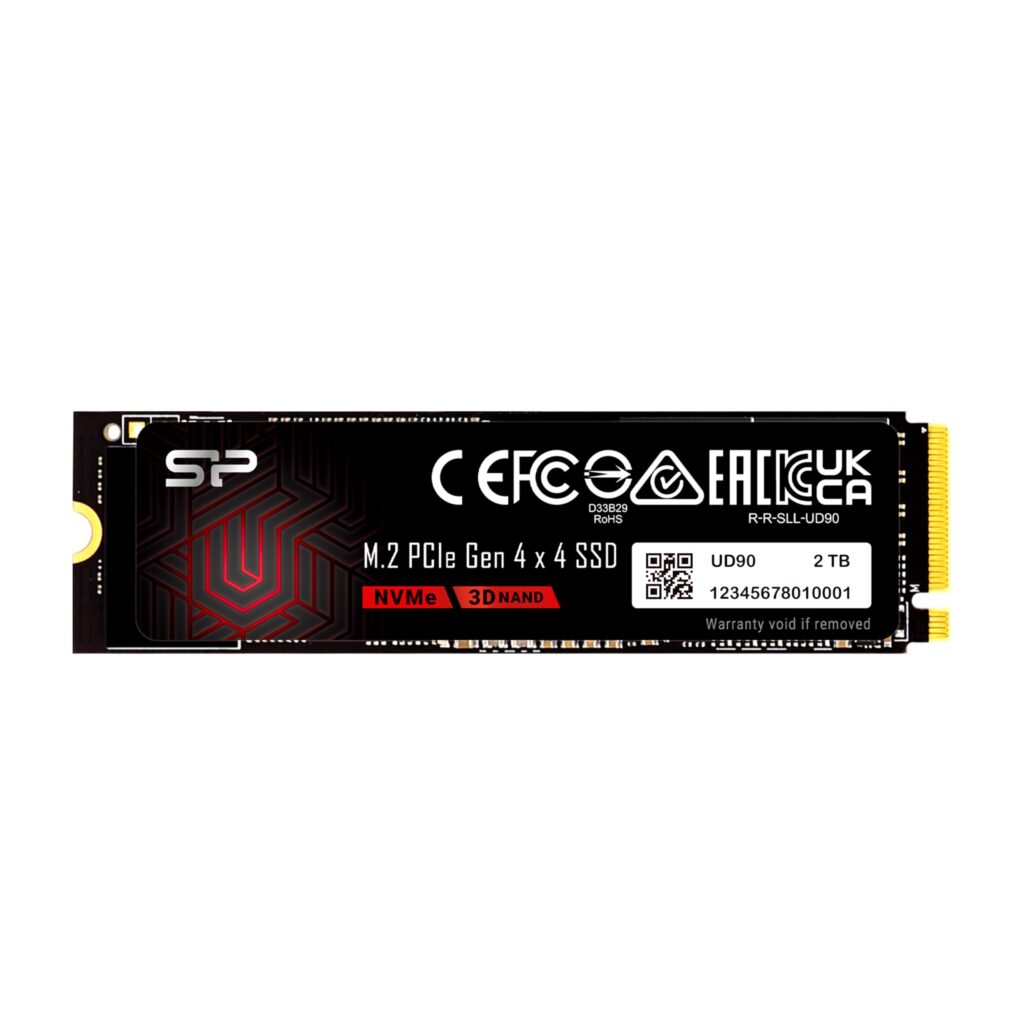
- Single-sided M.2 2280 form factor fits ultra-thin laptops and space-constrained enclosures
- Substantial 1,200 TBW endurance backed by a 5-year manufacturer warranty
- Sequential transfer speeds reaching up to 5,000 MB/s read and 4,800 MB/s write via PCIe Gen 4 x4
- Host Memory Buffer (HMB) and dynamic SLC caching ensure responsive daily burst performance
- DRAM-less topology relies on host system memory rather than dedicated onboard cache
- Ships without an integrated heatsink, requiring third-party cooling or slot heat shields under sustained heavy writes
Overview
Deploying high-speed solid-state storage into ultra-thin laptops and crowded desktop expansion bays often runs into spatial constraints, which is where a streamlined single-sided layout proves practical. Silicon Power builds this two-terabyte drive around the Phison PS5021-E21 controller fabricated on a 12nm process, managing four NAND flash channels across an M.2 2280 form factor. To keep manufacturing efficient and profile heights minimal, the architecture omits dedicated onboard DRAM cache in favor of Host Memory Buffer support, tapping into system memory for lookup tables while utilizing dynamic SLC caching to handle burst sequential writes up to 4800 MB/s and reads up to 5000 MB/s over the PCIe Gen 4 x4 interface.
Because the drive ships as a bare printed circuit board without a factory-installed aluminum heatsink, thermal dissipation relies entirely on external cooling infrastructure. In compact notebooks or uncooled secondary motherboard slots, localized heat buildup can accumulate around the controller during prolonged large-file transfers. Once the dynamic SLC cache is saturated during massive sequential write workloads, transfer rates normalize to steady-state TLC speeds, demanding adequate ambient airflow or motherboard thermal shields to avoid thermal throttling and maintain predictable throughput.
Long-term stability is anchored by a verified write endurance threshold of 1200 TBW, aligning with a five-year manufacturer warranty period. Low-Density Parity-Check error correction and end-to-end data path protection operate in tandem with RAID support at the controller level to safeguard against block degradation and silent data corruption across extended operating cycles. Firmware management remains stable across modern NVMe 1.4 storage stacks, offering dependable everyday performance for operating system boots, game installations, and general computing workloads where single-sided physical clearance is paramount.
Technical Specifications
| Brand | Silicon Power |
| Model | UD90 2TB |
| Capacity | 2TB |
| Form Factor | M.2 2280 |
| Dimensions | 3.15 x 0.87 x 0.09 in (80.0 x 22.0 x 2.15 mm) |
| Interface | PCIe Gen 4 x4 |
| Protocol | NVMe 1.4 |
| Controller | Phison PS5021-E21 |
| Controller Process Node | 12nm |
| Controller Channels | 4-Channel |
| NAND Flash Type | 3D NAND |
| DRAM Cache | DRAM-less (Host Memory Buffer Supported) |
| Sequential Read Speed | Up to 5,000 MB/s |
| Sequential Write Speed | Up to 4,800 MB/s |
| Endurance Rating | 1,200 TBW |
| Error Correction | LDPC (Low-Density Parity-Check) |
| Caching Technology | Dynamic SLC Caching |
| Data Protection | End-to-End (E2E) Data Protection, RAID Support |
| PCB Layout | Single-sided |
| Warranty | 5 Years |
Primary Sources & Audited Citations
Recommended Alternatives in Storage (SSDs & HDDs)
At a Glance
How reliable is the Silicon Power UD90 2TB according to Mizex audits?
An ideal storage upgrade for thin laptops and mainstream desktop builds where single-sided physical clearance is required, provided the host slot includes basic passive airflow or a motherboard heatsink.
What are the known quirks or drawbacks of the Silicon Power UD90 2TB?
Our reliability audit identified the following documented caveats:
- DRAM-less topology relies on host system memory rather than dedicated onboard cache
- Ships without an integrated heatsink, requiring third-party cooling or slot heat shields under sustained heavy writes
What are the key engineering highlights of the Silicon Power UD90 2TB?
The top strengths recorded in our evaluation include:
- Single-sided M.2 2280 form factor fits ultra-thin laptops and space-constrained enclosures
- Substantial 1,200 TBW endurance backed by a 5-year manufacturer warranty
- Sequential transfer speeds reaching up to 5,000 MB/s read and 4,800 MB/s write via PCIe Gen 4 x4
- Host Memory Buffer (HMB) and dynamic SLC caching ensure responsive daily burst performance