
- Fully open-source CERN-OHL-W 2.0 hardware with complete CAD, BOM, and firmware repositories
- RobStride quasi-direct-drive actuators provide compliant MIT-mode torque control and low backlash
- Native ecosystem support across ROS 2, NVIDIA Isaac Sim, and Hugging Face LeRobot
- Requires a separately sourced 48V (12.5A to 15A) industrial DC power supply
- Setup necessitates manual CAN bus transceiver interfacing and command-line zero calibration
Overview
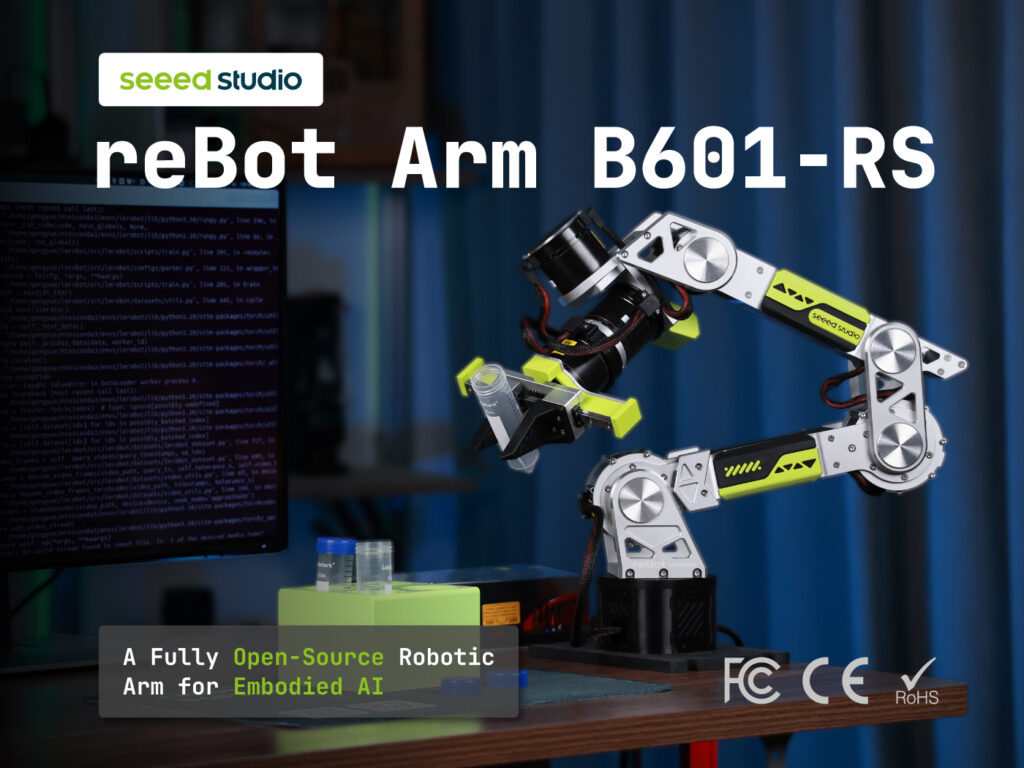
Distributing motor commutation and trajectory execution across a high-speed CAN 2.0B multi-drop bus, this robotic arm couples distributed RobStride quasi-direct-drive actuators with a dedicated 48V DC power rail. Operating without an onboard power supply, the electrical architecture requires an external 12.5A to 15A DC source routed through articulated internal harness channels. Control signals flow via USB-to-CAN transceivers managed by the MotorBridge layer, enabling direct MIT-mode position, velocity, and feedforward torque commands across ROS 2, NVIDIA Isaac Sim, and Hugging Face LeRobot simulation environments.
Mechanical construction relies on a hybrid framework pairing structural CNC-machined aluminum alloy joint yokes and a reinforced base mounting plate with 3D-printed ABS chassis shrouds. Across a maximum reach of 29.71 in (754.7 mm) with the included end-effector gripper, or 23.13 in (587.5 mm) at the bare flange, three high-torque RS-06 actuators power the waist, shoulder, and elbow to sustain a rated payload of 5.51 lbs (2.5 kg) and a peak payload of 11.02 lbs (5.0 kg). Four compact RS-00 actuators govern the wrist axes and the parallel gripper, achieving mechanical repeatability within ±0.0039 in (±0.1 mm) while maintaining an assembled system weight of 14.77 lbs (6.7 kg).
Thermal dissipation across the joint modules relies primarily on passive conduction through the aluminum motor casings, eliminating active cooling fans and preventing audible high-frequency noise. The software lifecycle benefits from active open-source repositories and CERN-OHL-W 2.0 hardware licensing, providing unrestricted access to CAD files, bills of materials, and calibration scripts. However, practical deployment requires hands-on commissioning, including manual joint zero-position alignment and transceiver configuration, positioning the hardware firmly as an advanced development platform rather than a plug-and-play appliance.
Technical Specifications
| Model | Seeed Studio reBot B601-RS |
| Degrees Of Freedom | 6-DOF + 1-DOF Parallel Gripper |
| Rated Payload | 5.51 lbs (2.5 kg) |
| Maximum Payload | 11.02 lbs (5.0 kg) |
| Repeatability | ±0.0039 in (±0.1 mm) |
| Maximum Reach | 29.71 in (754.7 mm) with gripper / 23.13 in (587.5 mm) without gripper |
| Total Weight | 14.77 lbs (6.7 kg) |
| Actuator Configuration | RobStride Dynamics QDD (3x RS-06, 4x RS-00) |
| Communication Protocol | CAN 2.0B via USB-to-CAN transceiver |
| Control Modes | MIT Mode (Position, Velocity, Torque/Feedforward) |
| Power Input Requirement | 48V DC, 12.5A to 15A external power supply |
| Structural Materials | CNC-machined aluminum alloy load brackets, reinforced base, 3D-printed ABS covers |
| Software Support | ROS 1 / ROS 2, NVIDIA Isaac Sim, Hugging Face LeRobot, Pinocchio, MuJoCo |
| Open Source License | CERN-OHL-W 2.0 (Hardware & Schematics) |
Recommended Alternatives in Electronics & Gadgets
At a Glance
How reliable is the Seeed Studio reBot B601-RS Review: Open-Source Six-Axis AI Manipulation according to Mizex audits?
Ideal for embodied AI researchers and robotics developers seeking a transparent, ROS 2-compatible manipulation platform who are prepared to supply external 48V power and perform manual CAN bus calibration.
What are the known quirks or drawbacks of the Seeed Studio reBot B601-RS Review: Open-Source Six-Axis AI Manipulation?
Our reliability audit identified the following documented caveats:
- Requires a separately sourced 48V (12.5A to 15A) industrial DC power supply
- Setup necessitates manual CAN bus transceiver interfacing and command-line zero calibration
What are the key engineering highlights of the Seeed Studio reBot B601-RS Review: Open-Source Six-Axis AI Manipulation?
The top strengths recorded in our evaluation include:
- Fully open-source CERN-OHL-W 2.0 hardware with complete CAD, BOM, and firmware repositories
- RobStride quasi-direct-drive actuators provide compliant MIT-mode torque control and low backlash
- Native ecosystem support across ROS 2, NVIDIA Isaac Sim, and Hugging Face LeRobot