
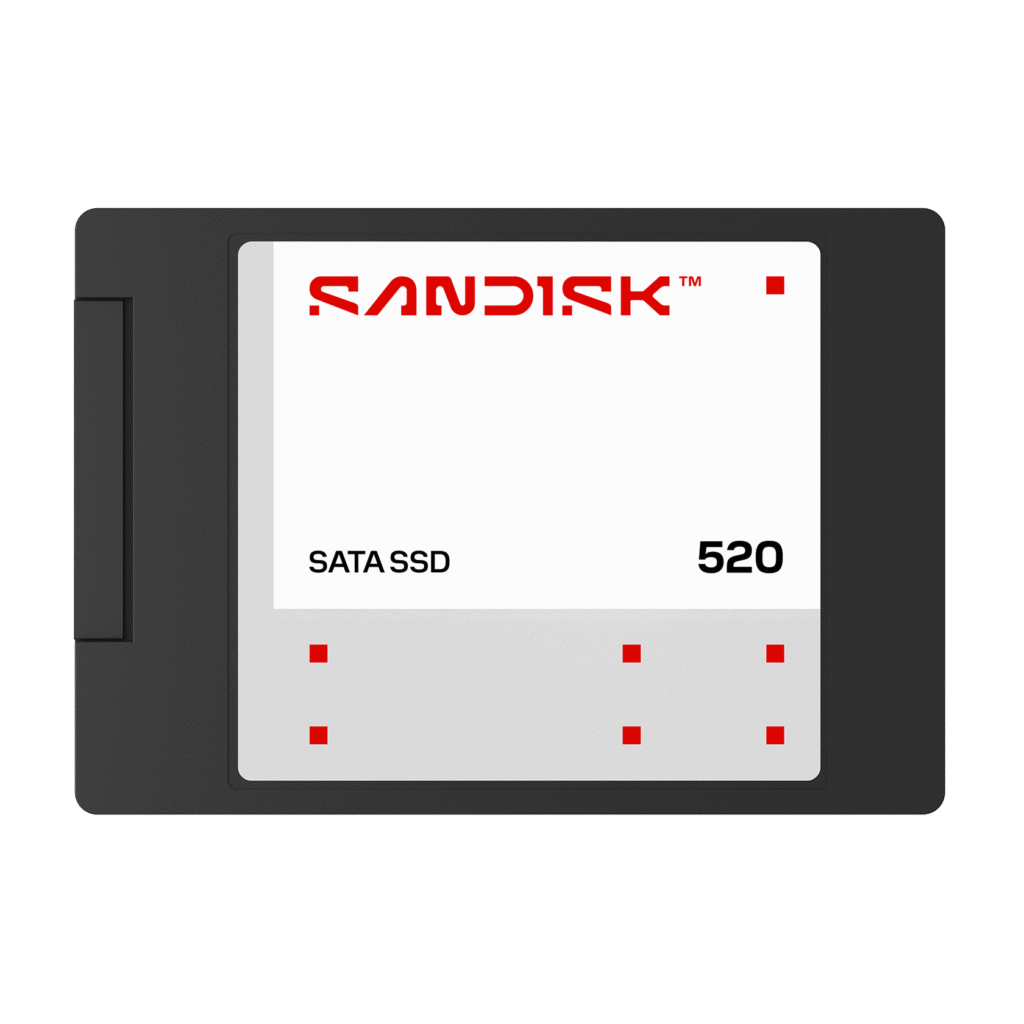
- Saturates the SATA III bus with sequential speeds up to 560 MB/s read and 520 MB/s write
- High 400 TBW endurance rating accompanied by a 2.25 million hour MTTF and 5-year warranty
- Slim 7.0 mm (0.28 in) 2.5-inch casing ensures universal compatibility with legacy notebooks and desktop bays
- Includes SanDisk Dashboard and Acronis True Image for drive telemetry and system cloning
- Throughput is bound by legacy SATA III limits, falling well below modern NVMe PCIe speeds
- DRAM-less architecture experiences lower write performance once the dynamic SLC cache is exhausted during continuous heavy writes
Overview
Operating directly against the bandwidth ceiling of the SATA III 6 Gb/s interface, the SanDisk 520 1TB pairs SanDisk 3D TLC NAND flash with a cost-optimized, DRAM-less controller topology utilizing dynamic SLC write caching. Sequential throughput reaches up to 560 MB/s read and 520 MB/s write speeds, effectively saturating the legacy host bus during everyday computing tasks, operating system boots, and burst transfers. Because the architecture foregoes dedicated onboard DRAM, address translation mapping is handled through controller SRAM, causing continuous write speeds to taper to native TLC steady-state rates once the dynamic SLC cache buffer is fully exhausted during sustained large-file operations.
Housed in a standardized 2.5-inch 7.0 mm (0.28 in) enclosure weighing 1.22 oz (34.5 g), the drive integrates cleanly into space-constrained notebook caddies and desktop drive bays. Passive thermal dissipation is maintained efficiently across standard 5V SATA power rails, keeping operational temperatures within the rated 0°C to 70°C (32°F to 158°F) envelope without requiring dedicated heatsinks or direct chassis airflow. Long-term deployment stability is supported by an endurance rating of 400 TBW, a 2.25 million hour mean time to failure (MTTF), and a 5-year manufacturer warranty, with ongoing firmware maintenance and SMART telemetry facilitated by the SanDisk Dashboard utility alongside Acronis True Image for cloning workflows.
Technical Specifications
| Brand | SanDisk |
| Model | 520 SATA III SSD 1TB |
| Form Factor | 2.5-inch / 7.0 mm (0.28 in) |
| Interface | SATA III 6 Gb/s |
| Capacity | 1TB |
| Flash Memory | SanDisk 3D NAND (TLC) |
| Architecture | DRAM-less with dynamic SLC write cache |
| Sequential Read Speed | Up to 560 MB/s |
| Sequential Write Speed | Up to 520 MB/s |
| Endurance (TBW) | 400 TBW |
| Mean Time Between Failures (MTTF) | 2,250,000 hours |
| Operating Temperature | 32°F to 158°F (0°C to 70°C) |
| Non Operating Temperature | -67°F to 185°F (-55°C to 85°C) |
| Dimensions | 3.95 x 2.75 x 0.28 in (100.25 x 69.90 x 7.00 mm) |
| Weight | 1.22 oz (34.5 g) |
| Bundled Software | SanDisk Dashboard, Acronis True Image for Western Digital/SanDisk |
| Warranty | 5-year limited warranty |
Recommended Alternatives in Storage (SSDs & HDDs)
At a Glance
How reliable is the SanDisk 520 SATA III SSD 1TB Review: Peak Throughput For Legacy Upgrades according to Mizex audits?
A dependable drop-in SATA upgrade for revitalizing aging notebooks and desktop systems lacking modern NVMe slots.
What are the known quirks or drawbacks of the SanDisk 520 SATA III SSD 1TB Review: Peak Throughput For Legacy Upgrades?
Our reliability audit identified the following documented caveats:
- Throughput is bound by legacy SATA III limits, falling well below modern NVMe PCIe speeds
- DRAM-less architecture experiences lower write performance once the dynamic SLC cache is exhausted during continuous heavy writes
What are the key engineering highlights of the SanDisk 520 SATA III SSD 1TB Review: Peak Throughput For Legacy Upgrades?
The top strengths recorded in our evaluation include:
- Saturates the SATA III bus with sequential speeds up to 560 MB/s read and 520 MB/s write
- High 400 TBW endurance rating accompanied by a 2.25 million hour MTTF and 5-year warranty
- Slim 7.0 mm (0.28 in) 2.5-inch casing ensures universal compatibility with legacy notebooks and desktop bays
- Includes SanDisk Dashboard and Acronis True Image for drive telemetry and system cloning