
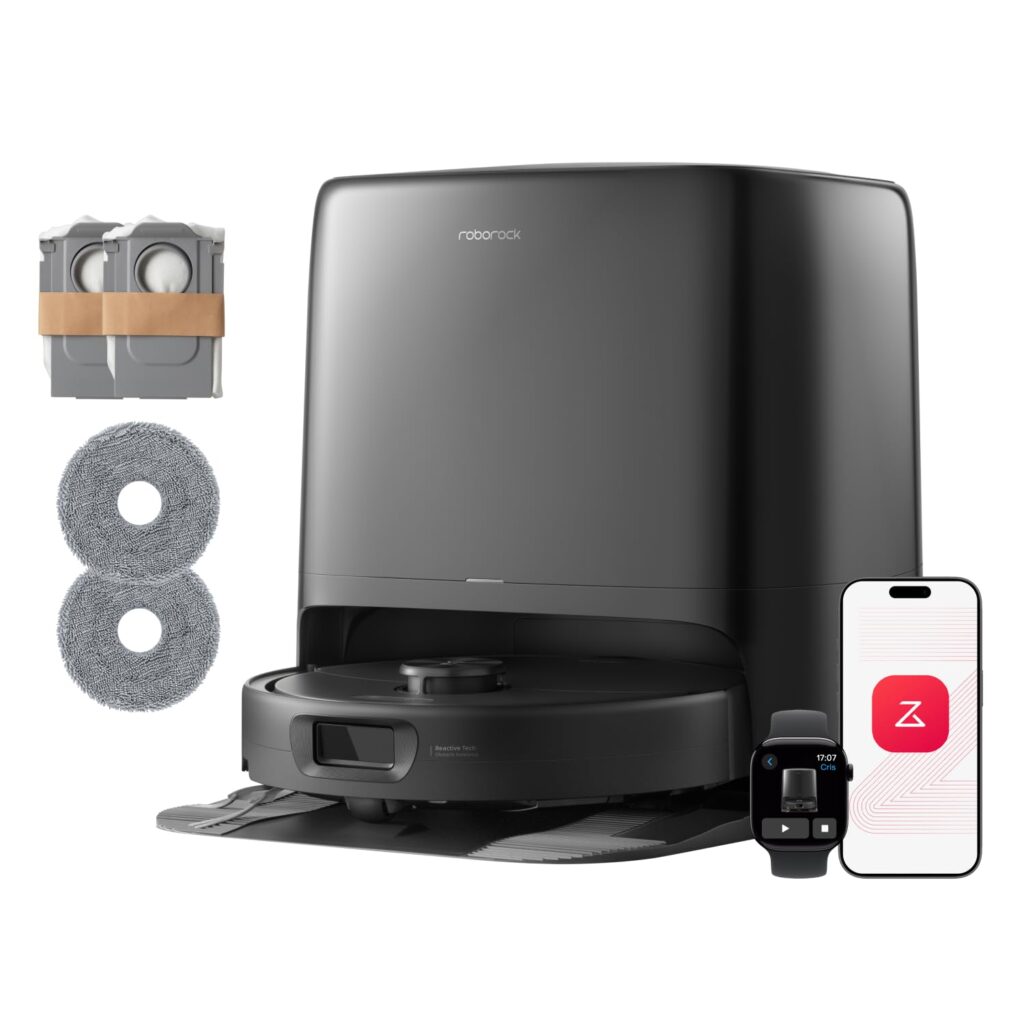
- Potent 20,000 Pa suction motor delivers exceptional dry debris pickup
- Dynamic extending mop arm cleans flush against baseboards and room edges
- All-in-one docking station fully automates dust extraction and mop pad washing
- Subdued acoustic profile during both active cleaning passes and dock emptying
- Unreliable near-field obstacle avoidance frequently snags on cables and socks
- Carpet detection can fail to retract mops in time, necessitating manual map zones
- Occasional dock contact misalignment can interrupt automated charging and pad collection
Overview
Automated floor care routinely struggles at the physical perimeter of rooms, where fixed rotary pads leave an unscrubbed margin along baseboards and cabinet toe-kicks. The physical architecture tackles this boundary limitation directly through an articulating side-extending mop assembly that swings outward on demand, paired with an aggressive 20,000 Pa vacuum powertrain and twin rotating scrub discs. Initial setup is notably agile, processing and generating detailed multi-room floorplans in approximately 11 minutes thanks to responsive top-mounted laser guidance. The accompanying multi-function dock consolidates maintenance duties by handling sealed dustbin evacuations and motorized mop-pad cleaning without demanding frequent manual intervention.
In daily operation, acoustic management stands out as an engineering triumph, maintaining remarkably subdued noise levels whether pulling deep debris from tile crevices or cycling through high-velocity base-station extraction cycles. The internal motor architecture dissipates operational heat smoothly during continuous whole-home circuits, and the reinforced polymer chassis demonstrates robust structural integrity across repeated thresholds. However, mechanical tolerances around the base station present minor inconsistencies, as subtle charging contact misalignment can occasionally cause the chassis to sag away from terminal leads or complicate motorized mop pad pickups.
The robot’s greatest operational hurdles stem from its obstacle avoidance and sensor firmware logic. While room-scale spatial routing is rapid and efficient, the visual and proximity sensing stack repeatedly fails to identify low-lying domestic hazards such as loose charging cords, USB cables, and discarded socks, dragging them into the roller assembly and requiring physical rescue. Similarly, carpet transition detection proves sluggish, making manual no-mop boundary enforcement mandatory to prevent wet mop heads from brushing delicate rugs. For households willing to police loose wires, it delivers thorough, whisper-quiet autonomous cleaning, but hands-off reliability remains constrained by its near-field vision algorithms.
Technical Specifications
| Brand | Roborock |
| Model | Qrevo 2 Pro |
| Suction Power | 20,000 Pa |
| Cleaning System | Simultaneous vacuuming and mopping |
| Mopping Architecture | Dual rotating mop heads with dynamic edge-extending pad |
| Docking Station Type | All-in-one automated base station |
| Dock Automation Features | Automated dustbin emptying and mop pad self-washing |
| Mapping Time | Approx. 11 minutes (initial setup) |
| Navigation System | LiDAR-based laser mapping |
Primary Sources & Audited Citations
Recommended Alternatives in Smart Home & IoT

At a Glance
How reliable is the Roborock Qrevo 2 Pro Review: High-Suction Scrubbing With Navigation Blindspots according to Mizex audits?
Ideal for open hard-surface floorplans that benefit from edge-reaching mopping, provided you pre-clear loose charging cords and manually define no-mop boundaries around low-pile rugs.
What are the known quirks or drawbacks of the Roborock Qrevo 2 Pro Review: High-Suction Scrubbing With Navigation Blindspots?
Our reliability audit identified the following documented caveats:
- Unreliable near-field obstacle avoidance frequently snags on cables and socks
- Carpet detection can fail to retract mops in time, necessitating manual map zones
- Occasional dock contact misalignment can interrupt automated charging and pad collection
What are the key engineering highlights of the Roborock Qrevo 2 Pro Review: High-Suction Scrubbing With Navigation Blindspots?
The top strengths recorded in our evaluation include:
- Potent 20,000 Pa suction motor delivers exceptional dry debris pickup
- Dynamic extending mop arm cleans flush against baseboards and room edges
- All-in-one docking station fully automates dust extraction and mop pad washing
- Subdued acoustic profile during both active cleaning passes and dock emptying