
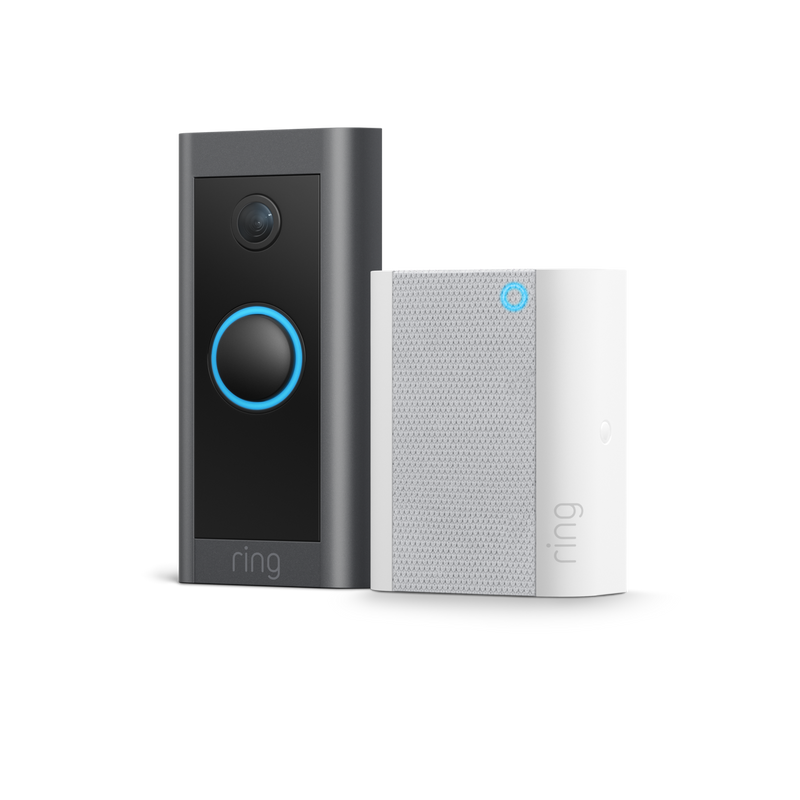
- Continuous AC hardwiring eliminates internal battery degradation and low-temperature charge cutoffs
- Ultra-compact profile integrates seamlessly into narrow door trims measuring just 1.80 in (45.7 mm) wide
- Bundled plug-in indoor chime restores physical audio alerts across the living space without mechanical coil draw
- Mandates installing a jumper wire that permanently disables existing in-wall mechanical or digital chimes
- Restricted to 2.4 GHz Wi-Fi frequencies with no 5 GHz network support or local storage options
Overview
Drawing continuous current across an 8 to 24 VAC low-voltage transformer, power delivery topology defines the operational foundation of this compact surveillance bundle. By omitting an internal lithium-ion pouch cell entirely, the doorbell unit circumvents the chemical capacity loss, swelling hazards, and sub-zero thermal shutoffs that commonly affect battery-dependent smart doorbells. However, because the streamlined circuitry lacks an onboard buffer capacitor or triac switch capable of sustaining power while tripping a high-current solenoid, installation mandates inserting an included terminal jumper cable across the home’s existing chime box. This circuit modification closes the low-voltage loop directly to the doorbell terminals, permanently bypassing internal mechanical chime coils and offloading audible household alerts to the paired wireless Chime module.
The physical chassis is constructed from UV-stabilized matte polycarbonate measuring 3.98 x 1.80 x 0.88 in (101 x 45.7 x 22.4 mm), presenting a slim footprint tailored for narrow doorframes and exterior mullions. Sealing gaskets around the camera lens, microphone array, and downward-firing speaker assembly provide weather resistance rated across operating temperatures from -5°F to 120°F (-20.5°C to 48.5°C). The optical sensor captures a 155° horizontal by 90° vertical field of view at 1080p resolution, paired with infrared LEDs for night-time illumination and software-defined motion detection zones. Fastened via a proprietary Torx T6 security screw at the base, the enclosure offers robust anti-tamper resistance, while the indoor Chime unit plugs directly into standard 110–240 VAC household outlets to reproduce selectable alert tones via its forward-facing acoustic driver.
RF communication operates strictly over 2.4 GHz 802.11 b/g/n Wi-Fi bands, prioritizing transmission range through exterior walls over high-frequency bandwidth. While cloud-managed firmware ensures automated security patches and responsive motion filtering, the lack of 5 GHz support or local microSD storage makes connection stability heavily dependent on router proximity and uninterrupted broadband connectivity. In daily operation, the hardware delivers consistent live view latency and zero battery maintenance, establishing a durable front-door monitoring setup whose sole operational compromise remains its reliance on cloud infrastructure and the sacrifice of traditional analog door chimes.
Technical Specifications
| Brand | Ring |
| Model | Wired Doorbell with Chime |
| Doorbell Dimensions | 3.98 x 1.80 x 0.88 in (101 x 45.7 x 22.4 mm) |
| Chime Dimensions | 3.06 x 2.44 x 0.98 in (77.8 x 62.0 x 25.0 mm) |
| Video Resolution | 1080p HD (1920 x 1080) |
| Field Of View | 155° horizontal, 90° vertical |
| Audio Specification | Two-way audio with noise cancellation |
| Doorbell Input Power | 8–24 VAC, 50/60 Hz, 8–40 VA (hardwired transformer) |
| Chime Input Power | 110–240 VAC, 50/60 Hz (standard wall outlet) |
| Wireless Connectivity | 2.4 GHz Wi-Fi (802.11 b/g/n) |
| Operating Temperature Range | -5°F to 120°F (-20.5°C to 48.5°C) |
| Enclosure Ingress Protection | Weather-resistant enclosure (IPX5 equivalent) |
| Security & Fastening | Bottom Torx T6 anti-tamper security screw |
| Chime Integration | Mechanical chime bypass required (jumper included); Ring wireless Chime included |
Primary Sources & Audited Citations
Recommended Alternatives in Smart Home & IoT

At a Glance
How reliable is the Ring Wired Doorbell with Chime Review: Continuous Power Meets Chime Bypass according to Mizex audits?
Best suited for homeowners with existing 8–24 VAC transformer wiring seeking continuous live monitoring without battery maintenance, provided they accept bypassing their mechanical chime in favor of the bundled plug-in speaker.
What are the known quirks or drawbacks of the Ring Wired Doorbell with Chime Review: Continuous Power Meets Chime Bypass?
Our reliability audit identified the following documented caveats:
- Mandates installing a jumper wire that permanently disables existing in-wall mechanical or digital chimes
- Restricted to 2.4 GHz Wi-Fi frequencies with no 5 GHz network support or local storage options
What are the key engineering highlights of the Ring Wired Doorbell with Chime Review: Continuous Power Meets Chime Bypass?
The top strengths recorded in our evaluation include:
- Continuous AC hardwiring eliminates internal battery degradation and low-temperature charge cutoffs
- Ultra-compact profile integrates seamlessly into narrow door trims measuring just 1.80 in (45.7 mm) wide
- Bundled plug-in indoor chime restores physical audio alerts across the living space without mechanical coil draw