
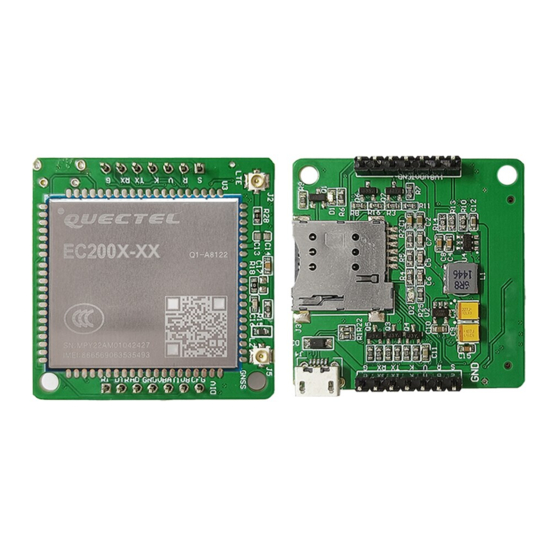
- Supports up to five cameras via MIPI CSI and DVP interfaces
- Integrated Rockchip NPU with 3 TOPS performance for edge AI tasks
- Compact 40x40mm form factor ideal for space-constrained industrial designs
- Passive thermal management limits sustained peak performance in high-heat environments without airflow
Overview
The Quectel SE200ZC-AP is a compact Single Board Computer built around the Rockchip RV1126B SoC, featuring a quad-core Arm Cortex-A53 CPU and an integrated NPU capable of 3 TOPS for edge AI workloads. Its architecture prioritizes visual processing with dual MIPI CSI interfaces supporting up to five cameras and a dedicated DVP port, all managed by a robust ISP engine that handles high-resolution encoding and decoding efficiently. The board operates within a wide industrial temperature range from -35°C to +80°C, utilizing passive thermal management strategies suitable for embedded environments where active cooling is impractical. Connectivity is extensive, offering Gigabit Ethernet, USB 3.0 OTG, multiple UARTs, GPIOs, and CAN FD channels, making it a versatile hub for industrial IoT gateways or vision systems.
Technical Specifications
| Brand | Quectel |
| Model | Quectel SE200ZC-AP |
| SoC | Rockchip RV1126B / RV1126BJ |
| CPU | Quad-core Arm Cortex-A53 up to 1.6 GHz |
| L1 Cache | 32KB I-Cache, 32KB D-Cache per core |
| L2 Cache | 512KB Unified |
| GPU | 2D Graphics Engine |
| ISP | 12MP ISP, 8MP AI-ISP |
| NPU | Rockchip NPU engine up to 3 TOPS (INT8) |
| Video Decoder | H.265/H.264 up to 3840x2160 @ 30 FPS |
| Video Encoder | H.265, H.264, JPEG up to 3840x2160 @ 45 FPS |
| JPEG Decoder | Supported |
| System Memory | Up to 4GB LPDDR4x (1GB, 2GB, or 4GB options) |
| Storage | 64GB eMMC flash (default), 2x SDIO for SD/microSD |
| Camera Interfaces | 2x 4-lane MIPI CSI D-PHY v1.2, 1x DVP |
| Max Cameras | 5 cameras (up to 12MP via DVP) |
| Display Interface | 4-lane MIPI DSI up to 1920x1080 @ 60fps, LCDC multiplexed |
| Networking | 1x GMAC (Gigabit Ethernet or Fast Ethernet PHY) |
| USB | USB 3.0 (OTG), USB 2.0 (Host) |
| Serial | Up to 8x UART |
| GPIO | Up to 115 GPIOs |
| I2C | 6x I2C |
| ADC | 22 ADC |
| SPI | 2x SPI |
| PWM | 3x PWM |
| CAN | 2x CAN FD |
| Audio | 3x SAI, 1x PDM (up to 8 channels), 2x DSM, 2x MIC |
| Operating Temp Commercial | -25°C to +75°C |
| Operating Temp Industrial | -35°C to +80°C |
Primary Sources & Audited Citations
Recommended Alternatives in Single Board Computers (SBCs)
At a Glance
How reliable is the Quectel SE200ZC-AP Review: Compact Visual AI With Passive Cooling according to Mizex audits?
This board is an ideal choice for ruggedized edge computing and multi-camera vision projects requiring industrial-grade temperature tolerance without active cooling.
What are the known quirks or drawbacks of the Quectel SE200ZC-AP Review: Compact Visual AI With Passive Cooling?
Our reliability audit identified the following documented caveats:
- Passive thermal management limits sustained peak performance in high-heat environments without airflow
What are the key engineering highlights of the Quectel SE200ZC-AP Review: Compact Visual AI With Passive Cooling?
The top strengths recorded in our evaluation include:
- Supports up to five cameras via MIPI CSI and DVP interfaces
- Integrated Rockchip NPU with 3 TOPS performance for edge AI tasks
- Compact 40x40mm form factor ideal for space-constrained industrial designs