
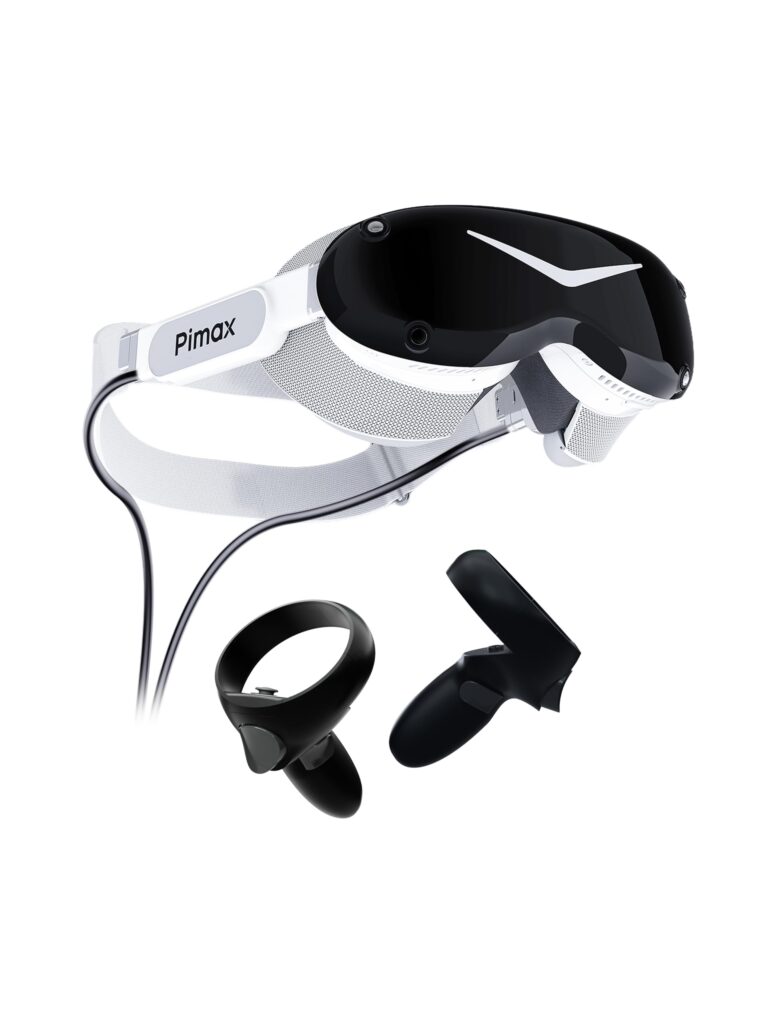
- Ultralight sub-170g (< 6.0 oz) chassis dramatically mitigates neck fatigue and facial pressure
- Dual 3840x3552 Sony Micro-OLED panels provide exceptional pixel density with deep black levels
- Integrated 120 Hz eye tracking supports dynamic foveated rendering to lessen host GPU strain
- Uncompressed DisplayPort 1.4a tether delivers native video stream without wireless latency or compression artifacts
- Stock elastic headstrap lacks rigid ergonomic support, requiring third-party strap upgrades for long sessions
- High resolution requires an enthusiast-tier host GPU for smooth rendering performance
- Vertical field of view is perceptibly narrower than the 110-degree horizontal field
Overview
Shedding the cumbersome heft of traditional enthusiast virtual reality headsets, Pimax’s ultra-compact optical design targets one of simulation’s longest-standing bottlenecks: sustained facial pressure. Weighing under 6.0 oz (< 170 g), the chassis repositions high-end visual computing around high-density Sony Micro-OLED panels running at 3840 x 3552 pixels per eye. Paired with custom ConcaveView pancake lenses delivering a 110-degree horizontal field of view, the visual plane eliminates the screen-door effect while sustaining deep black levels and high contrast at either 72 Hz or 90 Hz refresh cadences. While the horizontal field provides generous peripheral awareness for cockpit simulators and virtual desktop workspaces, the vertical field of view is perceptibly tighter, requiring conscious head movement rather than pure eye travel during vertical scans. Internal packaging demonstrates disciplined component integration, anchored by an automatic motorized interpupillary distance mechanism adjustable from 2.28 to 2.83 in (58 to 72 mm). Embedded 120 Hz eye-tracking sensors continuously monitor gaze vectors, supplying real-time coordinates to drive dynamic foveated rendering. This hardware-level gaze tracking critically offsets the immense GPU processing burden demanded by dual high-resolution displays by focusing peak rendering horsepower exclusively where the user looks. Thermal dissipation is managed by two integrated active continuous cooling fans built directly into the housing, circulating airflow around the displays and internal processing logic to prevent thermal throttling and lens fogging during extended wear without transferring intrusive vibration to the face. Off-ear speakers integrated into the frame deliver spatial audio while keeping the ears open and unencumbered. Real-world tracking and connectivity rely on a hybrid inside-out platform coupled to a dedicated DisplayPort 1.4a and USB 3.0 split cable measuring 16.4 ft (5.0 m). Four onboard tracking cameras drive six-degree-of-freedom SLAM localization, bypassing external base stations while tracking the included dual motion controllers. On the software front, the headset interfaces through Pimax Play and SteamVR, providing a direct, uncompressed video feed free from the compression artifacts and encoding lag common to wireless streaming alternatives. However, the factory elastic headstrap constitutes the platform's primary ergonomics trade-off; lacking structured crown support or rear counterbalancing, it often prompts users to invest in aftermarket or rigid strap solutions to preserve comfort across prolonged cockpit sessions.
Technical Specifications
| Brand | Pimax |
| Model | Dream Air Slam |
| Display Type | Sony Micro-OLED |
| Per Eye Resolution | 3840 x 3552 |
| Refresh Rate | 72 Hz / 90 Hz |
| Optics | Pimax ConcaveView Pancake |
| Horizontal Field Of View | 110° |
| IPD Adjustment | Automatic Motorized, 2.28–2.83 in (58–72 mm) |
| Headset Weight | < 6.0 oz (< 170 g) |
| Tracking Architecture | Inside-Out 6DoF SLAM (4 Onboard Cameras) |
| Eye Tracking | Integrated 120 Hz Gaze Tracking (Dynamic Foveated Rendering) |
| Cooling Solution | Dual Integrated Continuous Active Fans |
| Audio System | Integrated Off-Ear Spatial Speakers |
| I/O Connectivity | DisplayPort 1.4a & USB 3.0 Tethered Cable, 16.4 ft (5.0 m) |
| Controllers | Dual 6DoF Motion Controllers Included |
| Software Platform | Pimax Play, SteamVR |
Primary Sources & Audited Citations
Recommended Alternatives in VR & AR Headsets
At a Glance
How reliable is the Pimax Dream Air Slam according to Mizex audits?
Ideal for simulation enthusiasts demanding uncompressed Micro-OLED visual fidelity in an ultralight shell, provided buyers budget for an aftermarket comfort strap and possess enthusiast-tier GPU hardware.
What are the known quirks or drawbacks of the Pimax Dream Air Slam?
Our reliability audit identified the following documented caveats:
- Stock elastic headstrap lacks rigid ergonomic support, requiring third-party strap upgrades for long sessions
- High resolution requires an enthusiast-tier host GPU for smooth rendering performance
- Vertical field of view is perceptibly narrower than the 110-degree horizontal field
What are the key engineering highlights of the Pimax Dream Air Slam?
The top strengths recorded in our evaluation include:
- Ultralight sub-170g (< 6.0 oz) chassis dramatically mitigates neck fatigue and facial pressure
- Dual 3840x3552 Sony Micro-OLED panels provide exceptional pixel density with deep black levels
- Integrated 120 Hz eye tracking supports dynamic foveated rendering to lessen host GPU strain
- Uncompressed DisplayPort 1.4a tether delivers native video stream without wireless latency or compression artifacts