
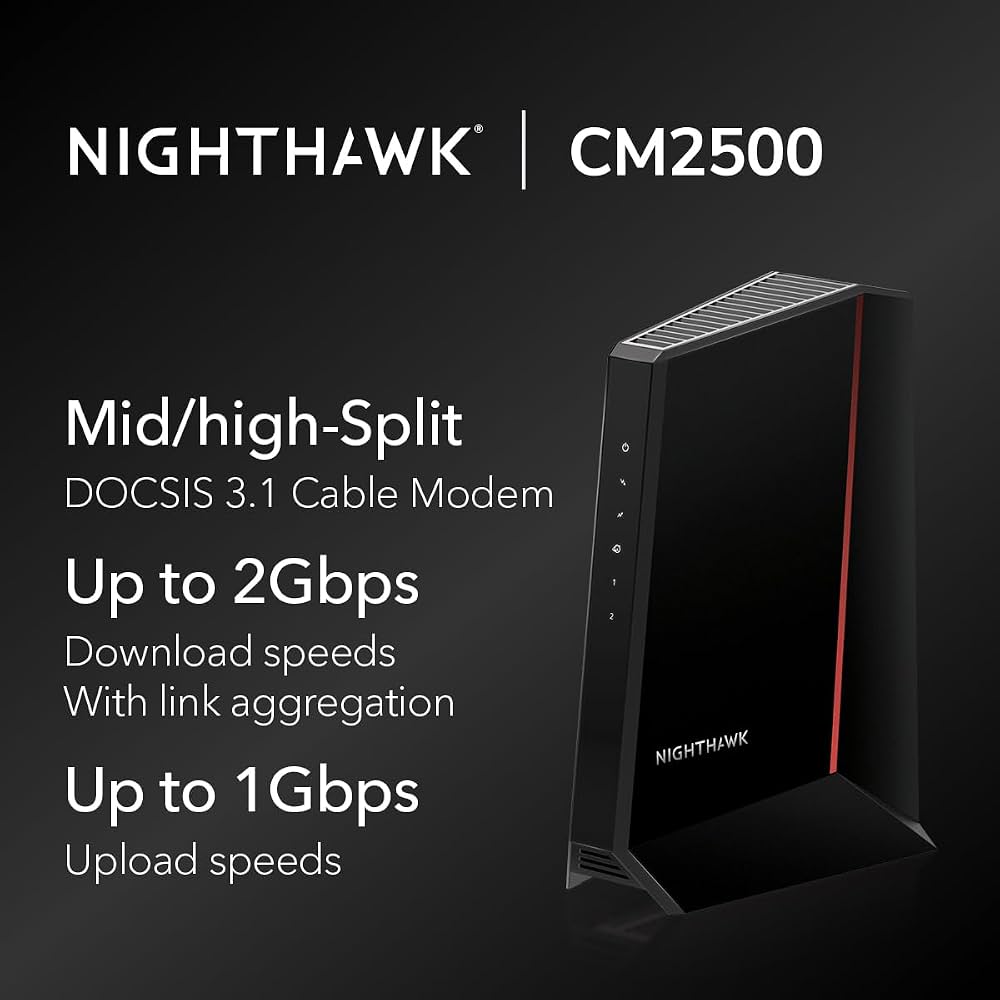
- DOCSIS 3.1 mid/high-split support enables up to 2 Gbps download and 1 Gbps upload speeds
- Dual Gigabit Ethernet ports support link aggregation for up to 2 Gbps combined throughput
- Certified for major US cable providers including Xfinity, Spectrum, and Cox
- Requires a separate Wi-Fi router or mesh system (no built-in wireless)
- Reaching 2 Gbps requires a router supporting dual-port link aggregation
- Not compatible with cable bundled voice lines or fiber internet connections
Overview
Mid- and high-split DOCSIS 3.1 cable upgrades have finally pushed residential cable uploads out of the slow lane, and the NETGEAR Nighthawk CM2500 targets that exact shift. Built strictly as a standalone modem, it pairs up to 2 Gbps download throughput with up to 1 Gbps upload speeds across certified US cable networks from Xfinity, Spectrum, and Cox.
Keeping wireless radios and telephony circuits out of the enclosure lets the hardware focus entirely on coax signal processing without sharing internal space with high-power Wi-Fi transmitters. The main architectural quirk sits on the back panel: instead of a single multi-gig port, NETGEAR uses two 1 Gbps Ethernet jacks that require link aggregation to push past a single gigabit.
In everyday setups, that port layout means pairing the modem with a standalone router or mesh system that supports dual-WAN aggregation if you pay for plans faster than 1 Gbps. Households relying on bundled cable voice service or fiber internet will also need to look elsewhere, as this unit handles pure DOCSIS 3.1 data only.
Technical Specifications
| Brand | NETGEAR |
| Model | Nighthawk CM2500 |
| Model Number | CM2500 |
| Device Type | Cable Modem (No Built-in Wi-Fi Router) |
| Cable Standard | DOCSIS 3.1 with Mid/High-Split |
| Max Download Speed | Up to 2 Gbps |
| Max Upload Speed | Up to 1 Gbps |
| Ethernet Ports | 2x Gigabit Ethernet (Link Aggregation up to 2 Gbps) |
| ISP Compatibility | Xfinity from Comcast, Spectrum, Cox |
| Incompatible Services | Cable bundled voice services, Fiber internet services |
Primary Sources & Audited Citations
Recommended Alternatives in Networking & Routers

At a Glance
How reliable is the NETGEAR Nighthawk CM2500 according to Mizex audits?
Buy this if you run a standalone router with link aggregation on Xfinity, Spectrum, or Cox; skip it if you need built-in Wi-Fi, cable voice ports, or a single multi-gig Ethernet jack.
What are the known quirks or drawbacks of the NETGEAR Nighthawk CM2500?
Our reliability audit identified the following documented caveats:
- Requires a separate Wi-Fi router or mesh system (no built-in wireless)
- Reaching 2 Gbps requires a router supporting dual-port link aggregation
- Not compatible with cable bundled voice lines or fiber internet connections
What are the key engineering highlights of the NETGEAR Nighthawk CM2500?
The top strengths recorded in our evaluation include:
- DOCSIS 3.1 mid/high-split support enables up to 2 Gbps download and 1 Gbps upload speeds
- Dual Gigabit Ethernet ports support link aggregation for up to 2 Gbps combined throughput
- Certified for major US cable providers including Xfinity, Spectrum, and Cox