
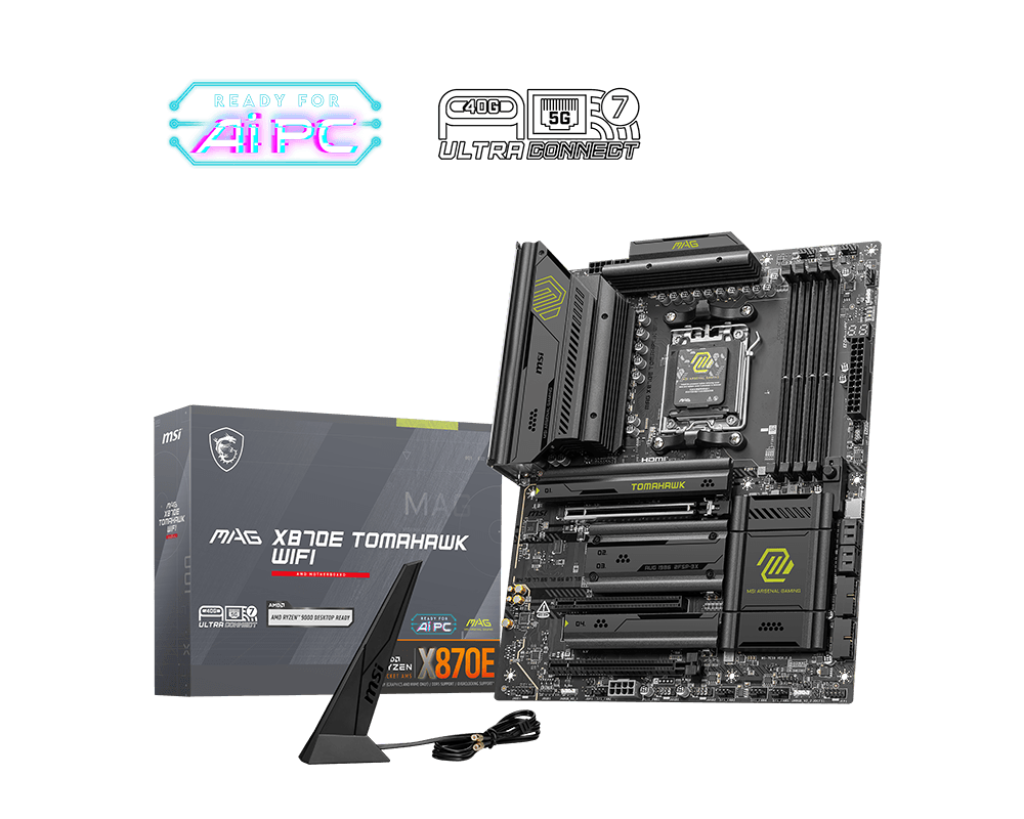
- Unbifurcated PCIe 5.0 x16 primary expansion slot maintains dedicated graphics bandwidth regardless of M.2 drive configuration.
- Robust 14+2+1 phase VRM with 80A MPS power stages operates at a cool 65°C under sustained 16-core load.
- Doubled 64MB BIOS Flash ROM and integrated external clock generator supply extensive future AGESA microcode and BCLK tuning headroom.
- Supplemental 8-pin PCIe power header supplies up to 252W of auxiliary 12V current to handle high-transient board loads.
- Secondary PCIe 5.0 M.2 slot shares bandwidth with rear USB4 ports, forcing lane downshifting to x2 or disabling USB4.
- Absence of an onboard segment alphanumeric diagnostic display limits direct pre-boot hardware troubleshooting.
Overview
Routing 16 dedicated PCIe 5.0 lanes directly from the AM5 socket to the primary graphics expansion slot without bandwidth-halving lane bifurcation defines the board’s core interconnect strategy. Rather than adopting the common industry compromise of dropping the primary PEG slot to x8 when a secondary high-speed drive is installed, the platform routes its secondary PCIe 5.0 M.2 connection through a shared switch with the dual 40Gbps ASMedia ASM4242 USB4 controller. Supplying current to the AM5 socket is a 14+2+1 Duet Rail power subsystem utilizing 80A Monolithic Power Systems MP87670 Smart Power Stages driven by a Richtek and MPS multi-phase PWM topology. Power integrity is distributed across an 8-layer server-grade printed circuit board incorporating 2oz thickened copper, backed at the lower edge by a dedicated 8-pin auxiliary PCIe power connector that injects up to 252W of additional 12V current to handle severe motherboard-level PCIe transient spikes alongside dual 8-pin EPS CPU inputs.
Thermal management relies on high-mass passive dissipation, combining finned aluminum VRM heatsinks and 7 W/mK MOSFET thermal pads with multi-zone EZ M.2 Shield Frozr II covers. In sustained 30-minute full-load stress testing with flagship 16-core Ryzen 9000 processors, VRM surface temperatures peak at 65°C without active cooling assistance, while the primary M.2 heatsink keeps high-performance PCIe 5.0 solid-state drives operating at 73°C under sustained sequential traffic. Physical integration incorporates toolless EZ M.2 quick-release latches and an EZ PCIe latch button for rapid GPU extraction, with structural rigidity reinforced by Steel Armor II solder anchors surrounding the primary expansion slot to resist mechanical shear from heavy graphics cards.
Firmware architecture integrates an expanded 64MB (512Mb) UEFI Flash ROM paired with an external clock generator, delivering extensive AGESA microcode capacity for upcoming CPU generations alongside asynchronous base clock overclocking capabilities. Connectivity is rounded out by a Realtek RTL8126 5Gbps Ethernet PHY, a MediaTek MT7927 Wi-Fi 7 wireless module supporting 320MHz channels and Bluetooth 5.4, and an isolated Realtek ALC4080 audio codec. While system builders must navigate the lane-sharing trade-off between the secondary Gen 5 M.2 slot and rear USB4 bandwidth, the platform’s robust power delivery, stable thermal envelope, and doubled BIOS memory establish an enduring hardware foundation for high-end AM5 configurations.
Technical Specifications
| Brand | MSI |
| Model | MAG X870E Tomahawk MAX WiFi V1 |
| Form Factor | ATX (304.8 mm x 243.84 mm) |
| Socket | AMD Socket AM5 |
| Chipset | AMD X870E (Dual Promontory 21) |
| Cpu Support | AMD Ryzen 9000 / 8000 / 7000 Series |
| Power Delivery Vrm | 14+2+1 Duet Rail Power System |
| Power Stages | 80A Smart Power Stages (Monolithic Power Systems MP87670) |
| Pwm Controller | Richtek RT3672EE / Monolithic Power Systems MP2509 |
| Pcb Construction | 8-layer server-grade PCB with 2oz thickened copper |
| Power Connectors | 1x 24-pin ATX, 2x 8-pin EPS 12V CPU, 1x 8-pin Supplemental PCIe Power (up to 252W) |
| Memory Support | 4x DDR5 DIMM, Dual Channel, up to 256GB, DDR5-8400+ (OC) |
| Pcie Expansion Slots | 1x PCIe 5.0 x16 (CPU, Steel Armor II), 1x PCIe 4.0 x4 (Chipset), 1x PCIe 3.0 x1 (Chipset) |
| M2 Storage Slots | 4x M.2 (2x PCIe 5.0 x4 from CPU, 2x PCIe 4.0 x4 from Chipset) |
| Sata Ports | 4x SATA 6Gb/s |
| Usb4 Controller | ASMedia ASM4242 (2x 40Gbps Type-C with DP Alt Mode) |
| Rear Usb Ports | 2x USB4 40Gbps Type-C, 3x USB 10Gbps Type-A, 1x USB 10Gbps Type-C, 4x USB 5Gbps Type-A |
| Front Usb Headers | 1x USB 20Gbps Type-C, 2x USB 5Gbps Type-A, 2x USB 2.0 |
| Networking Wired | Realtek RTL8126 5Gbps Ethernet |
| Networking Wireless | MediaTek MT7927 Wi-Fi 7 (802.11be, 320MHz) + Bluetooth 5.4 |
| Audio Codec | Realtek ALC4080 7.1-Channel HD Audio with isolated audio PCB |
| Cooling Heatsinks | Extended VRM aluminum heatsinks with 7 W/mK pads, EZ M.2 Shield Frozr II |
| Bios Rom Capacity | 64MB (512Mb) UEFI AMI Flash ROM |
| Diy Features | EZ PCIe Release, EZ M.2 Clip II, EZ Antenna, Flash BIOS Button, Clear CMOS Button |
Primary Sources & Audited Citations
Recommended Alternatives in Motherboards
At a Glance
How reliable is the MSI MAG X870E Tomahawk MAX WiFi V1 Review: Engineered For Sustained Generational Upgrades according to Mizex audits?
An ideal foundation for Ryzen 9000 builds prioritizing uncompromised full-bandwidth graphics lanes and heavy power stability, provided the lane-sharing trade-off between the secondary Gen 5 SSD slot and USB4 ports fits your storage roadmap.
What are the known quirks or drawbacks of the MSI MAG X870E Tomahawk MAX WiFi V1 Review: Engineered For Sustained Generational Upgrades?
Our reliability audit identified the following documented caveats:
- Secondary PCIe 5.0 M.2 slot shares bandwidth with rear USB4 ports, forcing lane downshifting to x2 or disabling USB4.
- Absence of an onboard segment alphanumeric diagnostic display limits direct pre-boot hardware troubleshooting.
What are the key engineering highlights of the MSI MAG X870E Tomahawk MAX WiFi V1 Review: Engineered For Sustained Generational Upgrades?
The top strengths recorded in our evaluation include:
- Unbifurcated PCIe 5.0 x16 primary expansion slot maintains dedicated graphics bandwidth regardless of M.2 drive configuration.
- Robust 14+2+1 phase VRM with 80A MPS power stages operates at a cool 65°C under sustained 16-core load.
- Doubled 64MB BIOS Flash ROM and integrated external clock generator supply extensive future AGESA microcode and BCLK tuning headroom.
- Supplemental 8-pin PCIe power header supplies up to 252W of auxiliary 12V current to handle high-transient board loads.