
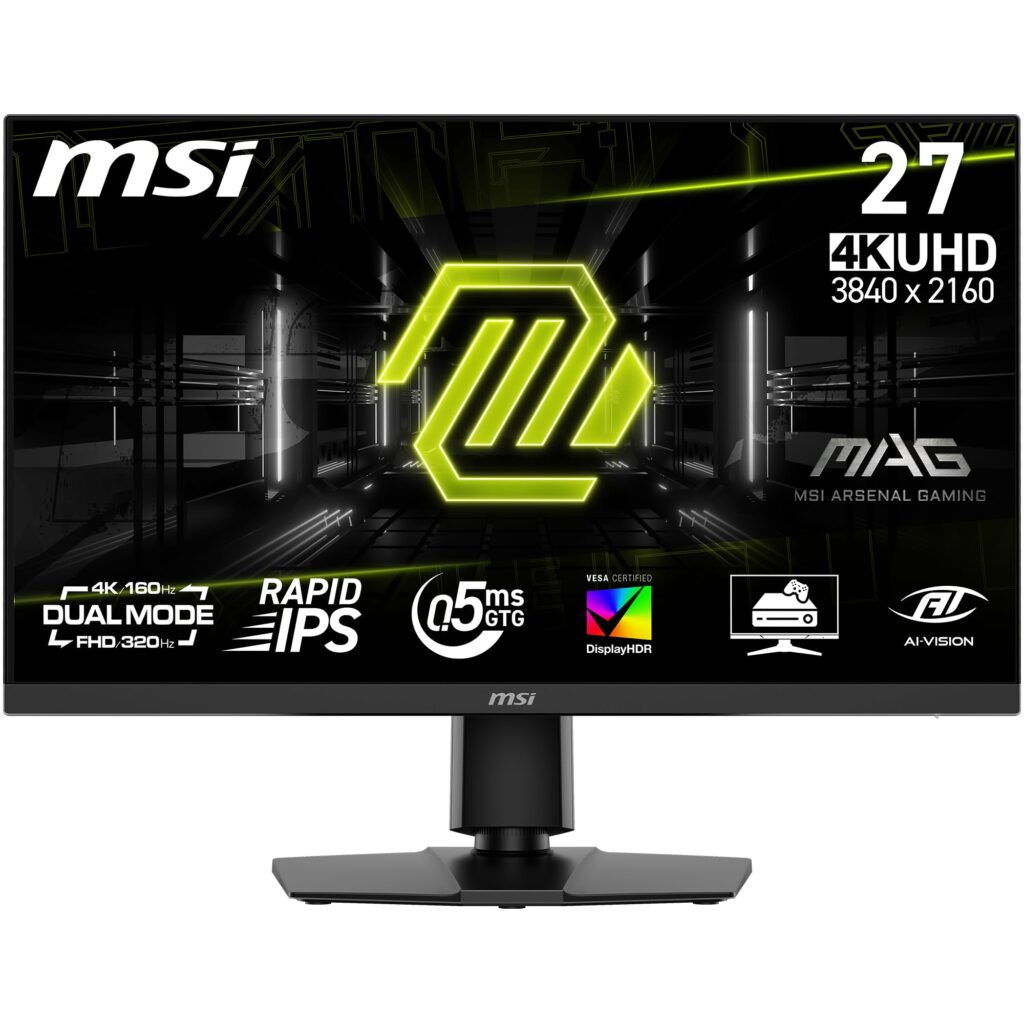
- Dual-mode Rapid IPS panel switches between 4K UHD (160Hz) and 1080p FHD (320Hz) with 0.5ms (GtG, Min.) response time
- Two full-bandwidth HDMI 2.1 ports (4K@160Hz) plus DisplayPort 1.4a with PS5/Xbox VRR and HDMI CEC support
- Full ergonomic stand with 0–5.12 in (0–130 mm) height adjustment, tilt, swivel, pivot, and an internal power board
- Wide color gamut coverage (131% sRGB, 93% DCI-P3) paired with AMD FreeSync Premium across both refresh modes
- Entry-level DisplayHDR 400 (400 cd/m² peak, 1000:1 static contrast) lacks local dimming for meaningful HDR
- Downstream hub is limited to two USB 2.0 Type-A ports with no built-in KVM switch
- 320Hz refresh rate requires dropping resolution to 1080p in Dual Mode
Overview
Dual-mode monitors solve an old desk dilemma: you no longer have to choose between crisp 4K detail for work and single-player games or hyper-responsive refresh rates for competitive shooters. MSI builds the MAG 272URDFA E16 around a 27-inch (68.6 cm) flat Rapid IPS panel that runs natively at 3840 x 2160 up to 160Hz, then drops cleanly to 1920 x 1080 at 320Hz whenever frame pacing matters more than pixel density. Rated at a 0.5ms minimum gray-to-gray response time with AMD FreeSync Premium spanning 48Hz to 160Hz in UHD and 48Hz to 320Hz in FHD, motion stays sharp across both modes without tearing.
Color coverage holds up well for everyday creative tasks and gaming, reaching 93% DCI-P3 and 131% sRGB on a 10-bit (8-bit plus FRC) panel with an anti-glare coating. The catch is HDR performance: with a 400 cd/m² typical brightness ceiling, a 1000:1 static contrast ratio, and no local dimming, VESA DisplayHDR 400 support here is strictly entry-level rather than true high-dynamic-range viewing. On the desk, MSI avoids external power brick clutter by integrating the power board directly into the 16.3 lbs (7.4 kg) chassis and pairing it with a fully articulated stand offering tilt, swivel, pivot, and 5.12 in (130 mm) of height adjustment alongside standard 3.94 x 3.94 in (100 x 100 mm) VESA mounting.
Connectivity covers modern PCs and consoles cleanly via two full-bandwidth HDMI 2.1 ports capable of 4K at 160Hz and a single DisplayPort 1.4a input, backed by PS5 and Xbox VRR support, HDMI CEC, and Picture-in-Picture modes. However, the peripheral side feels dated—you only get two USB 2.0 Type-A downstream ports via a USB 2.0 Type-B upstream link, and there is no built-in KVM switch for sharing peripherals between two systems. That leaves the MAG 272URDFA E16 squarely focused on display versatility rather than acting as an all-in-one desk hub.
Technical Specifications
| Brand | MSI |
| Model | MAG 272URDFA E16 |
| Panel Size | 27 in (68.6 cm) |
| Panel Type | Rapid IPS (Flat, Anti-glare) |
| Native Resolution & Refresh | 3840 x 2160 (UHD) @ 160Hz |
| Dual Mode Resolution & Refresh | 1920 x 1080 (FHD) @ 320Hz |
| Response Time | 0.5ms (GtG, Min.) |
| VRR Support | AMD FreeSync Premium (48–160Hz UHD / 48–320Hz FHD) |
| Brightness & HDR | 400 cd/m² (Typ./Peak), VESA DisplayHDR 400 |
| Static Contrast Ratio | 1000:1 (Typ.) |
| Color Depth & Gamut | 1.07B (8-bit + FRC), 131% sRGB, 93% DCI-P3, 88% Adobe RGB (CIE1976) |
| Video Inputs | 1x DisplayPort 1.4a (HBR3), 2x HDMI 2.1 (4K@160Hz) |
| USB & Audio Ports | 2x USB 2.0 Type-A, 1x USB 2.0 Type-B, 1x Headphone-out |
| Console & Multi View | PS5/Xbox VRR, HDMI CEC, Console Mode (60/120Hz), PiP/PbP (No KVM) |
| Power Supply | Internal Power Board (100–240V, 50/60Hz) |
| Ergonomics | Height 0–5.12 in (0–130 mm), Tilt -5°–20°, Swivel -30°–30°, Pivot -90°–90° |
| VESA Mount | 3.94 x 3.94 in (100 x 100 mm) |
| Dimensions (With Stand) | 24.15 x 8.97 x 21.11 in (613.5 x 227.9 x 536.3 mm) |
| Dimensions (Without Stand) | 24.15 x 2.15 x 14.39 in (613.5 x 54.6 x 365.4 mm) |
| Net Weight | 16.3 lbs (7.4 kg) |
Primary Sources & Audited Citations
Recommended Alternatives in Monitors & Displays
At a Glance
How reliable is the MSI MAG 272URDFA E16 according to Mizex audits?
Buy this if you play both visually demanding 4K titles and fast 1080p competitive shooters on one desk; look at a Mini-LED or OLED monitor instead if true HDR contrast or high-speed USB-C hub connectivity is a priority.
What are the known quirks or drawbacks of the MSI MAG 272URDFA E16?
Our reliability audit identified the following documented caveats:
- Entry-level DisplayHDR 400 (400 cd/m² peak, 1000:1 static contrast) lacks local dimming for meaningful HDR
- Downstream hub is limited to two USB 2.0 Type-A ports with no built-in KVM switch
- 320Hz refresh rate requires dropping resolution to 1080p in Dual Mode
What are the key engineering highlights of the MSI MAG 272URDFA E16?
The top strengths recorded in our evaluation include:
- Dual-mode Rapid IPS panel switches between 4K UHD (160Hz) and 1080p FHD (320Hz) with 0.5ms (GtG, Min.) response time
- Two full-bandwidth HDMI 2.1 ports (4K@160Hz) plus DisplayPort 1.4a with PS5/Xbox VRR and HDMI CEC support
- Full ergonomic stand with 0–5.12 in (0–130 mm) height adjustment, tilt, swivel, pivot, and an internal power board
- Wide color gamut coverage (131% sRGB, 93% DCI-P3) paired with AMD FreeSync Premium across both refresh modes