
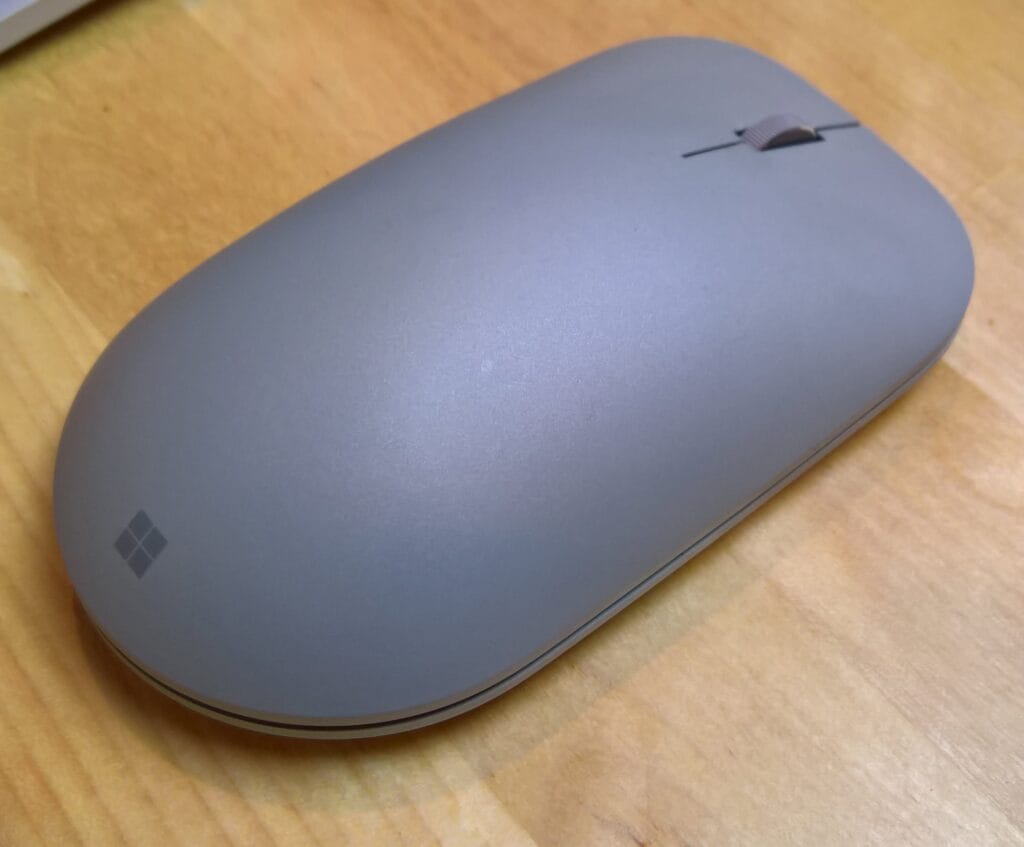
- Solid-state capacitive and pressure sensors eliminate mechanical microswitch wear and double-click defects
- Internal haptic engine provides customizable tactile feedback with minimal acoustic disruption
- Bluetooth 6.0 connectivity enables stable, seamless multi-device switching
- Up to six months of operational runtime on standard AAA cells
- Relies on disposable AAA batteries instead of an integrated USB-C rechargeable cell
- Higher launch price ($79.99) compared to predecessor generations
- Haptic adjustment and Action Button remapping require the dedicated Microsoft Surface application
Overview
The second-generation Microsoft Surface Mouse marks a major architectural pivot by replacing conventional mechanical microswitches with a solid-state actuation system. Built on capacitive touch and pressure sensors paired with a localized vibration motor housed in the top hump, the mouse synthesizes tactile click confirmation and contextual feedback electronically. Bluetooth 6.0 powers multi-device pairing, enabling seamless transitions across connected hosts while maintaining an ultra-low energy footprint that stretches two AAA batteries to roughly six months of continuous service.
Constructed with an ambidextrous shell incorporating 30% recycled materials, the chassis achieves structural rigidity with minimal seam lines, mitigating flex and creaking. Acoustically, the solid-state design dampens the sharp, audible snap typical of traditional microswitches, shifting the operational profile toward quiet, user-adjustable haptic pulses that emit negligible acoustic noise during rapid navigation. Thermal buildup remains nonexistent due to the passive, low-draw peripheral architecture.
In daily use, removing mechanical contact points directly addresses contact bounce and double-click degradation over extended lifecycles. However, deep customization of the dedicated Action Button and haptic intensity profiles relies strictly on the proprietary Microsoft Surface app rather than native Windows subsystem menus. Furthermore, the absence of an integrated rechargeable lithium-ion cell via USB-C requires users to maintain spare AAA batteries, presenting a practical trade-off against modern rechargeable productivity peripherals.
Technical Specifications
| Brand | Microsoft |
| Model | Microsoft Surface Mouse (2nd Gen) |
| Form Factor | Ambidextrous |
| Actuation Technology | Capacitive touch and pressure sensors with haptic force feedback |
| Haptic Engine | Integrated vibration motor in shell hump with adjustable intensity |
| Connectivity | Bluetooth 6.0 |
| Multi Device Pairing | Simultaneous multi-device connection |
| Battery Type | 2x AAA batteries |
| Battery Runtime | Up to 6 months |
| Buttons | Touch/click surface with customizable Action Button (default Copilot) |
| Sustainable Materials | 30% recycled content |
| Available Finishes | Black, Platinum |
| Configuration Interface | Microsoft Surface app |
Primary Sources & Audited Citations
- Microsoft revives the Surface Mouse with haptic feedback, six-month battery life | TechSpot
- Microsoft – AI, Cloud, Productivity, Computing, Gaming & Apps
- Microsoft account | Sign In or Create Your Account Today – Microsoft
- Microsoft’s new Surface Mouse has haptic feedback and a customizable action button
- The Surface Mouse’s Haptics Are Truly Unique, but We Need Even More Rumble
- Microsoft – AI, Cloud, Productivity, Computing, Gaming & Apps
- Gadget Teardowns - iFixit
- Microsoft – AI, Cloud, Productivity, Computing, Gaming & Apps
- Free CPU & GPU Stress Test — Check If Your PC Is Too Hot
- Microsoft – AI, Cloud, Productivity, Computing, Gaming & Apps
- Windows 11 25H2 (2025 Update) Known Issues and ... - AskVG
- Microsoft – AI, Cloud, Productivity, Computing, Gaming & Apps
- Surface Service Guide Center - Surface | Microsoft Learn
- Microsoft – AI, Cloud, Productivity, Computing, Gaming & Apps
- Identify your Surface mouse | Microsoft Support
Recommended Alternatives in Keyboards & Mice
At a Glance
How reliable is the Microsoft Surface Mouse (2nd Gen) Review: Haptic actuation eliminates switch fatigue according to Mizex audits?
An exceptionally durable, low-noise productivity mouse for mobile workflows, provided you accept disposable AAA battery operation and the premium launch price.
What are the known quirks or drawbacks of the Microsoft Surface Mouse (2nd Gen) Review: Haptic actuation eliminates switch fatigue?
Our reliability audit identified the following documented caveats:
- Relies on disposable AAA batteries instead of an integrated USB-C rechargeable cell
- Higher launch price ($79.99) compared to predecessor generations
- Haptic adjustment and Action Button remapping require the dedicated Microsoft Surface application
What are the key engineering highlights of the Microsoft Surface Mouse (2nd Gen) Review: Haptic actuation eliminates switch fatigue?
The top strengths recorded in our evaluation include:
- Solid-state capacitive and pressure sensors eliminate mechanical microswitch wear and double-click defects
- Internal haptic engine provides customizable tactile feedback with minimal acoustic disruption
- Bluetooth 6.0 connectivity enables stable, seamless multi-device switching
- Up to six months of operational runtime on standard AAA cells