
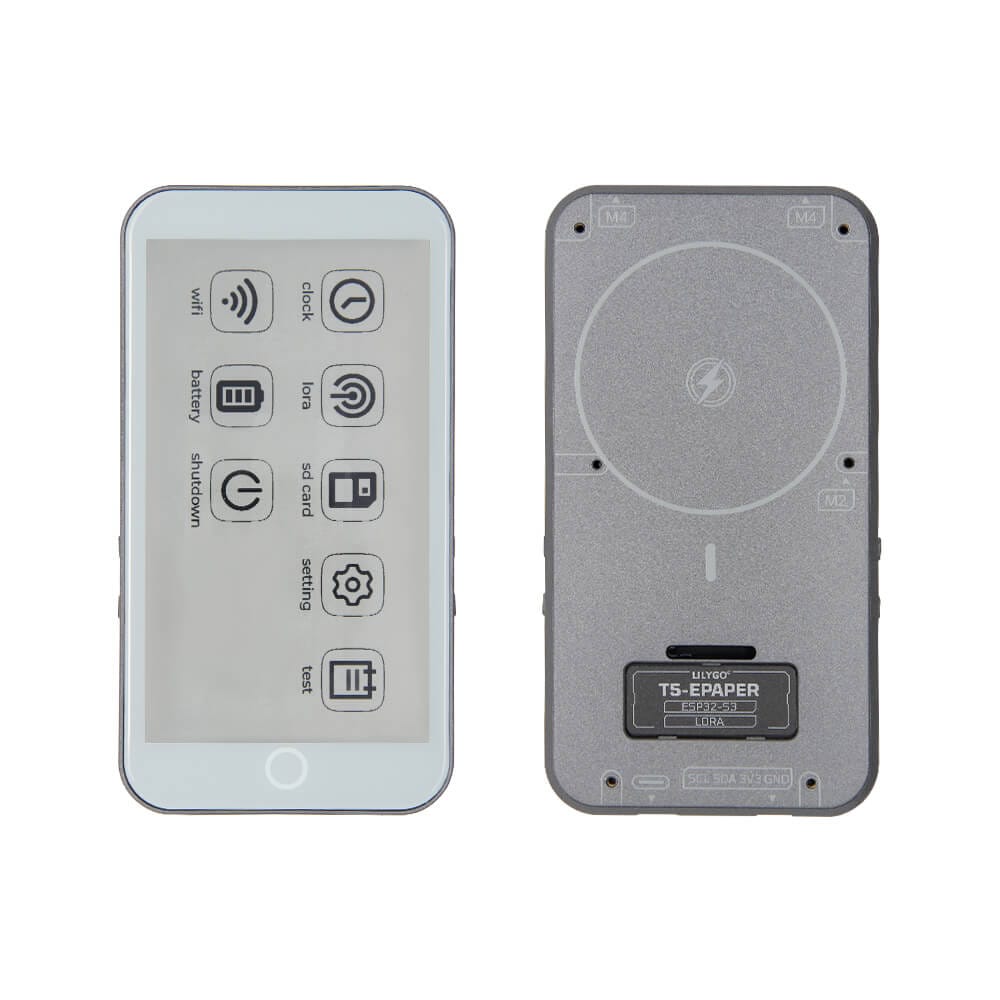
- Integrated LoRa transceiver enables long-range off-grid communication without external modules.
- Comprehensive power management suite including fuel gauge and RTC for true battery independence.
- V2 revision adds support for multi-constellation GNSS tracking.
- Arduino IDE examples frequently fail to compile on M1 Macs due to library incompatibilities.
- V1 boards lack a GNSS receiver, requiring an upgrade to V2 for location services.
- Passive thermal design limits sustained high-power transmission without external heat sinking.
Overview
The LILYGO T5 E-Paper S3 Pro is a specialized Single Board Computer designed for low-power, long-duration IoT deployments, leveraging the ESP32-S3-WROOM-1 processor to deliver 240 MHz performance within an ultra-slim 11mm chassis. Its architecture integrates a high-resolution 4.7-inch e-paper display with capacitive touch and a Semtech SX1262 LoRa transceiver, enabling robust off-grid communication across global frequencies while maintaining minimal energy consumption. The board features essential power management components including the BQ25896 charger and BQ27220 fuel gauge chips to ensure precise battery monitoring for its 1500 mAh Li-Po cell, alongside a PCF8563 RTC for timekeeping without constant power draw. While V1 units omit GNSS hardware, the V2 revision adds multi-constellation support, though users must navigate distinct firmware handling for this upgrade. The device operates silently as a passive electronic component, relying on thermal dissipation through its compact form factor rather than active cooling systems.
Technical Specifications
| Brand | LILYGO |
| Model | LILYGO T5 E-Paper S3 Pro |
| Mcu | ESP32-S3-WROOM-1 |
| Processor Speed Mhz | 240 |
| Wifi Standard | 802.11n WiFi 4 |
| Bluetooth Version | Bluetooth 5.0 LE |
| Flash Memory Mb | 16 |
| Psram Mb | 8 |
| Display Size Inches | 4.7 |
| Display Resolution | 960x540 |
| Display Technology | E-Paper (ED047TC1) |
| Grayscale Levels | 16 |
| Touch Controller | GT911 capacitive touch |
| LoRa Transceiver | Semtech SX1262 (TCXO) |
| LoRa Frequencies Mhz | 433, 868, 915 |
| Gnss Module | u-blox MIA-M10Q or Quectel L76K (V2 only) |
| Battery Capacity Mah | 1500 |
| Battery Type | Li-Po |
| Usb Port | USB Type-C |
| Rtc Chip | PCF8563 |
| Charger Chip | BQ25896 |
| Fuel Gauge Chip | BQ27220 |
| Io Expander | PCA9535 |
| Dimensions Mm | 129 x 69 x 11 |
Primary Sources & Audited Citations
- OpenTrailPaper transforms LILYGO T5 E-Paper S3 Pro devkit into a DIY e‑paper bike computer - CNX Software
- T5 E-Paper S3 Pro - LILYGO®
- T5-4.7 E-Paper S3 Pro | Documentation - wiki.lilygo.cc
- LILYGO® T5 E-Paper S3 Pro - Meshtastic
- T5S3-4.7-e-paper-PRO/lib/lvgl/demos/benchmark/README.md at ... - GitHub
- lilygo-t5-pro-epub-reader/docs/KNOWN_ISSUES.md at master - GitHub
- Problems with LilyGo e-paper - Electronic Components & Theory ...
Recommended Alternatives in Single Board Computers (SBCs)

At a Glance
How reliable is the LILYGO T5 E-Paper S3 Pro Review: Efficient IoT Hardware Plagued By Software according to Mizex audits?
Ideal for off-grid LoRa and e-paper projects but requires careful firmware selection due to known compilation issues on certain development environments.
What are the known quirks or drawbacks of the LILYGO T5 E-Paper S3 Pro Review: Efficient IoT Hardware Plagued By Software?
Our reliability audit identified the following documented caveats:
- Arduino IDE examples frequently fail to compile on M1 Macs due to library incompatibilities.
- V1 boards lack a GNSS receiver, requiring an upgrade to V2 for location services.
- Passive thermal design limits sustained high-power transmission without external heat sinking.
What are the key engineering highlights of the LILYGO T5 E-Paper S3 Pro Review: Efficient IoT Hardware Plagued By Software?
The top strengths recorded in our evaluation include:
- Integrated LoRa transceiver enables long-range off-grid communication without external modules.
- Comprehensive power management suite including fuel gauge and RTC for true battery independence.
- V2 revision adds support for multi-constellation GNSS tracking.