
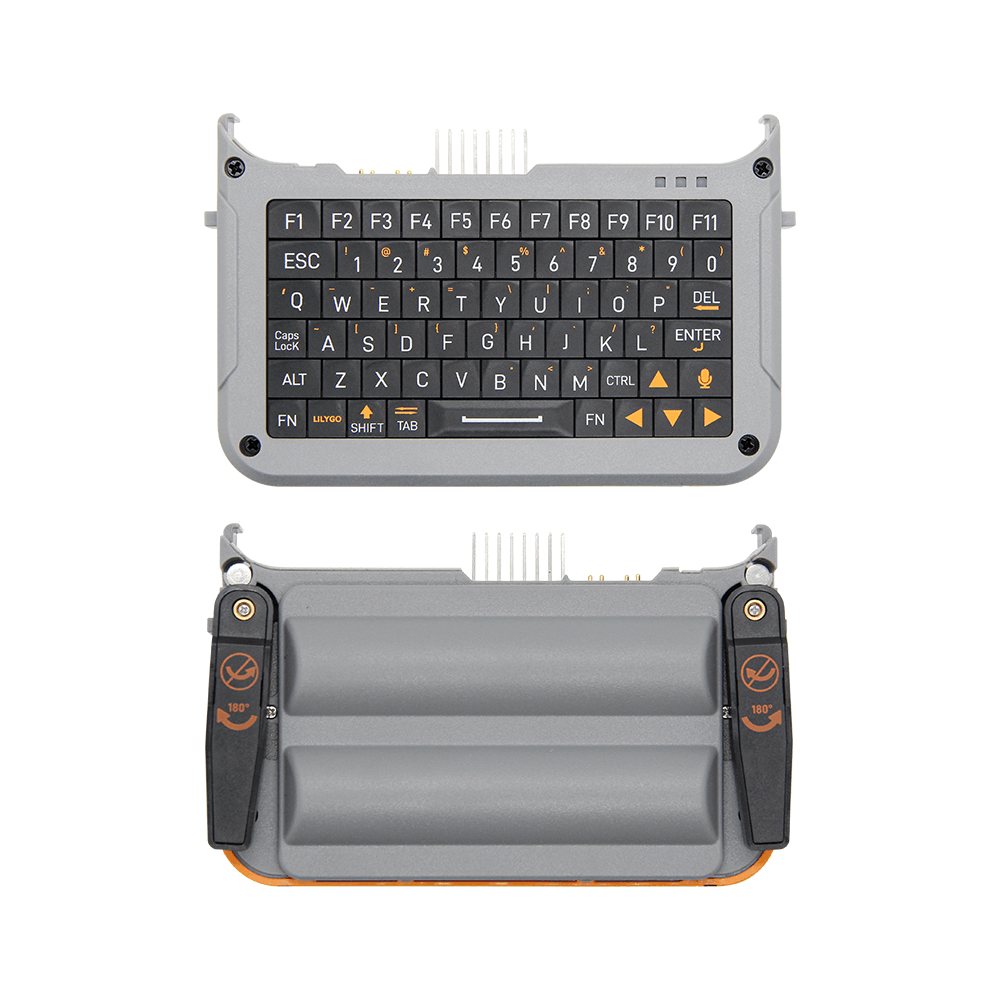
- Dedicated Texas Instruments TCA8418 I2C keyboard controller with hardware debouncing and key event FIFO
- Extensive RF consolidation integrating CC1101 Sub-GHz, nRF24L01 2.4 GHz, and ST25R3916 NFC transceivers
- Dual 21700 lithium-ion cell bay provides high-capacity runtime for untethered field terminal operation
- Cable-free mating via spring-loaded pogo pin interface directly to the host platform
- Quiescent standby battery drain can deplete 21700 cells into low-voltage lockout if the hardware switch is left on
- Pogo-pin bus alignment requires precise mechanical registration to prevent I2C initialization failures
- Cramped miniature tactile dome switch layout limits typing comfort during prolonged sessions
Overview
Interfacing directly through a rear-mounted pogo-pin array, LILYGO’s keyboard expansion transforms the ESP32-P4 host platform into an autonomous handheld cyberdeck terminal. Offloading key scanning from the primary RISC-V compute cores, the board integrates a dedicated Texas Instruments TCA8418 I2C keyboard scanner with hardware matrix debouncing and a ten-event FIFO queue. Complementing the matrix logic is an XL9555 16-bit GPIO expander, which routes control signals across peripheral subsystems and manages peripheral reset lines. In addition to tactile text input, the carrier integrates a comprehensive RF communication suite—embedding a TI CC1101 Sub-GHz transceiver, a Nordic nRF24L01 2.4 GHz radio, and an STMicroelectronics ST25R3916 NFC interface—creating a dense multi-band telemetry workstation within a single modular assembly.
Physical construction centers around a rigid polymer carrier fitted with an integrated dual-bay 21700 lithium-ion battery housing, supplying extensive off-grid runtime for field deployments. Key actuation relies on miniature tactile dome switches set beneath a contoured QWERTY keymat, illuminated via a Silergy SY7200A step-up LED driver with PWM dimming control. While key travel is inherently shallow and typing resistance is stiff compared to standard desktop layouts, the mechanical snap delivers distinct tactile feedback essential for error-free terminal input in mobile environments. Passive thermal dissipation handles power regulation and RF transmission without requiring forced airflow, maintaining manageable surface temperatures across typical duty cycles.
In operational practice, the module demands methodical assembly and active power hygiene. The spring-loaded pogo-pin interface eliminates external ribbon cables, yet improper seating or subtle pin misalignment can prevent the shared I2C bus from handshaking, manifesting as an initialization failure during boot. Furthermore, the hardware reset line for the TCA8418 controller is chained through the XL9555 expander rather than routed directly to the host processor, necessitating coordinated initialization routines within firmware distributions such as MeshCore and Meck-P4. Users must also diligently slide the integrated hardware power switch to the off position during storage; standby parasitic draw can steadily deplete installed 21700 cells into their protective low-voltage cutoff state, requiring external bench reactivation.
Technical Specifications
| Brand | LILYGO |
| Model | T-Display-P4 Standalone Keyboard Expansion Module |
| Keyboard Controller | Texas Instruments TCA8418 (I2C interface, 10x7 scan matrix) |
| I/O Expansion | XL9555 16-Bit I2C GPIO Expander |
| Key Layout | Miniature QWERTY tactile dome matrix |
| Backlight Driver | Silergy SY7200A Step-Up LED Driver (PWM Dimming) |
| Host Interconnect | Rigid multi-pin spring-loaded pogo pin array |
| Sub GHz Radio | Texas Instruments CC1101 (433 / 868 / 915 MHz) |
| 2.4 GHz Radio | Nordic Semiconductor nRF24L01+ |
| NFC Transceiver | STMicroelectronics ST25R3916 |
| Battery Compatibility | Dual 21700 Lithium-Ion Cells |
| Power Control | Integrated hardware slide switch |
| Host Platform Compatibility | LILYGO T-Display-P4 (TFT and AMOLED variants) |
| Form Factor Integration | Handheld terminal / cyberdeck expansion shell |
| Host Dimensions Reference | 4.29 x 2.48 x 0.87 in (109 x 63 x 22 mm) |
Primary Sources & Audited Citations
Recommended Alternatives in Keyboards & Mice
At a Glance
How reliable is the LILYGO T-Display-P4 Standalone Keyboard Expansion Module Review: Modular Handheld Input and Multi-Radio Carrier according to Mizex audits?
Ideal for Meshtastic developers and cyberdeck builders needing standalone field typing and multi-radio telemetry, provided you manually toggle the hardware power switch to prevent deep cell discharge.
What are the known quirks or drawbacks of the LILYGO T-Display-P4 Standalone Keyboard Expansion Module Review: Modular Handheld Input and Multi-Radio Carrier?
Our reliability audit identified the following documented caveats:
- Quiescent standby battery drain can deplete 21700 cells into low-voltage lockout if the hardware switch is left on
- Pogo-pin bus alignment requires precise mechanical registration to prevent I2C initialization failures
- Cramped miniature tactile dome switch layout limits typing comfort during prolonged sessions
What are the key engineering highlights of the LILYGO T-Display-P4 Standalone Keyboard Expansion Module Review: Modular Handheld Input and Multi-Radio Carrier?
The top strengths recorded in our evaluation include:
- Dedicated Texas Instruments TCA8418 I2C keyboard controller with hardware debouncing and key event FIFO
- Extensive RF consolidation integrating CC1101 Sub-GHz, nRF24L01 2.4 GHz, and ST25R3916 NFC transceivers
- Dual 21700 lithium-ion cell bay provides high-capacity runtime for untethered field terminal operation
- Cable-free mating via spring-loaded pogo pin interface directly to the host platform