
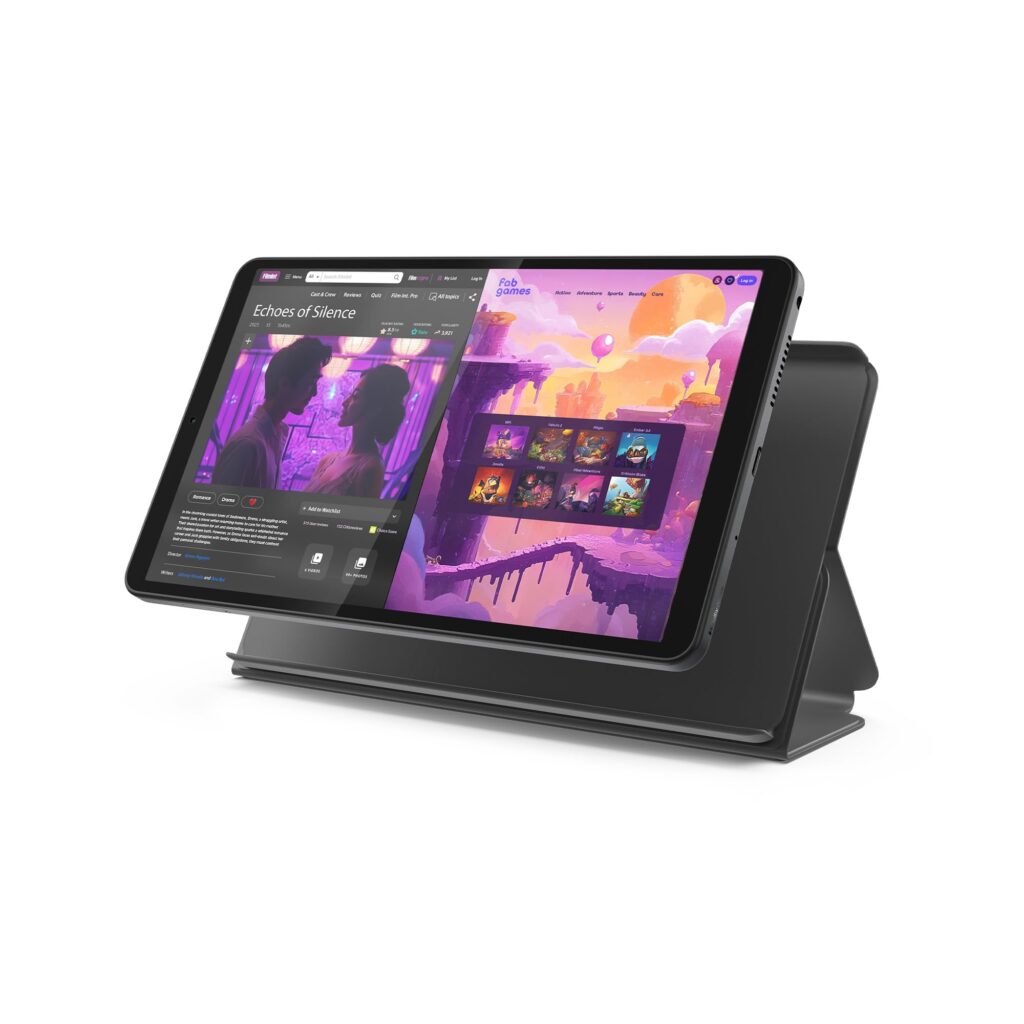
- Lightweight 11.3 oz (320 g) chassis with a flicker-free, PWM-free 8.7-inch (221 mm) display
- EU Repairability Class A rating and 1,000-cycle 5,100 mAh battery rated for 80:53h endurance
- Includes 3.5 mm headphone jack, Dolby Atmos stereo speakers, and dedicated microSDXC slot
- Full GNSS positioning (even on the Wi-Fi variant) with optional 4G LTE connectivity
- Entry-level MediaTek Helio G85 SoC and eMMC 5.1 storage limit multitasking and gaming
- Low ~179 ppi resolution (800 x 1340) on a basic TFT LCD panel
- Slow 20W wired charging over USB Type-C 2.0 and EU Free Fall Class E drop rating
Overview
Compact one-handed ergonomics and straightforward serviceability define the everyday pitch of this 8.7-inch (221 mm) Android tablet. Tipping the scales at 11.3 oz (320 g) with a slim 0.33 in (8.5 mm) profile, the plastic frame and back panel wrap around an 81.6% screen-to-body front face in either Luna grey or Seafoam green. Practical hardware touches that have largely vanished from pricier slates remain intact here, including a 3.5 mm headphone jack, dual stereo speakers tuned with Dolby Atmos, a dedicated microSDXC slot, and built-in FM radio. Its TFT LCD reaches a typical 480 nits and relies on flicker-free backlighting without pulse-width modulation, making long reading sessions easy on sensitive eyes even if the 800 x 1340 resolution (roughly 179 ppi) leaves text and fine icons noticeably soft.
Under the hood, Lenovo pairs MediaTek’s 12 nm Helio G85 with 4 GB of RAM and either 64 GB or 128 GB of eMMC 5.1 flash storage. That combination handles web browsing, streaming video, and lightweight apps smoothly enough, though the older Cortex-A75 and Cortex-A55 cores alongside eMMC storage bottleneck heavy multitasking, large app installs, and demanding 3D games. Connectivity is unusually well rounded for an entry-level chassis: dual-band Wi-Fi 5 and Bluetooth 5.3 sit alongside multi-constellation GNSS positioning (GPS, GLONASS, GALILEO, and BDS, supported even on the Wi-Fi-only TB305FU alongside optional 4G LTE on the TB305XU). Passive cooling keeps the slim chassis sealed, and the 12 nm silicon draws from a 5,100 mAh battery rated for 80 hours and 53 minutes of endurance on the EU energy label.
Firmware ships on Android 14 with Android 15 support, though buyers give up physical proximity hardware in favor of virtual accessory-based sensing and must live with USB Type-C 2.0 transfer speeds capped at 20W wired charging. Where the chassis quietly punches above its weight is long-term maintainability. The battery is rated for 1,000 charge cycles and the hardware earns an EU Repairability Class A score, giving budget-conscious buyers and fleet deployments a clear path to keeping units in service—just add a protective case, since its EU Free Fall Class E rating (surviving three drops) shows the plastic shell isn’t ruggedized out of the box.
Technical Specifications
| Brand | Lenovo |
| Model | Tab One |
| Model Numbers | TB305FU / TB305XU |
| Operating System | Android 14 / Android 15 |
| SoC | MediaTek Helio G85 (12 nm) |
| CPU | Octa-core (2x 2.0 GHz Cortex-A75, 6x 1.8 GHz Cortex-A55) |
| GPU | ARM Mali-G52 MC2 |
| Memory | 4 GB |
| Storage | 64 GB / 128 GB eMMC 5.1 (dedicated microSDXC slot) |
| Display | 8.7 in (221 mm) TFT LCD, 800 x 1340 (~179 ppi), 480 nits typ., flicker-free |
| Cameras | 8 MP AF rear (1080p) / 2 MP front (720p) |
| Audio | Stereo speakers (Dolby Atmos), 3.5 mm headphone jack, FM radio |
| Wireless & Positioning | Wi-Fi 802.11 a/b/g/n/ac, Bluetooth 5.3, Optional 4G LTE, GPS/GLONASS/GALILEO/BDS |
| Ports | USB Type-C 2.0 |
| Battery & Charging | 5100 mAh Li-Ion (1000 cycles), 20W wired charging |
| Dimensions | 8.31 x 4.91 x 0.33 in (211 x 124.8 x 8.5 mm) |
| Weight | 11.3 oz (320 g) |
| Materials | Glass front, plastic frame, plastic back |
| EU Label Ratings | Energy Class D, 80:53h endurance, 1000 cycles, Free fall Class E (3 falls), Repairability Class A |
Primary Sources & Audited Citations
Recommended Alternatives in Tablets & E-Readers

At a Glance
How reliable is the Lenovo Tab One according to Mizex audits?
Buy if you want a lightweight one-handed Android tablet with a headphone jack, microSD expansion, and long-term battery serviceability; skip it for a higher-resolution OLED or faster midrange tablet if you plan to edit photos, multitask heavily, or play demanding 3D games.
What are the known quirks or drawbacks of the Lenovo Tab One?
Our reliability audit identified the following documented caveats:
- Entry-level MediaTek Helio G85 SoC and eMMC 5.1 storage limit multitasking and gaming
- Low ~179 ppi resolution (800 x 1340) on a basic TFT LCD panel
- Slow 20W wired charging over USB Type-C 2.0 and EU Free Fall Class E drop rating
What are the key engineering highlights of the Lenovo Tab One?
The top strengths recorded in our evaluation include:
- Lightweight 11.3 oz (320 g) chassis with a flicker-free, PWM-free 8.7-inch (221 mm) display
- EU Repairability Class A rating and 1,000-cycle 5,100 mAh battery rated for 80:53h endurance
- Includes 3.5 mm headphone jack, Dolby Atmos stereo speakers, and dedicated microSDXC slot
- Full GNSS positioning (even on the Wi-Fi variant) with optional 4G LTE connectivity