
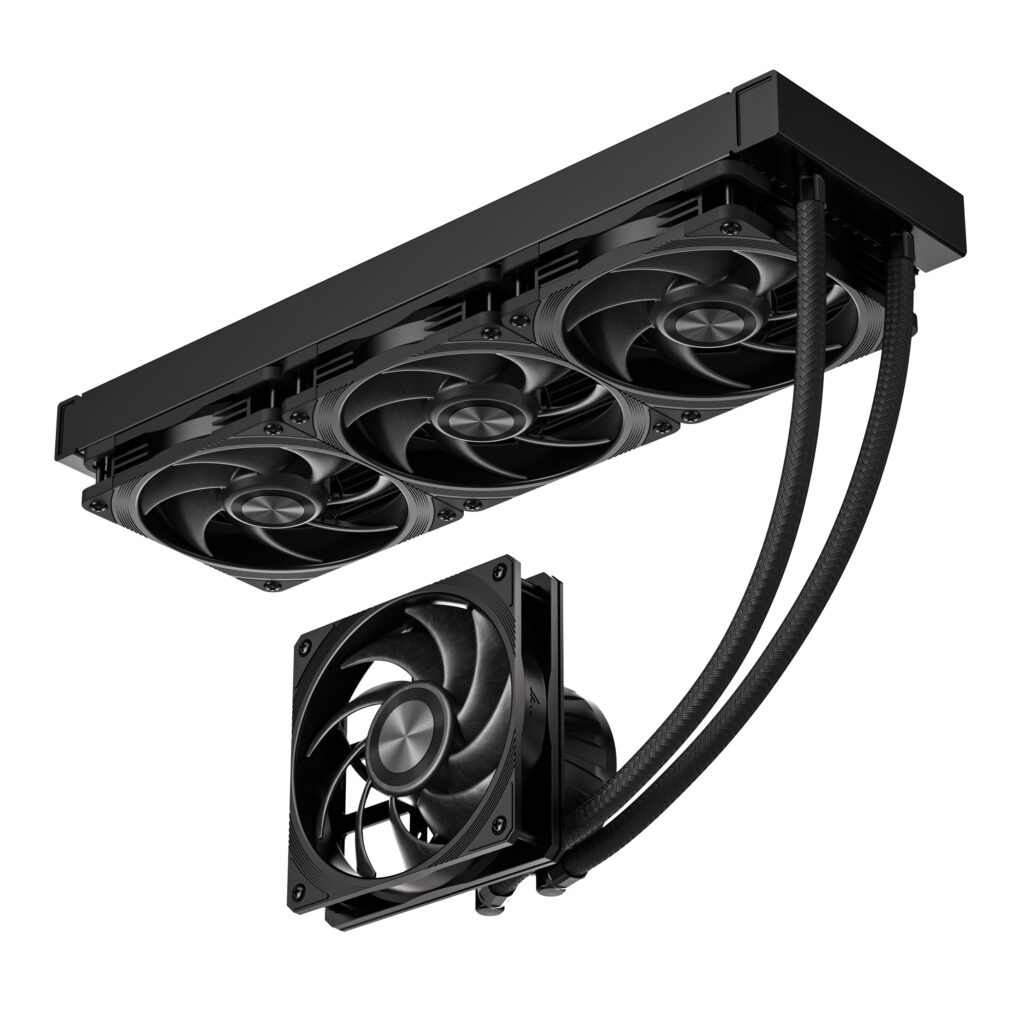
- Integrated 3+1 downdraft socket fan provides active airflow to motherboard VRMs and M.2 storage
- High static pressure rating of 6.48 mmH₂O on 120 mm radiator fans overcomes dense fin resistance
- Fluid dynamic bearings across all four cooling fans ensure extended operating lifespan
- Wide 800 to 3,400 RPM PWM pump operating range allows fine-tuned balancing between flow and acoustics
- High cumulative acoustic footprint when all four fans ramp toward their 2,600 RPM peak
- Socket-mounted auxiliary fan increases pump block height and creates cable management clutter
Overview
Integrating an auxiliary downdraft fan directly onto the CPU pump housing tackles one of liquid cooling’s longest-standing blind spots: stagnant airflow across surrounding motherboard voltage regulators and primary M.2 slots. Jungle Leopard approaches the 360mm format with an uncommon quad-fan configuration, pairing a standard triple-fan heat exchanger with a dedicated concentric blower sitting atop the copper cold plate. This architectural layout actively circulates intake air across power delivery stages that typically bake under sustained loads when traditional tower heatsinks are swapped out for all-in-one coolers.
Thermal transfer is driven by a 29 mm aluminum radiator threaded with 16 coolant channels and paired with a variable-speed pump capable of ramping from 800 to 3,400 RPM over a standard four-pin PWM header. On the radiator side, three 120 mm P2 APEX fans generate up to 6.48 mmH₂O of static pressure and 77 CFM of airflow, pushing ambient air through the dense fin array. Meanwhile, the pump-mounted P2 CORE unit pulls ambient air downward at up to 86.53 CFM. Fluid dynamic bearings across all four rotating assemblies minimize mechanical friction and axial wobble, ensuring balanced rotor operation across long computing sessions.
Deploying this quad-fan setup introduces notable acoustic and spatial considerations inside standard desktop enclosures. While the cooler manages thermal loads up to a rated 370W capacity, running all four fans toward their 2,600 RPM ceiling yields a noticeable sound profile peaking around 35 dBA per fan. Builders must also account for the increased physical height above the CPU socket, where the elevated pump cowl and four separate PWM connections demand intentional cable routing to keep fan blades clear and preserve unobstructed access to adjacent memory slots.
Technical Specifications
| Brand | Jungle Leopard |
| Model | Dark Vortex 360 (DV 360) |
| Cooler Type | All-in-One (AIO) Liquid CPU Cooler |
| Socket Compatibility | Intel LGA 1851 / 1700 / 1200 / 115X, AMD AM5 / AM4 |
| Thermal Dissipation Rating | 370W TDP |
| Radiator Dimensions | 15.63 x 4.72 x 1.14 in (397 x 120 x 29 mm) |
| Radiator Material | Aluminum (16 Micro-Channels) |
| Cold Plate Material | Copper |
| Pump Speed Range | 800 – 3,400 RPM (±10%) |
| Pump Connector | 4-Pin PWM |
| Fan Configuration | 3+1 Quad-Fan Setup (3x Radiator + 1x Pump Block) |
| Radiator Fan Dimensions | 4.72 x 4.72 x 0.98 in (120 x 120 x 25 mm) |
| Radiator Fan Model | P2 APEX |
| Radiator Fan Bearing | Fluid Dynamic Bearing (FDB) |
| Radiator Fan Speed | Up to 2,600 RPM |
| Radiator Fan Airflow | 77.0 CFM |
| Radiator Fan Static Pressure | 6.48 mmH₂O |
| Radiator Fan Noise | ≤ 35.0 dBA |
| Block Fan Model | P2 CORE |
| Block Fan Airflow | 86.53 CFM |
| Block Fan Static Pressure | 4.75 mmH₂O |
| Block Fan Noise | ≤ 33.7 dBA |
| Tubing Length | 15.75 in (400 mm) |
| Tubing Construction | Braided Sleeved Rubber |
Recommended Alternatives in CPU Coolers (AIO & Air)
At a Glance
How reliable is the Jungle Leopard DV 360mm according to Mizex audits?
An aggressive cooling solution for overclocked multi-core rigs where motherboard VRM temperatures demand active downdraft airflow alongside standard 360mm radiator dissipation.
What are the known quirks or drawbacks of the Jungle Leopard DV 360mm?
Our reliability audit identified the following documented caveats:
- High cumulative acoustic footprint when all four fans ramp toward their 2,600 RPM peak
- Socket-mounted auxiliary fan increases pump block height and creates cable management clutter
What are the key engineering highlights of the Jungle Leopard DV 360mm?
The top strengths recorded in our evaluation include:
- Integrated 3+1 downdraft socket fan provides active airflow to motherboard VRMs and M.2 storage
- High static pressure rating of 6.48 mmH₂O on 120 mm radiator fans overcomes dense fin resistance
- Fluid dynamic bearings across all four cooling fans ensure extended operating lifespan
- Wide 800 to 3,400 RPM PWM pump operating range allows fine-tuned balancing between flow and acoustics