
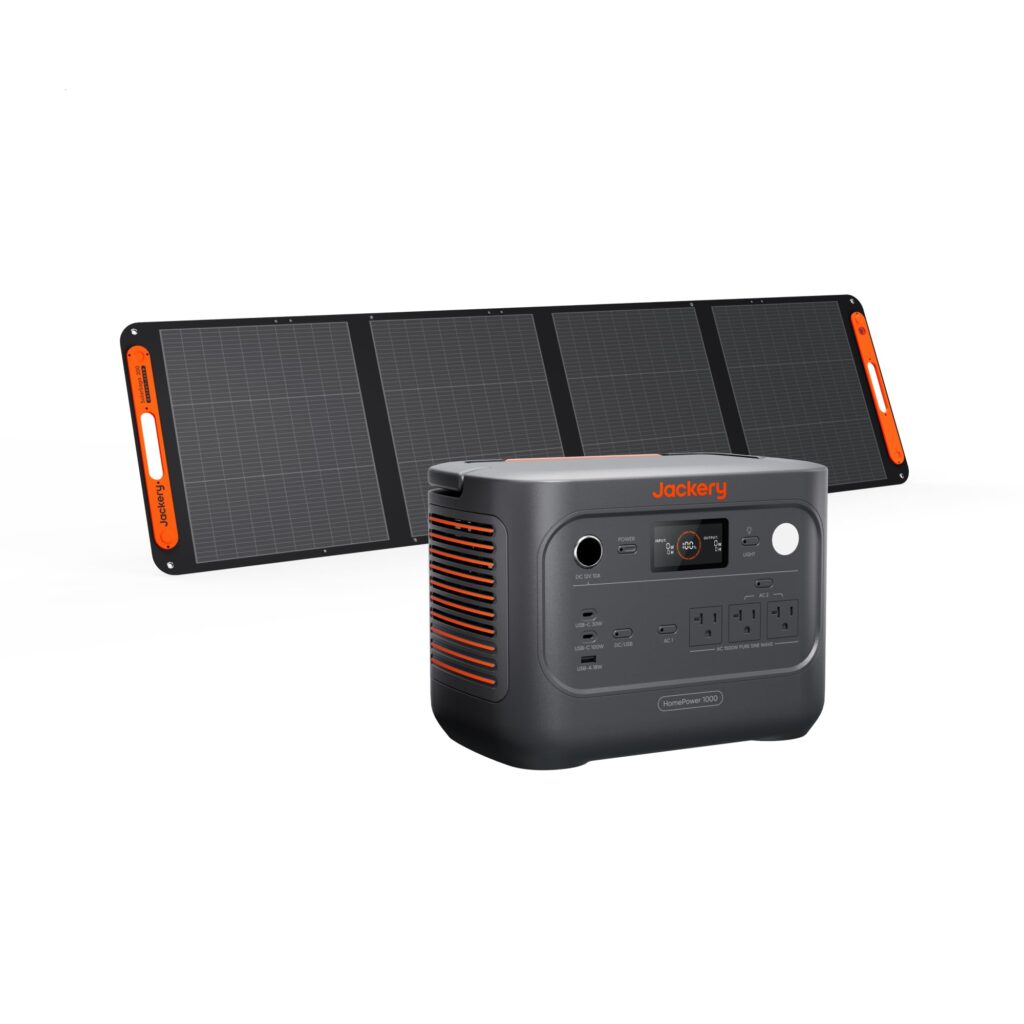
- Durable LiFePO4 battery chemistry offering superior cycle longevity
- Compact footprint weighing only 25 lbs (11.34 kg) with integrated carry handle
- Rapid AC wall recharging from 30% to 100% in under 90 minutes
- Quiet active cooling fan operation during sustained 1500W load
- Strict 1500W continuous output cutoff trips internal safety circuit under heavy appliance loads
- Solar replenishment capped at a modest 200W input ceiling
- Inverter and operational conversion losses consume approximately 25% of rated battery capacity
Overview
Balancing off-grid energy storage with everyday portability usually forces a compromise between battery longevity and carrying bulk. Jackery addresses this balance in the Explorer 1000 v2 by shifting to a 1070 Wh lithium iron phosphate (LiFePO4) cell chemistry packed into an enclosure weighing just 25 lbs (11.34 kg). The result is a substantial reduction in physical footprint compared to traditional 1kWh-class generators, pairing an integrated carry handle and a straightforward four-button physical interface with an emergency LED utility light for field deployment.
Internal architecture centers on a pure sine wave inverter capable of delivering 1500W continuous AC output. Under high sustained draw, integrated cooling fans manage thermal dissipation with restrained acoustic noise, preventing thermal runaway while maintaining steady output. However, the electrical engineering enforces strict protective boundaries: loads exceeding the 1500W continuous threshold trip internal safety cutoffs within seconds to shield the battery management system and power electronics. Additionally, real-world inverter and operational conversion losses consume roughly 25% of rated capacity during standard AC discharge, delivering approximately 7.6 hours of runtime when powering a continuous 100W load.
Replenishing the system highlights both modern charging conveniences and noticeable input trade-offs. Wall recharging via AC mains is remarkably rapid, restoring the pack from 30% to 100% in under 90 minutes alongside an available 50-minute emergency fast-charge profile. Conversely, off-grid recharging is constrained by a conservative 200W solar input ceiling, which prolongs solar replenishment times during extended outdoor excursions. Combined with a streamlined port layout featuring three AC receptacles, two USB-C ports (100W and 30W), and a lone 18W USB-A connector, the station prioritizes straightforward, dependable mobile power over dense multi-device connectivity.
Technical Specifications
| Brand | Jackery |
| Model | Explorer 1000 v2 |
| Model Number | JE-1000D |
| Battery Capacity | 1070 Wh |
| Battery Chemistry | LiFePO4 (Lithium Iron Phosphate) |
| Continuous AC Output | 1500W |
| AC Output Ports | 3x 120V AC sockets (US) / 2x 240V AC sockets (AU) |
| DC Output Ports | 1x 12V car cigarette lighter port |
| USB Ports | 2x USB-C (1x 100W, 1x 30W), 1x USB-A (18W) |
| Solar Input Capacity | Up to 200W |
| AC Recharge Time | 30% to 100% in under 90 minutes (50-minute emergency fast charge) |
| Dimensions | 13.0 x 9.0 x 10.0 in (330 x 229 x 254 mm) |
| Weight | 25.0 lbs (11.34 kg) |
| Integrated Controls & Lighting | 4-button hardware control interface, built-in LED utility light |
Primary Sources & Audited Citations
- TechRadar Pro: Jackery Explorer 1000 v2 Portable Power Station In-Depth Review
- OutdoorGearLab: Jackery Explorer 1000 v2 Lab Benchmarks & Field Review
- The Drive: Jackery Explorer 1000 v2 Solar Generator Hands-On Review & Load Testing
- GadgetGuy: Jackery Explorer 1000 v2 Comprehensive Hardware Review & Performance Analysis
Recommended Alternatives in Power Stations & UPS
At a Glance
How reliable is the Jackery Explorer 1000 v2 according to Mizex audits?
Ideal for mobile basecamps and emergency backup requiring dependable LiFePO4 longevity and fast wall recharging, provided your continuous power needs remain strictly within the 1500W ceiling and 200W solar input cap.
What are the known quirks or drawbacks of the Jackery Explorer 1000 v2?
Our reliability audit identified the following documented caveats:
- Strict 1500W continuous output cutoff trips internal safety circuit under heavy appliance loads
- Solar replenishment capped at a modest 200W input ceiling
- Inverter and operational conversion losses consume approximately 25% of rated battery capacity
What are the key engineering highlights of the Jackery Explorer 1000 v2?
The top strengths recorded in our evaluation include:
- Durable LiFePO4 battery chemistry offering superior cycle longevity
- Compact footprint weighing only 25 lbs (11.34 kg) with integrated carry handle
- Rapid AC wall recharging from 30% to 100% in under 90 minutes
- Quiet active cooling fan operation during sustained 1500W load