
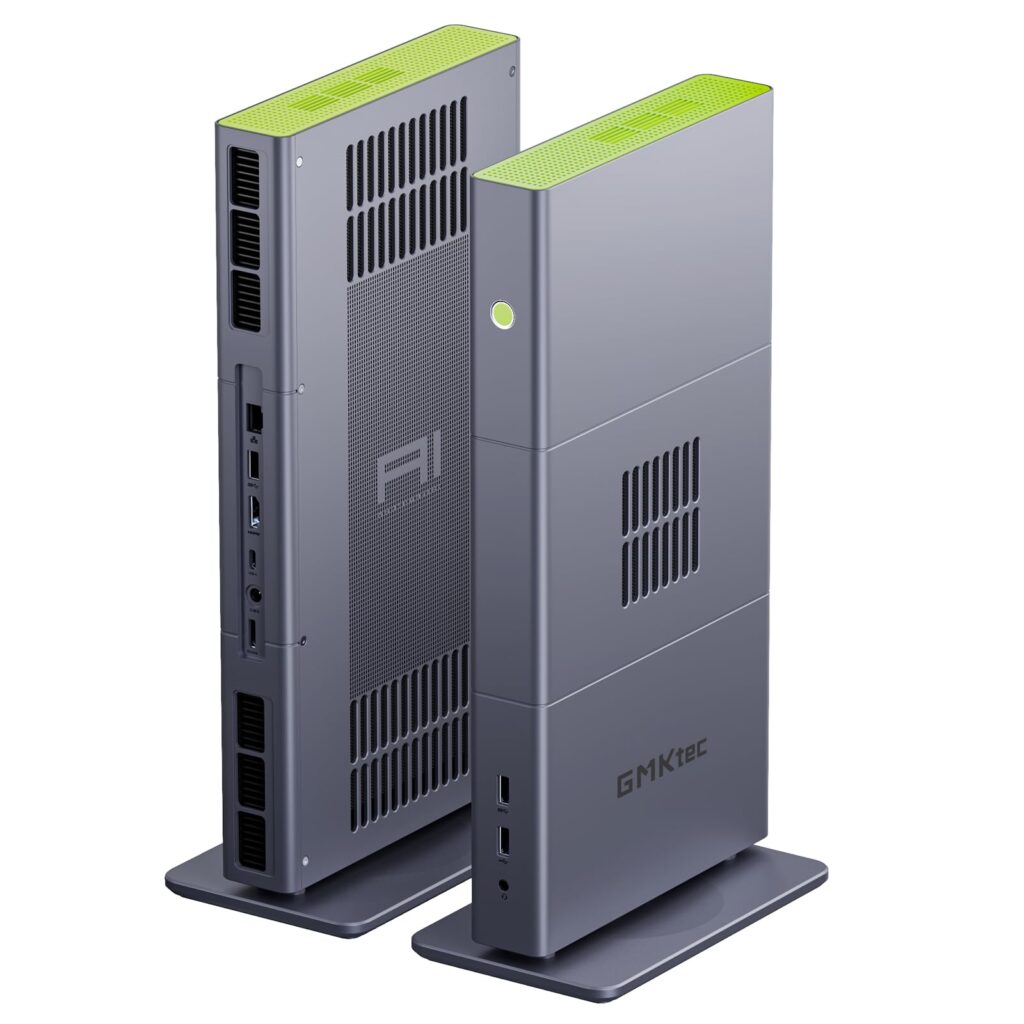
- Sixteen-core Zen 5 AMD Ryzen AI Max+ 395 APU with Radeon 8060S graphics
- Up to 128 GB unified LPDDR5X memory with up to 96 GB dynamically allocatable to graphics
- Sustained 1440p gaming performance exceeding 60 to 85 FPS in demanding titles
- Dense workstation compute housed in a compact console-sized footprint
- Pre-installed software environment requires manual configuration for local AI deployment
- Soldered LPDDR5X architecture precludes aftermarket physical memory upgrades
Overview
Packing desktop workstation compute into an enclosure roughly the footprint of a home gaming console, GMKtec approaches edge artificial intelligence through dense integration rather than sprawling discrete hardware. At the heart of the system sits AMD’s Ryzen AI Max+ 395 processor, leveraging sixteen Zen 5 CPU cores and Radeon 8060S integrated graphics configured for up to a 140 W thermal design power envelope. Rather than relying on traditional modular memory slots that throttle bandwidth, the architecture incorporates up to 128 GB of unified LPDDR5X memory directly onto the mainboard, allowing users to allocate as much as 96 GB of high-speed memory directly to the graphics engine for running expansive local neural network models.
In daily operation, this architectural density translates to exceptional dual-purpose versatility. Under SteamOS, the integrated Radeon graphics demonstrate sustained 1440p gaming output exceeding 60 to 85 frames per second across modern demanding titles, bridging the gap between a specialized developer workstation and an efficient living-room entertainment console. Storage scalability remains practical with configurations supporting 2 TB or 4 TB of high-speed NVMe storage, ensuring ample capacity for large datasets, model weights, and media libraries without forcing external peripheral tethering.
The primary operational friction lies within software environment readiness rather than physical silicon constraints. While the underlying hardware provides immense raw compute and expansive unified memory buffers, the pre-installed software ecosystem lacks turnkey out-of-the-box automation for local AI workflows, requiring users to manually configure development runtimes and offline libraries. For developers and technical enthusiasts willing to tune their local environments, the platform delivers remarkable processing density and graphics memory headroom that previously demanded dedicated multi-slot expansion rigs.
Technical Specifications
| Brand | GMKtec |
| Model | X3 AI |
| Processor | AMD Ryzen AI Max+ 395 |
| CPU Architecture | Zen 5 |
| CPU Core Count | 16 cores |
| Integrated Graphics | AMD Radeon 8060S |
| Memory Type | Unified LPDDR5X |
| Memory Capacity | Up to 128 GB |
| Maximum VRAM Allocation | Up to 96 GB allocatable to iGPU |
| Storage Configurations | 2 TB / 4 TB NVMe |
| Processor Max TDP | 140 W |
| Form Factor | Compact AI Workstation (PS4-sized footprint) |
Primary Sources & Audited Citations
- ServeTheHome: GMKtec EVO-X3 Mini PC Review
- Tom's Hardware: Dramatically redesigned GMKtec EVO-X3 shown bearing Lisa Su's signature of approval
- TechPowerUp: GMKtec Launches EVO-X3 Compact AI Mini PC Workstation
- TechRadar Pro: GMKtec EVO-X3 Mini PC Review
- Notebookcheck: GMKtec EVO-X3 Mini PC and SteamOS prove to be match made in heaven
Recommended Alternatives in Mini PCs
At a Glance
How reliable is the GMKtec X3 AI according to Mizex audits?
A compelling compact workstation for developers seeking massive unified memory for local AI models who are comfortable manually configuring software runtimes.
What are the known quirks or drawbacks of the GMKtec X3 AI?
Our reliability audit identified the following documented caveats:
- Pre-installed software environment requires manual configuration for local AI deployment
- Soldered LPDDR5X architecture precludes aftermarket physical memory upgrades
What are the key engineering highlights of the GMKtec X3 AI?
The top strengths recorded in our evaluation include:
- Sixteen-core Zen 5 AMD Ryzen AI Max+ 395 APU with Radeon 8060S graphics
- Up to 128 GB unified LPDDR5X memory with up to 96 GB dynamically allocatable to graphics
- Sustained 1440p gaming performance exceeding 60 to 85 FPS in demanding titles
- Dense workstation compute housed in a compact console-sized footprint