
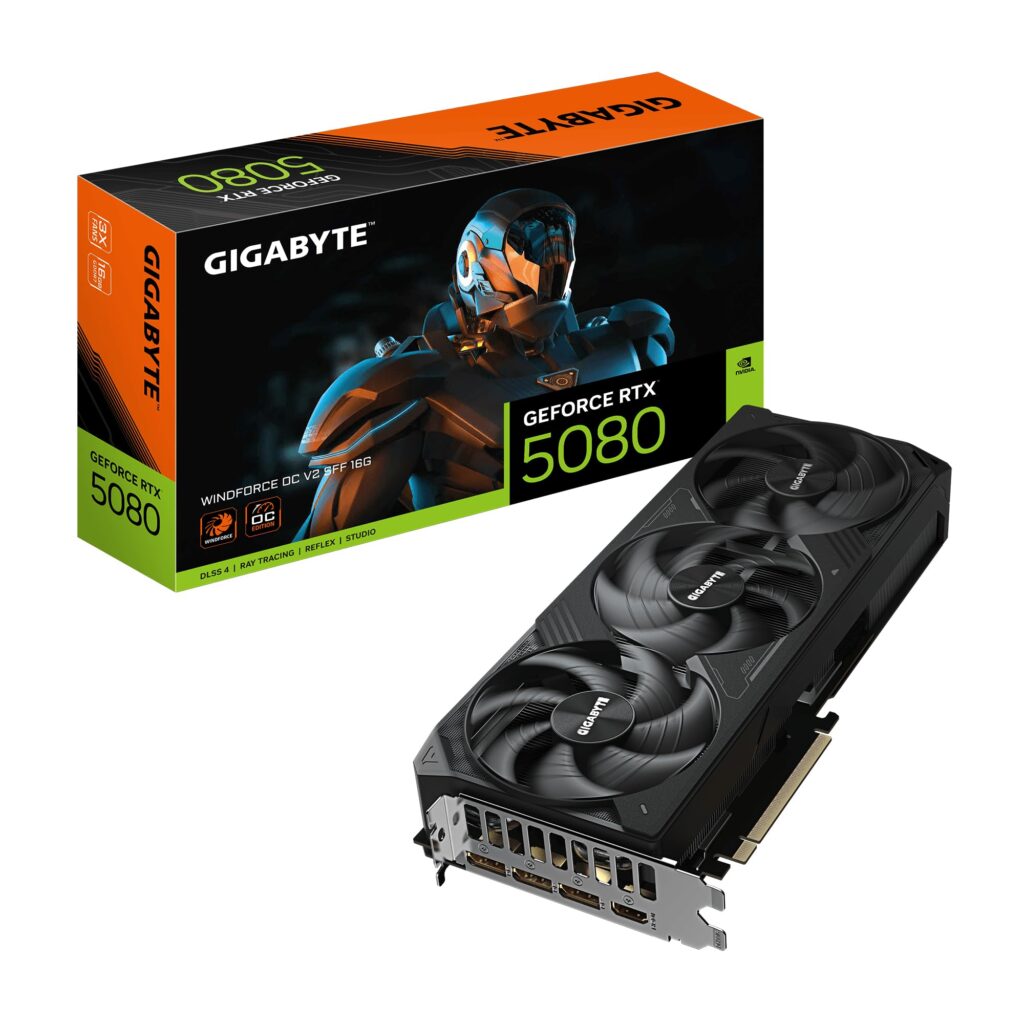
- Small Form Factor (SFF) footprint enables compatibility with compact and space-constrained desktop enclosures
- Factory overclocked (OC) profile delivers tuned out-of-the-box performance without manual configuration
- 16 GB memory configuration supports demanding modern gaming and GPU compute workloads
- Compact SFF shroud provides less thermal mass and heatsink surface area than oversized full-height designs
- Factory overclocking in a space-constrained cooler increases reliance on strong case airflow under sustained loads
Overview
Compact graphics hardware forces an immediate engineering balancing act between high-tier compute density and physical enclosure compatibility. Built for space-constrained desktop systems, Gigabyte’s WINDFORCE OC SFF 16G variant brings GeForce RTX 5080-class silicon and a 16 GB memory configuration into a Small Form Factor footprint with factory overclocking applied out of the box. Rather than relying on an oversized full-height shroud to brute-force heat dissipation, this configuration prioritizes clearance for compact chassis layouts while maintaining discrete add-in card power delivery and board-level stability.
Fitting factory-overclocked graphics silicon into an SFF envelope places direct demands on heatsink airflow paths, shroud rigidity, and fan curve calibration. Gigabyte’s WINDFORCE cooling architecture is designed to channel airflow across a tighter fin stack than full-sized enthusiast cards, which helps preserve case compatibility in dense builds at the cost of reduced raw thermal mass. Under sustained gaming or compute workloads, compact shrouds naturally operate with tighter acoustic and thermal margins than larger counterparts, making chassis ventilation and intake clearance meaningful factors in everyday noise levels.
In daily desktop use, the appeal of an SFF-compliant overclocked card centers on predictable out-of-the-box boost behavior and straightforward driver and firmware maintenance without manual tuning. Long-term reliability in smaller enclosures depends heavily on fan bearing longevity, clean power-stage load handling, and consistent board tolerances that resist sag or resonance. For builders targeting compact workstations or living-room rigs where full-length cards simply will not fit, this model offers a practical middle ground between size discipline and factory-tuned graphics performance, provided the surrounding case offers steady airflow.
Technical Specifications
| Brand | Gigabyte |
| Model | GeForce RTX 5080 WINDFORCE OC SFF 16G |
| Category | Graphics Cards (GPUs) |
| Device Class | Discrete Desktop GPU |
| Form Factor Target | Small Form Factor (SFF) |
| Memory Configuration | 16 GB (per model designation) |
| Clock Profile | Factory Overclocked (OC) |
| Cooling Series | WINDFORCE |
Primary Sources & Audited Citations
Recommended Alternatives in Graphics Cards (GPUs)
At a Glance
How reliable is the Gigabyte GeForce RTX 5080 WINDFORCE OC SFF 16G according to Mizex audits?
Best suited for compact and Small Form Factor builds that need factory-overclocked RTX 5080-class graphics and 16 GB of memory in a space-conscious chassis with adequate intake airflow.
What are the known quirks or drawbacks of the Gigabyte GeForce RTX 5080 WINDFORCE OC SFF 16G?
Our reliability audit identified the following documented caveats:
- Compact SFF shroud provides less thermal mass and heatsink surface area than oversized full-height designs
- Factory overclocking in a space-constrained cooler increases reliance on strong case airflow under sustained loads
What are the key engineering highlights of the Gigabyte GeForce RTX 5080 WINDFORCE OC SFF 16G?
The top strengths recorded in our evaluation include:
- Small Form Factor (SFF) footprint enables compatibility with compact and space-constrained desktop enclosures
- Factory overclocked (OC) profile delivers tuned out-of-the-box performance without manual configuration
- 16 GB memory configuration supports demanding modern gaming and GPU compute workloads