
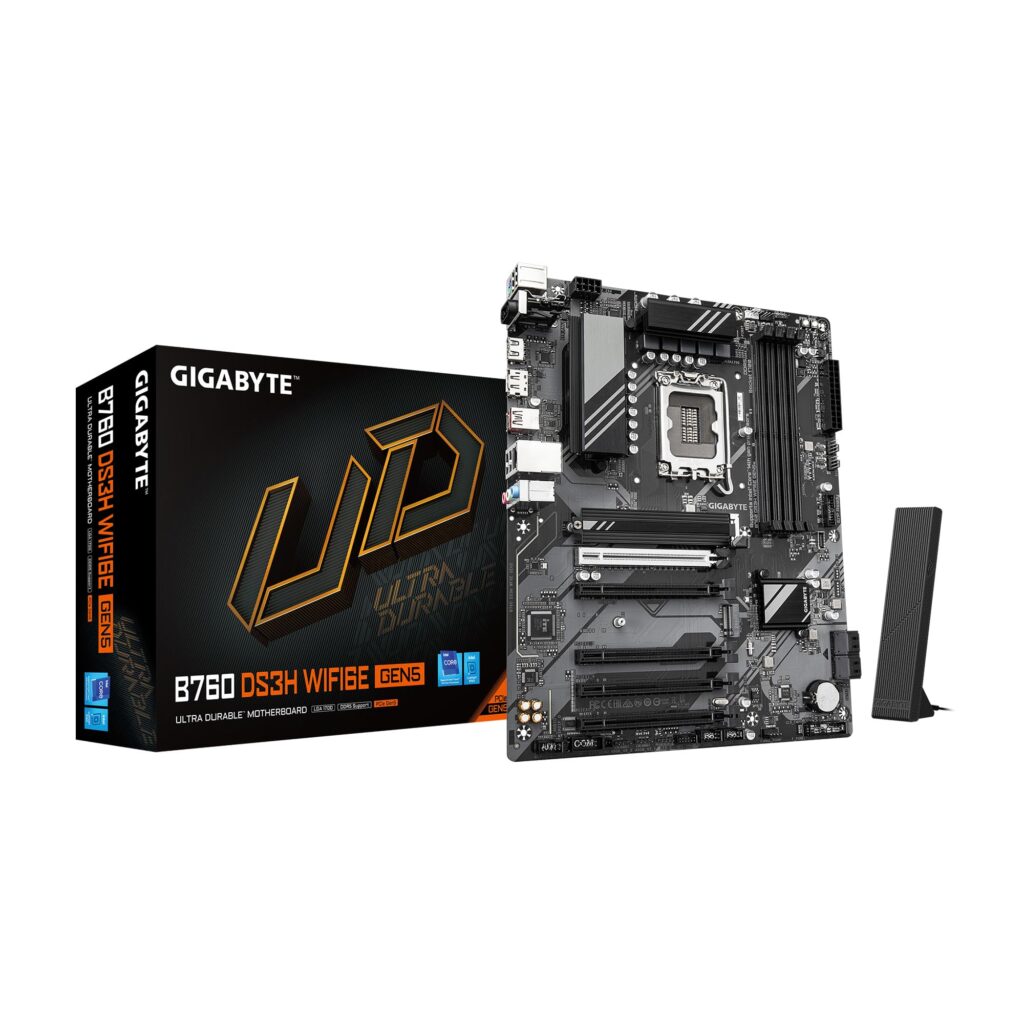
- Native PCIe 5.0 x16 GPU interface with reinforced steel shielding and EZ-Latch release
- Quad-DIMM DDR5 memory topology accommodating up to 256 GB and 7600 MT/s XMP profiles
- High-speed rear I/O including 20 Gbps USB 3.2 Gen 2x2 Type-C and Intel Wi-Fi 6E AX210
- Hardware-level Q-Flash Plus button enables BIOS recovery without CPU, memory, or GPU
- Modest hybrid VRM heatsink surface area constrains thermal headroom with sustained high-TDP K-series processors
- Wired networking restricted to 1 Gbps Gigabit Ethernet rather than standard 2.5 Gbps
- Secondary M.2 slot omits an integrated heatsink, and secondary PCIe slots run at PCIe 3.0 x1 bandwidth
Overview
Direct-routed PCIe 5.0 signal paths from the LGA1700 socket anchor the platform architecture of the B760 DS3H WIFI6E GEN5, delivering up to 64 GB/s of theoretical unidirectional bandwidth to the primary graphics card slot. Paired with Intel’s B760 chipset, the board deploys four DDR5 DIMM sockets accommodating dual-channel configurations up to 256 GB with XMP overclocking support up to 7600 MT/s. Power delivery relies on a hybrid digital VRM arrangement fed by an 8-pin solid-pin 12V auxiliary connector, targeted at mainstream 65W to 125W base-power processors across Intel’s 12th, 13th, and 14th Generation Core lineups. Peripheral interconnects encompass two M.2 PCIe 4.0 x4 storage interfaces alongside four SATA 6Gb/s ports, though secondary expansion slots operating off the chipset are routed with PCIe 3.0 x1 electrical bandwidth.
Constructed on a standard ATX PCB measuring 12.0 x 9.6 in (305 x 244 mm), the board integrates mechanical reinforcement via an SMD PCIe Armor steel bracket and an EZ-Latch release tab to mitigate slot tearing during GPU installation. Thermal dissipation for the primary MOSFET stage is managed by a single extruded aluminum heatsink, complemented by an M.2 Thermal Guard aluminum heat spreader dedicated solely to the top M.2 drive slot. With passive solid-state operation across the chipset and VRM array, acoustic regulation is entirely handled by six onboard PWM/DC fan headers managed through the Smart Fan 6 control suite. The secondary M.2 drive location lacks heatsink coverage, relying on aftermarket SSD spreaders or chassis airflow to maintain storage temperatures.
Connectivity across the rear I/O combines an Intel AX210 Wi-Fi 6E module supporting 2.4 GHz, 5 GHz, and 6 GHz spectrum with Bluetooth 5.3, alongside a 20 Gbps USB 3.2 Gen 2×2 Type-C port, HDMI 2.1, DisplayPort 1.2, and legacy USB 2.0 connectivity. Wired networking is supplied by a Realtek 1 Gbps Ethernet controller, omitting the 2.5 Gbps standard commonly found across modern desktop platforms. Firmware maintenance is anchored by GIGABYTE’s Q-Flash Plus infrastructure, which allows users to flash the UEFI BIOS using a dedicated rear button and USB drive without installing a CPU, memory module, or graphics card. This firmware recovery architecture simplifies compatibility updates for newer Intel architectures, positioning the platform as a practical, functional foundation for mid-tier gaming and productivity rigs that do not demand sustained multi-threaded overclocking loads.
Technical Specifications
| Brand | GIGABYTE |
| Model | B760 DS3H WIFI6E GEN5 |
| Form Factor | ATX |
| Dimensions | 12.0 x 9.6 in (305 x 244 mm) |
| CPU Socket | LGA1700 |
| Chipset | Intel B760 |
| Supported Processors | Intel 14th, 13th, and 12th Gen Core, Pentium Gold, and Celeron |
| Memory Type | DDR5 |
| Memory Slots | 4 x DIMM |
| Max Memory Capacity | 256 GB |
| Memory Frequency Support | Up to 7600 MT/s (OC) |
| PCIe Expansion Slots | 1 x PCIe 5.0 x16 (CPU), 4 x PCIe 3.0 x16 (running at x1 mode, Chipset) |
| M.2 Storage Interfaces | 2 x M.2 2280/22110 PCIe 4.0 x4 |
| SATA Ports | 4 x SATA 6Gb/s |
| Wireless Connectivity | Intel Wi-Fi 6E AX210 (2.4/5/6 GHz) + Bluetooth 5.3 |
| Ethernet Controller | Realtek 1GbE LAN (1 Gbps) |
| Rear USB Connectivity | 1 x USB 3.2 Gen 2x2 Type-C (20 Gbps), 1 x USB 3.2 Gen 2 Type-A, 4 x USB 2.0/1.1 |
| Video Outputs | 1 x HDMI 2.1 (4096x2160@60Hz), 1 x DisplayPort 1.2 (4096x2304@60Hz) |
| Audio Codec | Realtek Audio CODEC (7.1-channel HD Audio) |
| Power Connectors | 1 x 24-pin ATX, 1 x 8-pin ATX 12V |
| BIOS Architecture | 1 x 128 Mb flash, UEFI AMI BIOS, Q-Flash Plus support |
Recommended Alternatives in Motherboards
At a Glance
How reliable is the GIGABYTE B760 DS3H WIFI6E GEN5 Review: Mainstream Bandwidth Meets VRM Limits according to Mizex audits?
An economical entry into DDR5 and PCIe 5.0 computing for 65W to 125W Intel Core processors, provided you do not require 2.5GbE networking or heavy workstation VRM thermal margins.
What are the known quirks or drawbacks of the GIGABYTE B760 DS3H WIFI6E GEN5 Review: Mainstream Bandwidth Meets VRM Limits?
Our reliability audit identified the following documented caveats:
- Modest hybrid VRM heatsink surface area constrains thermal headroom with sustained high-TDP K-series processors
- Wired networking restricted to 1 Gbps Gigabit Ethernet rather than standard 2.5 Gbps
- Secondary M.2 slot omits an integrated heatsink, and secondary PCIe slots run at PCIe 3.0 x1 bandwidth
What are the key engineering highlights of the GIGABYTE B760 DS3H WIFI6E GEN5 Review: Mainstream Bandwidth Meets VRM Limits?
The top strengths recorded in our evaluation include:
- Native PCIe 5.0 x16 GPU interface with reinforced steel shielding and EZ-Latch release
- Quad-DIMM DDR5 memory topology accommodating up to 256 GB and 7600 MT/s XMP profiles
- High-speed rear I/O including 20 Gbps USB 3.2 Gen 2x2 Type-C and Intel Wi-Fi 6E AX210
- Hardware-level Q-Flash Plus button enables BIOS recovery without CPU, memory, or GPU