
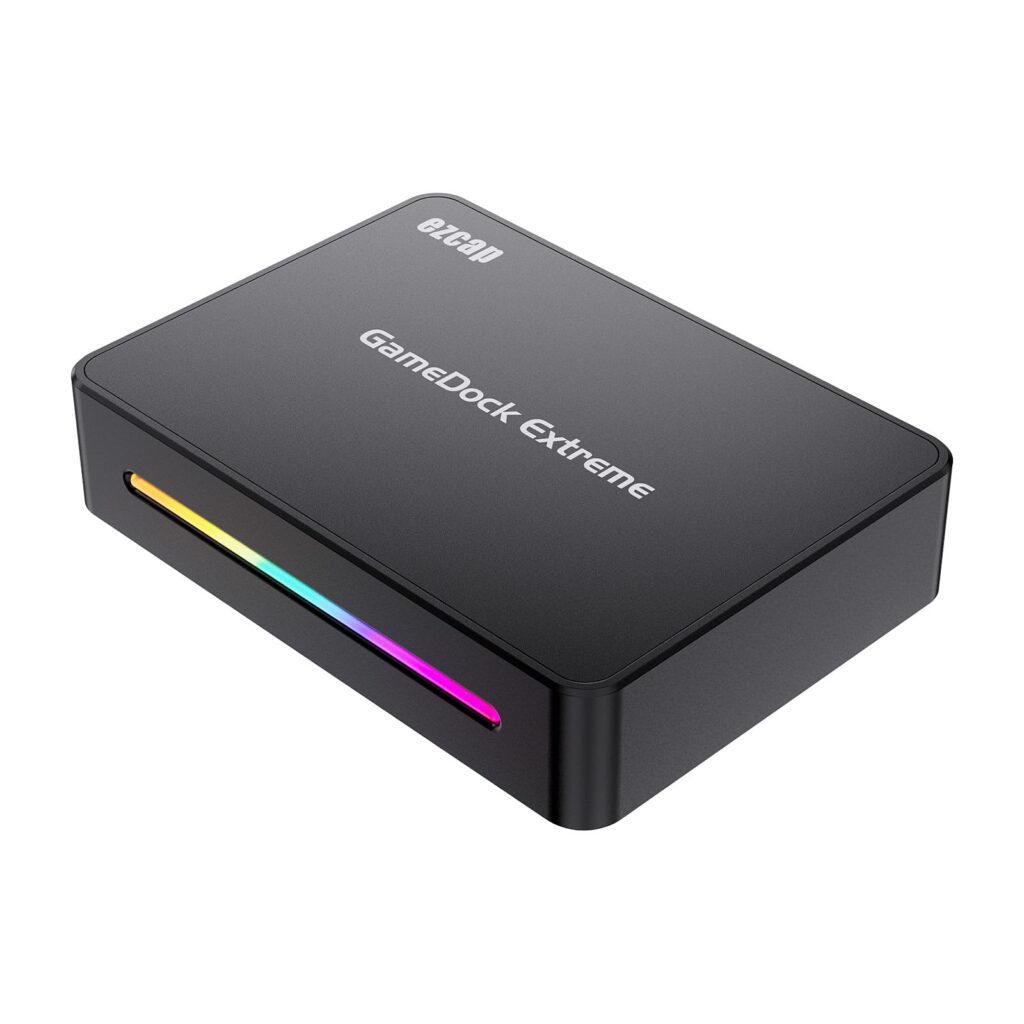
- Supports high-refresh HDMI 2.0 passthrough up to 1080p at 240Hz, 1440p at 120Hz, and 4K at 60Hz with HDR10 and VRR
- High-framerate video capture up to 1080p at 240fps and 4K at 60fps using MJPG encoding
- Driverless UVC architecture offering plug-and-play setup and sub-50ms latency across broadcasting software
- Dedicated 3.5mm analog line-in and CTIA 4-pole headset ports for direct microphone mixing and audio monitoring
- 4K60 and high-refresh capture requires lossy MJPG compression over USB 3.2 Gen 1, capping uncompressed NV12 at 4K30
- Console VRR passthrough fails with default YCbCr 4:2:0 subsampling, requiring manual configuration to YCC 4:2:2
- Audio routing is strictly stereo, lacking HDMI LPCM 5.1 and 7.1 multichannel surround passthrough or capture
Overview
Bridging the divide between fast competitive gaming monitors and desktop streaming rigs, ezcap’s 386 capture unit focuses on keeping player displays fluid while broadcasting. The device incorporates HDMI 2.0 pass-through capable of driving 1080p displays at up to 240Hz, 1440p panels at 120Hz, and 4K setups at 60Hz, complete with HDR10 and Variable Refresh Rate handling. For esports players who demand high-refresh visuals without input delay on their primary monitor, this loop ensures fast frame rendering remains intact. On the capture side, the unit interfaces over USB 3.2 Gen 1 Type-C, enabling sub-50ms latency into popular broadcasting software like OBS Studio through standard driverless USB Video Class protocols.
The physical chassis is compact and straightforward, measuring 5.0 x 3.6 x 1.1 in (128 x 92 x 28 mm) to fit unobtrusively on a crowded desk. Analog audio handling is integrated directly into the front panel, offering dedicated 3.5mm line-in connectivity alongside a 4-pole CTIA headset port. This allows creators to mix party chat and analog microphone feeds directly into their broadcast without requiring a separate audio interface. Passive thermal dissipation manages internal component heat across continuous sessions without relying on mechanical fans.
Operating within the bandwidth limits of a 5 Gbps USB connection requires a few practical trade-offs during live production. While the unit captures 1080p at up to 240 frames per second and 4K at 60 frames per second using MJPG compression, uncompressed NV12 and I420 color recording at 4K is constrained to 30 frames per second. Furthermore, audio handling is strictly stereo, meaning connected consoles must be set to uncompressed stereo rather than multichannel 5.1 or 7.1 surround. Console gamers also need to navigate a known HDMI color handshake limitation: Variable Refresh Rate pass-through is incompatible with YCbCr 4:2:0 chroma subsampling, requiring users on systems like the Xbox to manually enable the YCC 4:2:2 video setting to engage VRR sync reliably.
Technical Specifications
| Brand | ezcap |
| Model | ezcap386 |
| Host Interface | USB 3.2 Gen 1 Type-C |
| Video Input | HDMI 2.0 |
| Video Passthrough | HDMI 2.0 |
| Max Passthrough Resolution | 3840x2160 @ 60Hz, 2560x1440 @ 120Hz, 1920x1080 @ 240Hz |
| HDR Passthrough | HDR10 (up to 2160p60, 1440p120, 1080p240) |
| VRR Passthrough | Supported (3840x2160 @ 48-60Hz, 1920x1080 @ 48-120Hz) |
| Max Capture Resolutions | 3840x2160 @ 60fps (MJPG) / 30fps (NV12/I420), 2560x1440 @ 144fps (MJPG) / 60fps (NV12/I420) / 50fps (YUY2), 1920x1080 @ 240fps (MJPG) / 120fps (NV12/I420) / 60fps (YUY2/RGB24) |
| Supported Color Formats | NV12, I420, YUY2, RGB24 (up to 1080p60), MJPG |
| Audio Inputs | HDMI, 3.5mm Line In (TRS 3-pole), 3.5mm headset microphone (CTIA 4-pole) |
| Audio Outputs | HDMI, 3.5mm headset earphone (CTIA 4-pole) |
| Audio Channel Configuration | Stereo (2-channel LPCM) |
| Capture Latency | <50ms |
| Driver Architecture | UVC (USB Video Class) driverless plug-and-play |
| Dimensions | 5.0 x 3.6 x 1.1 in (128 x 92 x 28 mm) |
Primary Sources & Audited Citations
Recommended Alternatives in Capture Cards
At a Glance
How reliable is the ezcap386 according to Mizex audits?
A capable external capture choice for competitive gamers prioritizing high-refresh passthrough up to 240Hz and integrated analog voice mixing, provided you accept compressed MJPG encoding for 4K60 captures and strictly stereo audio pipelines.
What are the known quirks or drawbacks of the ezcap386?
Our reliability audit identified the following documented caveats:
- 4K60 and high-refresh capture requires lossy MJPG compression over USB 3.2 Gen 1, capping uncompressed NV12 at 4K30
- Console VRR passthrough fails with default YCbCr 4:2:0 subsampling, requiring manual configuration to YCC 4:2:2
- Audio routing is strictly stereo, lacking HDMI LPCM 5.1 and 7.1 multichannel surround passthrough or capture
What are the key engineering highlights of the ezcap386?
The top strengths recorded in our evaluation include:
- Supports high-refresh HDMI 2.0 passthrough up to 1080p at 240Hz, 1440p at 120Hz, and 4K at 60Hz with HDR10 and VRR
- High-framerate video capture up to 1080p at 240fps and 4K at 60fps using MJPG encoding
- Driverless UVC architecture offering plug-and-play setup and sub-50ms latency across broadcasting software
- Dedicated 3.5mm analog line-in and CTIA 4-pole headset ports for direct microphone mixing and audio monitoring