
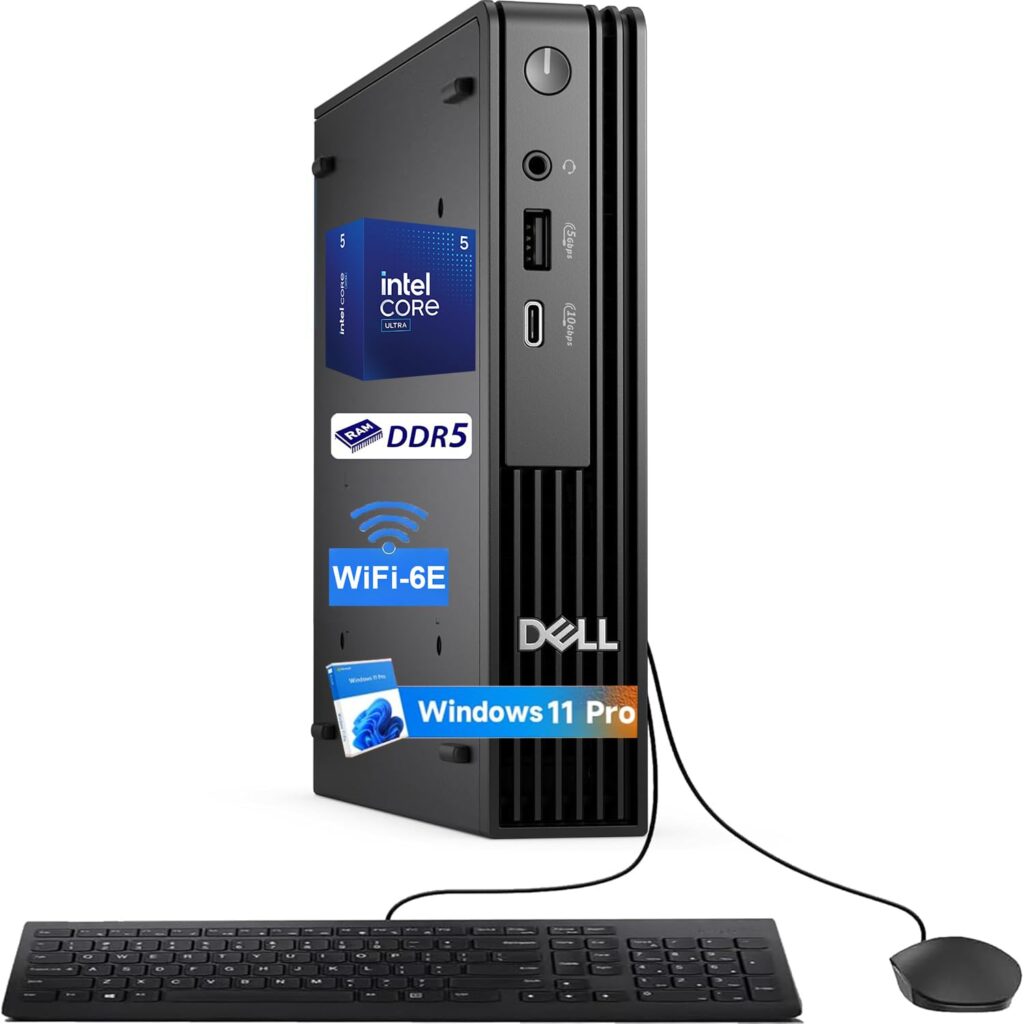
- Broad Intel 14th Gen processor support ranging from Core i3 up to 24-core Core i9
- Dual thermal design profiles supporting both efficient 35W T-series and standard 65W desktop processors
- Ultra-compact Micro Form Factor chassis tailored for high-density office and workstation environments
- Sustained 65W high-core processor loads require adequate ambient ventilation within the micro enclosure
- Ultra-compact micro footprint inherently limits internal expansion compared to larger desktop form factors
Overview
Packaging socketed desktop silicon into an ultra-compact chassis, Dell’s Micro Form Factor platform addresses the spatial and compute constraints of dense corporate and workstation environments. The architecture accommodates Intel 14th Generation Raptor Lake Refresh processors, spanning quad-core Core i3 implementations through 24-core, 32-thread Core i9 configurations reaching clock speeds up to 5.4 GHz. Dual power envelope engineering supports both 35W T-series low-power processors and standard 65W desktop processors, allowing hardware administrators to balance compute density against local power and thermal constraints.
The chassis layout optimizes component density, employing a durable metal enclosure designed for space-constrained desk integration, monitor mounting, or bracketed deployments. Internal airflow channels route intake air directly across the socketed processor assembly and critical voltage regulation components, maintaining continuous heat dissipation across the compact board footprint. Standardized commercial assembly tolerances facilitate straightforward enterprise maintenance and rapid component access.
Platform firmware follows Dell’s commercial maintenance lifecycle, providing structured BIOS and microcode updates to ensure power rail stability, silicon scheduling reliability, and long-term security compliance. The resulting hardware profile provides consistent everyday stability for multi-threaded workloads while maintaining the physical footprint of a micro-tier desktop.
Technical Specifications
| Model | Dell OptiPlex 7020 MFF |
| Form Factor | Micro Form Factor (MFF) |
| Processor Family | Intel Core 14th Gen (Raptor Lake Refresh) |
| Supported Processors | Core i3-14100/14100T, Core i5-14500/14500T, Core i5-14600/14600T, Core i7-14700/14700T, Core i9-14900/14900T |
| Processor TDP Options | 35W (T-series) / 65W (standard) |
| Maximum Core Count | Up to 24 cores (8 Performance cores, 16 Efficient cores) and 32 threads |
| Maximum Turbo Frequency | Up to 5.4 GHz |
Primary Sources & Audited Citations
Recommended Alternatives in Mini PCs
At a Glance
How reliable is the Dell OptiPlex 7020 MFF Review: High-Density Enterprise Desktop Silicon according to Mizex audits?
A reliable, enterprise-grade micro desktop well suited for space-constrained workstations requiring scalable Intel 14th Gen desktop processing across 35W and 65W thermal profiles.
What are the known quirks or drawbacks of the Dell OptiPlex 7020 MFF Review: High-Density Enterprise Desktop Silicon?
Our reliability audit identified the following documented caveats:
- Sustained 65W high-core processor loads require adequate ambient ventilation within the micro enclosure
- Ultra-compact micro footprint inherently limits internal expansion compared to larger desktop form factors
What are the key engineering highlights of the Dell OptiPlex 7020 MFF Review: High-Density Enterprise Desktop Silicon?
The top strengths recorded in our evaluation include:
- Broad Intel 14th Gen processor support ranging from Core i3 up to 24-core Core i9
- Dual thermal design profiles supporting both efficient 35W T-series and standard 65W desktop processors
- Ultra-compact Micro Form Factor chassis tailored for high-density office and workstation environments