
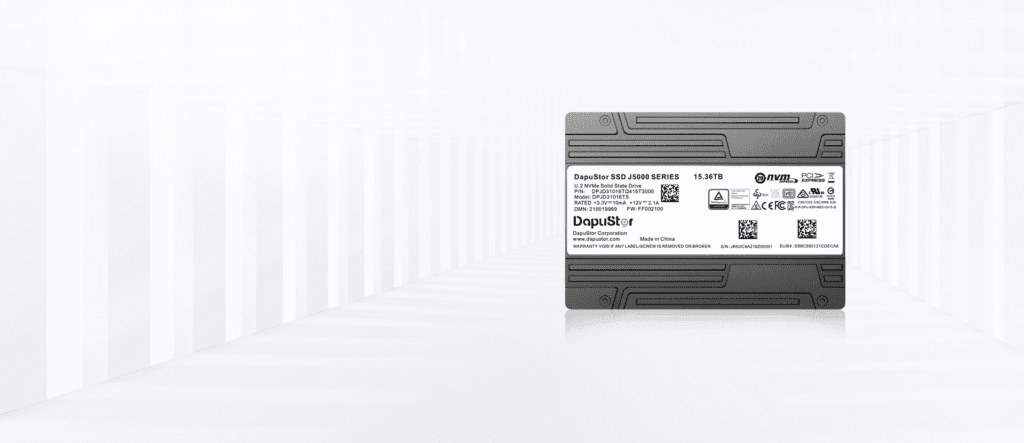
- Massive 61.44TB capacity in a single U.2 drive reduces rack density requirements
- Exceptional sequential read throughput of 7,300 MB/s for database scanning
- Fixed pSLC region mitigates some QLC write latency issues
- Enterprise-grade features including dual-port support and power loss protection
- Significantly limited random write performance at 30K IOPS due to QLC nature
- Lower write endurance compared to TLC enterprise drives under sustained loads
- Reduced sustained write headroom limits suitability for high-write workloads
Overview
The DapuStor J5060 represents a high-capacity enterprise storage solution built around dense 3D QLC NAND flash, specifically architected for read-intensive archival workloads, data analytics, and cold storage tiers. Leveraging a standard PCIe 4.0 x4 interface in a durable U.2 server form factor, the hardware integrates enterprise-grade features including dual-port redundancy support and a dedicated power loss protection capacitor bank to ensure in-flight data integrity during sudden power interruptions.
To offset the inherent write latency and endurance constraints of high-density QLC cells, the controller firmware provisions a permanent pSLC cache partition that handles burst transactions smoothly before settling into steady-state write speeds. Thermal dissipation relies on passive conduction through the brushed metal enclosure, maintaining safe operating margins under typical datacenter forced airflow while running completely silent with zero acoustic profile.
While endurance metrics and sustained random write throughput naturally trail premium TLC alternatives, the J5060 achieves an outstanding balance of capacity density and power efficiency. For systems requiring multi-terabyte read throughput and consistent retrieval latency without paying a TLC cost premium, it delivers dependable, predictable performance.
Technical Specifications
| Brand | DapuStor |
| Model | DapuStor J5060 QLC SSD |
| Form Factor | U.2 15mm |
| Interface | PCIe 4.0 x4 |
| Protocol | NVMe 1.4a |
| Nand Type | 3D Enterprise QLC NAND Flash |
| Max Capacity Tb | 61.44 |
| Sequential Read Mbs | 7300 |
| Random Read Iops 4k | 1500000 |
| Random Write Iops 16kb | 30000 |
| Features | Dual-port support, Advanced power loss protection, Flash-level voltage optimization, Fixed pSLC region (dual-mode configuration) |
Primary Sources & Audited Citations
- Tom's Hardware: Technical Launch & Teardown
- DapuStor J5060 SSD Review: High-Density QLC SSD Tuned for Read-Centric ...
- DapuStor J5060 Adds Fixed pSLC Region as Separate Block Devices
- DapuStor J5060 SSD Review: High-Density QLC SSD Tuned for Re
- DapuStor J5060 SSD Review: High-Density QLC SSD Tuned for Read-Centric ...
At a Glance
How reliable is the DapuStor J5060 QLC SSD Review: Enterprise Density Constrained By Write Endurance according to Mizex audits?
Ideal for cold storage and read-heavy archival tiers where cost per TB is the primary constraint, but unsuitable for high-throughput write workloads.
What are the known quirks or drawbacks of the DapuStor J5060 QLC SSD Review: Enterprise Density Constrained By Write Endurance?
Our reliability audit identified the following documented caveats:
- Significantly limited random write performance at 30K IOPS due to QLC nature
- Lower write endurance compared to TLC enterprise drives under sustained loads
- Reduced sustained write headroom limits suitability for high-write workloads
What are the key engineering highlights of the DapuStor J5060 QLC SSD Review: Enterprise Density Constrained By Write Endurance?
The top strengths recorded in our evaluation include:
- Massive 61.44TB capacity in a single U.2 drive reduces rack density requirements
- Exceptional sequential read throughput of 7,300 MB/s for database scanning
- Fixed pSLC region mitigates some QLC write latency issues
- Enterprise-grade features including dual-port support and power loss protection